Corruption
The Commission hosts the third plenary of the EU Network Against Corruption


On 15 October, the European Commission hosted the third plenary meeting of the EU Network Against Corruption in Brussels. Launched in May 2023 as part of the European Commission's anti-corruption set of proposals, the EU Network brings together national authorities, civil society, researchers, EU agencies, and international organisations to foster collaboration, share good practices, and strengthen the fight against corruption across the EU.
A video message from Justice Commissioner Michael McGrath opened the meeting, highlighting that strengthening the rule of law and combating corruption remains a key priority for the Commission.
In his opening remarks, Michael Schmid President of Eurojust, stressed the role of Eurojust in facilitating work on cross-border corruption cases – where the key is working together, early on, while Elizabeth Andersen, Executive Director of the Basel institute, highlighted the economic benefits of effective Anti-Corruption measures.
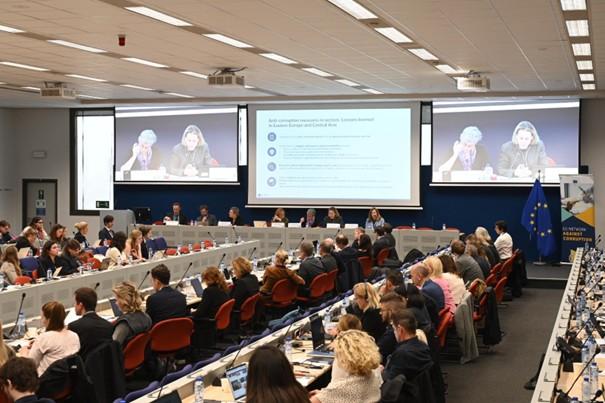
The plenary started with an overview of the work carried out by the Commission in the last year, including the publication of the sixth Rule of Law Report and on the upcoming EU anti-corruption strategy.
The network focused its discussions on the link between competitiveness – a key priority of the European Commission - and anti-corruption, in particular on possible avenues for EU anti-corruption policy to foster a more competitive business environment, attract investment, and promote sustainable economic growth across the EU. Moreover, a number of good practices and enablers in the fight against corruption were presented focusing on better measuring corruption cases, enhancing a culture of integrity through education or creating an enabling environment for civil society. Finally, key anti-corruption projects presented their findings and participants reflected how these could be put into practice on the ground, with all stakeholders involved.
The outcomes of the third plenary will inform the work of the Commission, particularly in view of the upcoming EU anti-corruption strategy.
Share this article:
EU Reporter publishes articles from a variety of outside sources which express a wide range of viewpoints. The positions taken in these articles are not necessarily those of EU Reporter. Please see EU Reporter’s full Terms and Conditions of publication for more information EU Reporter embraces artificial intelligence as a tool to enhance journalistic quality, efficiency, and accessibility, while maintaining strict human editorial oversight, ethical standards, and transparency in all AI-assisted content. Please see EU Reporter’s full A.I. Policy for more information.



EU and South Africa kick off intergovernmental dialogue on Clean Trade and Investment Partnership

Seveso - 50 years on: EU strengthens its commitment to industrial safety in a changing landscape of risk

Why young jobseekers struggle to find roles abroad that fit their expertise

Commission opens formal investigation into possible gun jumping in XXXLutz's acquisition of Porta

Farmers, fair markets and consumers: new report highlights the role of EU competition rules in agriculture

Shared commitment to advance EOSC through new EOSC Nodes and EOSC projects

Falling in love with the Maldives

ECR MEPs question the European Commission on cardiovascular health and diet promoting the Mediterranean diet as an alternative to ultra-processed foods as key to tackling obesity

STATEMENT by the Ministry of Foreign Affairs of the Republic of Kazakhstan

Kazakhstan seeks regional AI leadership as economic partnership with China enters new phase

Starmer’s problem? 'He is not a politician'

Why a Brussels–Nicosia–Eastern Mediterranean strategic affairs platform would benefit the European Union

Albania's Vlora airport standoff tests investor confidence as EU accession clock ticks
ECR MEPs question the European Commission on cardiovascular health and diet promoting the Mediterranean diet as an alternative to ultra-processed foods as key to tackling obesity

Kazakhstan's fixed capital investment tops 9.5 trillion tenge in H1 2026

Commission adopts simpler rules for EU agri-food promotion policy

Kazakhstan reforms under scrutiny at Brussels Press Club round table

Japan should face up to history and contribute more to regional peace

Ambassador calls for 'speeding up' of co-operation between EU and Kazakhstan

Timur Turlov at Smart Moves Summit 2025: How chess can transform global education

Shevtsova’s case: Out-of-court sanctions dismantling trust in Ukrainian cause

The future of European transport

Trump Vs Trueman

US 'no longer' an 'unconditional ally' for Europe - MEP
-
 South Africa5 days ago
EU and South Africa kick off intergovernmental dialogue on Clean Trade and Investment Partnership
-
 Disasters5 days ago
Seveso - 50 years on: EU strengthens its commitment to industrial safety in a changing landscape of risk
-
 Employment5 days ago
Why young jobseekers struggle to find roles abroad that fit their expertise
-
 European Commission5 days ago
Commission opens formal investigation into possible gun jumping in XXXLutz's acquisition of Porta