Migrants
Returns of irregular migrants up by 29% in Q2 2023


In the second quarter of 2023, there were 105,865 non-EU citizens ordered to leave an EU country, and a total of 26,600 were returned to another country following an order to leave. Compared with the same quarter of 2022, the number of non-EU citizens ordered to leave the EU country rose by 9%, while the number of people returned to another country rose by 29%.
In comparison to the previous quarter of this year, the number of orders to leave decreased by 5%, while the returns remained stable.
The majority of those returned in accordance with an order to leave, are those returned to countries located outside of the EU. This was also the case in the second quarter of 2023, with 76% of individuals returned to countries outside of the EU.

Source dataset: MIGR_EIORD1 and MIGR_EIRTN1
Among those ordered to leave the territory of an EU country, in the second quarter of 2023, Moroccan and Algerian citizens recorded the biggest share of the total (8% each), followed by citizens of Türkiye (5%), Georgia (5%) and Afghanistan (4%).
Among those returned to another country, most were citizens of Georgia (9%) followed by Albania (8%), Moldova (5%), Türkiye (5%) and India (4%).
Looking at the country data, the highest numbers of non-EU citizens ordered to leave the territory of an EU country were recorded in France (34,810), Germany (10,600) and Greece (7,095).
The highest number of people returned to another country were recorded in Germany (3 805), France (3 005) and Sweden (2 690).
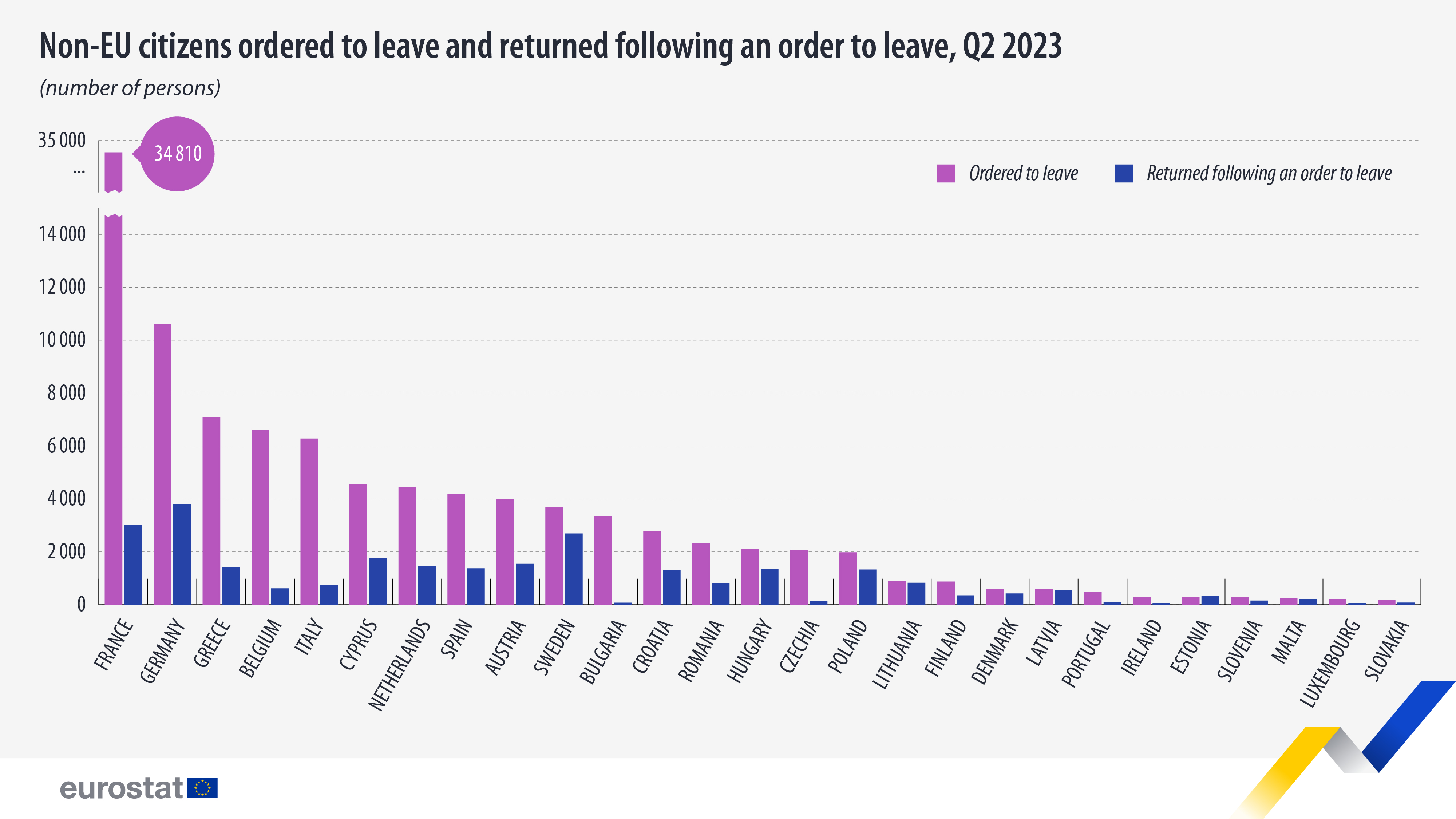
Source dataset: MIGR_EIORD1 and MIGR_EIRTN1
More information
- Statistics Explained article on returns of irregular migrants – quarterly statistics
- Statistics Explained article on enforcement of immigration legislation statistics (yearly data)
- Statistics Explained article on enforcement of immigration legislation statistics methodology
- Thematic section on managed migration statistics
- Database on managed migration statistics
If you have any queries, please visit the contact page.
Share this article:
EU Reporter publishes articles from a variety of outside sources which express a wide range of viewpoints. The positions taken in these articles are not necessarily those of EU Reporter. Please see EU Reporter’s full Terms and Conditions of publication for more information EU Reporter embraces artificial intelligence as a tool to enhance journalistic quality, efficiency, and accessibility, while maintaining strict human editorial oversight, ethical standards, and transparency in all AI-assisted content. Please see EU Reporter’s full A.I. Policy for more information.



The South Caucasus at a historic turning point: Between lasting peace and renewed confrontation
The security environment of the South Caucasus amid changing geopolitical realities

Commission registers two European Citizens' Initiatives on education and housing

Commission sends Statements of Objections to several companies and trade associations in suspected construction chemicals cartel

Kazakhstan and Belgium: Building a Partnership for the Future

Why the US is losing its legitimacy as a global superpower and the trust of the comity of nations

Commission endorses Latvia’s €617 million Social Climate Plan to support vulnerable households and transport users in the clean transition

Rome–Washington Axis: Italian Diplomat Zanardi Landi to Help Save Bosnia

JoinCare explores scientific exchange during visit to Japan’s National Institute of Infectious Diseases

New episode – DGT podcast: Languages and Technology

Become a European Commission trainee – applications are now open

Commission outlines measures to strengthen Europe's banking sector and support growth

British political shifts and the future of UK-China ties
The South Caucasus at a historic turning point: Between lasting peace and renewed confrontation

As Ireland chairs the EU Presidency, what impact has over fifty years of EU membership had on Ireland

The Digital Markets Act Is Hurting Europeans. It’s Time to Put Progress, Free Markets, and Competition First

Kazakhstan reforms under scrutiny at Brussels Press Club round table

Japan should face up to history and contribute more to regional peace

Ambassador calls for 'speeding up' of co-operation between EU and Kazakhstan

Timur Turlov at Smart Moves Summit 2025: How chess can transform global education

Shevtsova’s case: Out-of-court sanctions dismantling trust in Ukrainian cause

The future of European transport

Trump Vs Trueman

US 'no longer' an 'unconditional ally' for Europe - MEP
-
 South Caucasus1 day ago
The South Caucasus at a historic turning point: Between lasting peace and renewed confrontation
-
South Caucasus2 days ago
The security environment of the South Caucasus amid changing geopolitical realities
-
 European Citizens' Initiative4 days ago
Commission registers two European Citizens' Initiatives on education and housing
-
 European Commission2 days ago
Commission sends Statements of Objections to several companies and trade associations in suspected construction chemicals cartel