Azerbaijan
Azerbaijan: Concern over Leyla Yunus’s deteriorating health


The Observatory for the Protection of Human Rights Defenders, an OMCT-FIDH joint programme, is extremely concerned by recent information on Azerbaijani human-rights activist Leyla Yunus’s deteriorating health, which poses a serious threat to her life. The Observatory calls on the international community to strongly react in order to save her life.
Following seven months of ongoing and increasing harassment against Ms. Leyla Yunus, member of the OMCT General Assembly, including arbitrary detention, judicial harassment, denial of medical care, attacks in prison and a temporary transfer to the Investigative Prison of the Ministry of National Security[1], her health has been rapidly deteriorating, and is now posing a serious threat to her life. Yunus is no longer able to eat, can hardly move and recent blood tests have revealed her liver was decaying. Moreover, Ms. Yunus has lost significant weight, from 61 kg before her arrest to 48 kg presently. Human Rights Commissioner Nils Muižnieks managed to meet Yunus in prison in late October, and confirmed that her state was extremely serious and that she cried throughout the meeting.
Leyla Yunus was arrested on July 30, 2014, and has remained in pre-trial detention since then, on charges of “high treason” (Article 274 of the Criminal Code), “large-scale fraud” (Article (178.3.2), “forgery” (Article 320), “tax evasion” (Article 213), and “illegal business” (Article 192) (for more information, see in particular the Observatory Urgent Appeal AZE 002 / 0414 / OBS 031.3 of September 12, 2014). High treason can trigger 12 to 20 years’ imprisonment for women, and 12 to 20 years’ or life imprisonment for men. On August 5, 2014, the court eventually decided to also place Arif Yunusov in pre-trial detention for three months. Their detention was subsequently extended to February 2015. Although the health of Yunus has deteriorated while in detention, the prison authorities in Kurdakhany detention facility did not allow her to receive parcels with medication she needs for her diabetes and kidneys problems.Following a visit from delegates of the International Committee of the Red Cross (ICRC) on August 12, 2014, she finally got her painkiller-injections, but was not allowed to be hospitalized.
On September 6, 2014, Yunus was attacked and verbally harassed by her cellmate. However, no measure was taken to either punish the cellmate nor to ensure her protection.
The Observatory calls upon the authorities in Azerbaijan to ensure Yunus’s physical and psychological integrity by immediately putting an end to her pre-trial detention and by providing her with immediate and adequate medical care. The Observatory further requests that Yunus be immediately and unconditionally released, as her detention seems to only aim at sanctioning her activities amid a wave of increasing repression against civil society organizations and representatives in Azerbaijan.
Finally, the Observatory calls on the international community to take immediate action and to increase the pressure on the Azeri authorities in order to save the life of Yunus.
Share this article:
EU Reporter publishes articles from a variety of outside sources which express a wide range of viewpoints. The positions taken in these articles are not necessarily those of EU Reporter. Please see EU Reporter’s full Terms and Conditions of publication for more information EU Reporter embraces artificial intelligence as a tool to enhance journalistic quality, efficiency, and accessibility, while maintaining strict human editorial oversight, ethical standards, and transparency in all AI-assisted content. Please see EU Reporter’s full A.I. Policy for more information.



Kazakhstan seeks regional AI leadership as economic partnership with China enters new phase

Setting a new benchmark in premium travel

Survey on an EU Blueprint for intellectual property licensing and spinoff creation

Burnham as PM? 'Wait and see'

Rule of law report strengthens EU democracy and fundamental rights

Statement by the Ministry of Foreign Affairs of the Republic of Kazakhstan

Kazakhstan and Belgium: Building a Partnership for the Future

Kazakhstan: Central Election Committee reviews the results of the nomination of candidates for the deputies of Kurultai

Commission sends Statements of Objections to several companies and trade associations in suspected construction chemicals cartel

Commission endorses Latvia’s €617 million Social Climate Plan to support vulnerable households and transport users in the clean transition

Commission fines AliExpress €550 million for breaching the Digital Services Act

Astana Hub unveils infrastructure to support AI innovation in health care

The security environment of the South Caucasus amid changing geopolitical realities

Why the US is losing its legitimacy as a global superpower and the trust of the comity of nations

Commission launches EU-Ukraine Drone Alliance to boost drone and counter-drone technology

EU and Portugal team up to keep brightest tech talents at home

Kazakhstan reforms under scrutiny at Brussels Press Club round table

Japan should face up to history and contribute more to regional peace

Ambassador calls for 'speeding up' of co-operation between EU and Kazakhstan

Timur Turlov at Smart Moves Summit 2025: How chess can transform global education

Shevtsova’s case: Out-of-court sanctions dismantling trust in Ukrainian cause

The future of European transport

Trump Vs Trueman

US 'no longer' an 'unconditional ally' for Europe - MEP
-
 China5 days ago
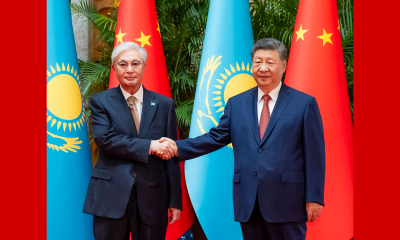
Kazakhstan seeks regional AI leadership as economic partnership with China enters new phase
-
 Aviation/airlines3 days ago
Setting a new benchmark in premium travel
-
 Intellectual Property Rights3 days ago
Survey on an EU Blueprint for intellectual property licensing and spinoff creation
-
 Labour3 days ago
Burnham as PM? 'Wait and see'