Kazakhstan
Kazakhstan becomes a more reliable partner of the European Union in Central Asia


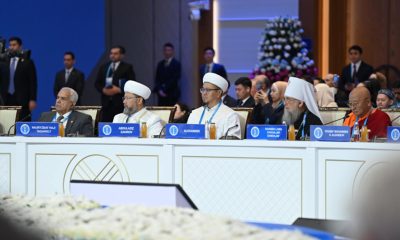
On October 2, the conference "Strategic Partnership with the EU and Kazakhstan: Opening New Niches and Dimensions" was held at the European Parliament in Brussels.
The event was organised by the largest group in the European Parliament, the European People's Party, namely its member, MEP Tomasz Zdechovsky from the Czech Republic.

The MEP headed the delegation for the countries of Central Asia in the European Parliament (DCAS) and knows this region well, whose importance is growing in the world today.

More than 100 employees of the European Parliament, the European Commission, the European External Action Service, and numerous guests gathered in the EP. Advisor to the President of Kazakhstan Bolat Akchulakov and deputies of the lower house of the Kazakhstan Mazhilis also arrived from Kazakhstan.
The moderator, Alberto Turkstra, an expert on Central Asia from the Diplomatic World Institute, said that relations between Kazakhstan and the EU have evolved significantly in recent years.
He noted that Kazakhstan is a strategically important partner of the European Union in Central Asia, successfully engaging with all major powers.
«The geopolitical and economic advantages of the Trans-Caspian transport route reduce geopolitical risks and support the strategy of Western countries aimed at diversifying trade routes and expanding global connections.
The Republic of Kazakhstan is taking active measures to modernise and improve its logistics infrastructure aimed at increasing capacity (construction of new terminals, railway lines and stations, and the establishment of additional reception and storage points)," the expert noted.

The European Commissioner for Agriculture, Janusz Wojciechowski spoke at the venue and noted that Kazakhstan is a key partner of the EU in Central Asia for European food producers.
Even though Kazakhstan's market is not so big, it has great prospects as a key and central market in the region.
In addition, J.Wojciechowski noted that this year he travelled to Kazakhstan himself, where he held a number of useful meetings with the leadership and business community of Kazakhstan.
The organizer of the event, Tomas Zdechovsky, also believes that relations between the European Union and Kazakhstan have further growth potential. He stressed that Brussels is interested in increasing trade turnover with Kazakhstan. The development of connections between ordinary people.
In addition, T.Zdekhovsky believes that the upcoming referendum in Kazakhstan on the construction of a nuclear power plant (06 of October) is a sign of the democratisation of local society.
"It is gratifying that important issues of the country's development are being resolved in the republic with the participation of society and ordinary people. Of course, holding a referendum on whether to build a new nuclear power plant in Kazakhstan or not is a positive fact," the MEP says.
Jerzy Oledzki, Member of the Foundation Council of the Michał Boym Institute for Asian and Global Studies, and expert for Central Asia also confirmed that the importance of Kazakhstan and Central Asia in the world and for Europe is growing.
He stressed that the war in Ukraine has changed the supply chains of energy resources to Europe. In this context, Kazakhstan has become a significant alternative source of energy resources and rare earth metals for Europeans.
In addition, the European Parliament added that the new MEPs intend to visit Kazakhstan in October-November this year in order to strengthen inter-parliamentary ties.
Share this article:
EU Reporter publishes articles from a variety of outside sources which express a wide range of viewpoints. The positions taken in these articles are not necessarily those of EU Reporter. Please see EU Reporter’s full Terms and Conditions of publication for more information EU Reporter embraces artificial intelligence as a tool to enhance journalistic quality, efficiency, and accessibility, while maintaining strict human editorial oversight, ethical standards, and transparency in all AI-assisted content. Please see EU Reporter’s full A.I. Policy for more information.






Kashmir's 9,765 missing women and girls demand international attention

EU foreign ministers to discuss options for restricting trade with Israeli communities in Judea and Samaria

New EU strategy must help farmers move toward a more humane food system

EU-Mexico: While others build walls, Europe builds bridges

Srebrenica's lesson is prevention. Why isn't the world applying It to Kashmir?

Europe's Cloud moment: The DMA must now deliver

European operation dismantles €10 million illicit cigarette network in Spain

Survey of city economic experts: Cities are driving Draghi’s competitiveness agenda, but need EU recognition to scale action

EU weighs age-13 limit for 'social media plus'

ALROSA Re-elects Supervisory Board with Minimal Changes

Public consultation on Joint Undertakings, Art. 185 initiatives, and thematic priorities for European Partnerships under Horizon Europe 28-34

Poland sees new research and changes to policies on migrant integration

EU launches a Team Gaza Initiative to support early recovery in Gaza with an initial amount of nearly €900 million

NESBp: Strengthening maritime spatial planning across the North Sea and Baltic Sea

Energy Union Task Force takes stock of oil and gas security of supply in the EU

AIFC to host Astana Finance Days 2026 in September

Kazakhstan reforms under scrutiny at Brussels Press Club round table

Japan should face up to history and contribute more to regional peace

Ambassador calls for 'speeding up' of co-operation between EU and Kazakhstan

Timur Turlov at Smart Moves Summit 2025: How chess can transform global education

Shevtsova’s case: Out-of-court sanctions dismantling trust in Ukrainian cause

The future of European transport

Trump Vs Trueman

US 'no longer' an 'unconditional ally' for Europe - MEP
-
 Kashmir5 days ago
Kashmir's 9,765 missing women and girls demand international attention
-
 Israel2 days ago
EU foreign ministers to discuss options for restricting trade with Israeli communities in Judea and Samaria
-
 Animal welfare5 days ago
New EU strategy must help farmers move toward a more humane food system
-
 Mexico5 days ago
EU-Mexico: While others build walls, Europe builds bridges