Belgium
Mobile operators question Belgian Government’s motive for new 5G law


The Belgian National Security preliminary draft law and royal decree that have been submitted for public consultation and concerned with the security of fifth-generation mobile networks (5G) is believed to be a cynical media manipulation tactic, to slip in a public consultation over a Christmas holiday period in the middle of a Covid-19 crisis, when public and media attention are focused elsewhere.
Whilst every government has a duty to ensure that any deployed 5G Technology is safe enough to use as a communication medium by its citizen and the government, the way the Belgian Government is proceeding seems clearly to be creating a law which prevents two out of the five possible 5G equipment suppliers from providing equipment for Belgium’s proposed new 5G network.
The capability of 5G is immense and will affect every area of the economy, which is why the Belgian government is worried about the inevitable security issues that come with the deployment of 5G technology.
The issue is so sensitive at this time that the CEO of a leading Belgian mobile operator spoke to this website only on the condition of strict anonymity.
He told EU Reporter
“It should be clarified that while the debate around 5G supply chain is around the generic “security”, what matters for the Governments is not much the resilience to attacks such as denial of service or the protection from frauds, but rather if the vendor has included back doors that allow a foreign power to extract sensitive data or even cause the network to malfunction. While the existence of such backdoors cannot be completely ruled out, of all the major suppliers Huawei has been the only one to give access to their source code to the
He said “If a backdoor was present, the inspection of the source code would have most likely revealed it.
As Huawei is unique in having given access to their software it is impossible to know how competitors fare in this regard.
Cases like Ericsson letting security certificates expire or widespread use of old version of SSL seem to suggest that Huawei is being blamed unfairley
As for the generic security all vendors need to implement the technical specifications created by 3GPP and failure to do so would result in the product not able to correctly function in a multi-vendor network.
In summary, while security will never be guaranteed 100% and while it would be naïve to rule out categorically the existence of backdoors, of all the vendors Huawei is the one who has gone the greatest length to reassure their customers.
A common conspiracy theory is that the US government has attacked Huawei because they refused to provide them with a backdoor.
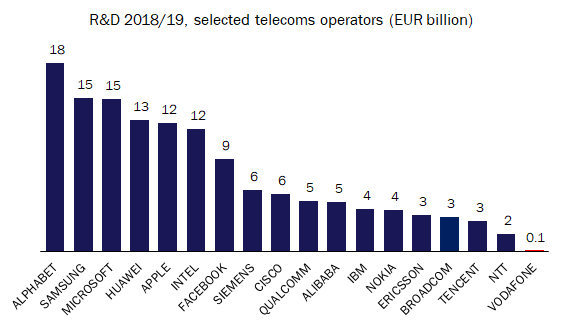
Coming to the cost of retiring Chinese equipment, this is very significant not only in the short term but more so in the long term. In the short term the main issue could be that existing suppliers could not meet the demand and new suppliers would produce low quality hardware (see debate on OpenRAN).
In the long run things don’t look good at all. As the diagram below shows Huawei is investing in R&D almost double what Nokia and Ericsson invest combined. It is well known that Huawei products are by far the most advanced, supporting the largest number of features and that a lot of the technology behind 5G writes on Huawei IPRs.
If Huawei is pushed out of the EU market completely, they could retaliate by leveraging their IPR portfolio directly with mobile network operators (today they are in cross licensing agreements with other suppliers) or they could even create their own standard for say, China, South East Asia, Africa, LatAm. (by the way, I know that the Chinese government was very unhappy with Huawei international ambitions back in early 2000s). This would result in a slower pace of innovation as well as in higher costs owing to the reduced economies of scale.”
Another mobile operator CEO told EU Reporter “It seems that Brussels is being pressurized by the USA to block certain 5G suppliers
If the process of defining the High-Risk Vendor list is not made transparent, it could result in gravely impacting the swiftness of 5G rollout and the cost of 5G equipment could go remarkably high. Who is going to suffer from this situation the most? Of course, the consumer…
Another possibility of secretly defining the High-Risk Vendor list is to allow only a handful of 5G Suppliers to participate in 5G rollout and therefore to create a duopoly in otherwise a free market. This in turn would destabilize the market and will end up demotivating new entrants to do business in a biased market.”
Brussels must realize that we are in a critical time of 5G infrastructure deployment. The government should act now to ensure that they implement a technology-neutral environment in which all the suppliers can fairly compete against each other, and make sure Belgium doesn`t end up the least competitive Telecom country in Europe`
[2] https://twitter.com/tomrebbeck/status/1228344034961317890
Share this article:
EU Reporter publishes articles from a variety of outside sources which express a wide range of viewpoints. The positions taken in these articles are not necessarily those of EU Reporter. Please see EU Reporter’s full Terms and Conditions of publication for more information EU Reporter embraces artificial intelligence as a tool to enhance journalistic quality, efficiency, and accessibility, while maintaining strict human editorial oversight, ethical standards, and transparency in all AI-assisted content. Please see EU Reporter’s full A.I. Policy for more information.



European Inventor Award 2026 winners announced: Honouring the innovators shaping tomorrow

Region Trade Bank strengthens international governance as Iraq's banking sector deepens global engagement

Open letter to president of the European Commission on the Schengen Entry/Exit System (EES)

EU policy toward Azerbaijan: Why Brussels must move beyond political dialogue

New rules to protect EU steel industry from damaging impacts of global overcapacity enter into application

The Iran war changed Pakistan's strategic value, not its political trajectory

EU and Canada conclude the Energy Security Business Roundtable to deepen transatlantic business relations

PMI defends AI consultation tool as scrutiny grows over EU tobacco rules review

Europe must double down on nuclear progress to achieve its long-term ambitions

Solana company partners with Kazakhstan on $6B Alatau Crypto Megacity

Astana's congress of world religions: A global platform for dialogue in an age of division

International Plastic Bag Free Day – from single use to reuse

Protect children from online sexual abuse: Call for urgent negotiations and permanent solution

Will the Gulf monarchies rise above internecine disputes in the interest of collective security?

MEPs supportive of draft Biotech report, but divisions over incentives remain

'Now is really the time!' for women's health, says Cooke

Kazakhstan reforms under scrutiny at Brussels Press Club round table

Japan should face up to history and contribute more to regional peace

Ambassador calls for 'speeding up' of co-operation between EU and Kazakhstan

Timur Turlov at Smart Moves Summit 2025: How chess can transform global education

Shevtsova’s case: Out-of-court sanctions dismantling trust in Ukrainian cause

The future of European transport

Trump Vs Trueman

US 'no longer' an 'unconditional ally' for Europe - MEP
-
 Science4 days ago
European Inventor Award 2026 winners announced: Honouring the innovators shaping tomorrow
-
 Iraq5 days ago
Region Trade Bank strengthens international governance as Iraq's banking sector deepens global engagement
-
 Schengen3 days ago
Open letter to president of the European Commission on the Schengen Entry/Exit System (EES)
-
 Azerbaijan3 days ago
EU policy toward Azerbaijan: Why Brussels must move beyond political dialogue