Firefighters
Firefighting in the EU: 390,600 professionals in 2024

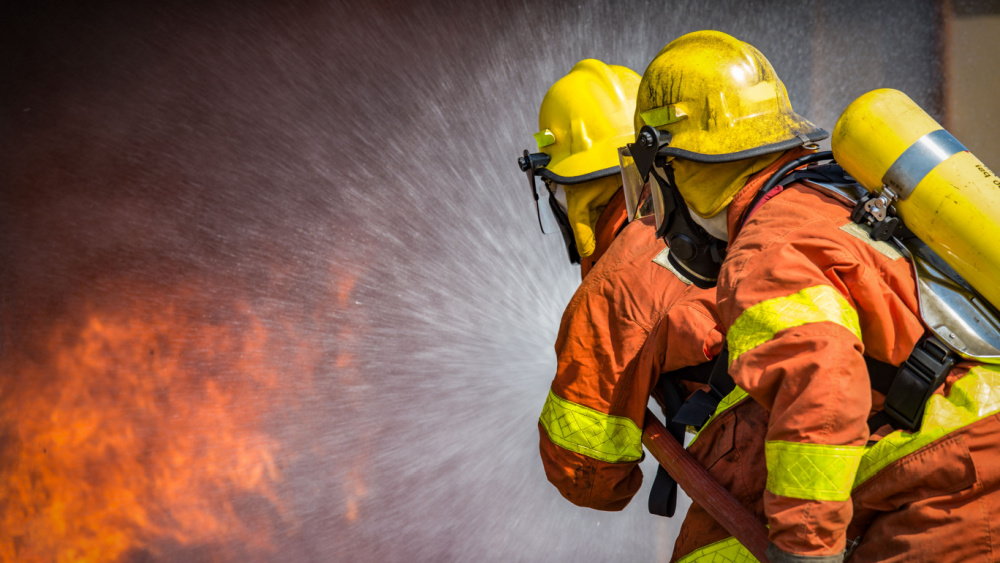
In 2024, the EU countries combined had 390,600 professional firefighters, representing 0.19% of the total EU employment. Compared with 2023, the number of firefighters increased by 28,200.
Among the 20 EU countries with available data, Croatia registered the highest share of firefighters in total employment (0.45%). Greece followed with 0.41%, ahead of Czechia with 0.34%.
The lowest shares were registered in the Netherlands (0.07%), Denmark (0.08%) and Sweden (0.10%).
Source dataset: Ad hoc EU Labour Force Survey extraction
Across the EU, 75.2% of all professional firefighters were aged 15 to 49. That’s a noticeably younger workforce compared with the total EU employment, where only 64.8% of workers fall into that age group.
EU governments spent €40.6 billion on fire-protection services in 2023
In 2023, EU governments spent €40.6bn on ‘fire-protection services’, reflecting an 8.5% increase in the general government expenditure on this function compared with 2022 (€37.4 billion).
The increase in expenditure on fire-protection services in absolute numbers is however in line with the increases in other functions, so that fire-protection services have consistently accounted for 0.5% of total government expenditure since 2017.
Source datasets: gov_10a_exp and ad hoc calculation
In 2023, Romania had the highest share of expenditure on fire-protection services at 0.9% of general government total expenditure, followed by Estonia and Greece with 0.7% each.
By contrast, Denmark reported the lowest share of expenditure on fire-protection services (0.1%), followed by Malta (0.2%), Portugal and Austria (both 0.3%).
For more information
- Thematic section on employment and unemployment (LFS)
- Database on employment and unemployment (LFS)
- Thematic section on government finance statistics
- Database on government finance statistics
- Online publication on general government expenditure by function
- Statistics Explained article on government expenditure on public order and safety
Methodological notes
- Firefighters refer to the category '5411 Firefighters', as defined under the International standard classification of occupations (ISCO-08) classification. This category includes both firefighters and forest firefighters.
- Data on firefighters in 2024 from the EU Labour Force Survey are not shown for Estonia, Ireland, Luxembourg, Malta, Austria, Slovenia and Slovakia because of very low reliability.
- Low reliability data of the number of firefighters for Bulgaria, Denmark, Finland Croatia, Cyprus, Latvia, Lithuania and Sweden.
- According to the methodology of the survey only people working in their main job as firefighters are included; voluntary workers, such as volunteer firefighters, are not included in employment statistics based on this activity.
- General government expenditure for the function 'fire protection services' (according to the Classification of the functions of government – COFOG) is based on national accounts/government finance statistics.
- ‘Fire protection services’ is part of the COFOG division ‘public order and safety’. According to the classification, it relates to the 'administration of fire prevention and firefighting affairs and services; operation of regular and auxiliary fire brigades and of other fire prevention and firefighting services maintained by public authorities; operation or support of fire prevention and firefighting training programmes. It includes civil protection services such as mountain rescue, beach surveillance, evacuation of flooded areas, etc'.
- Manual on sources and methods for the compilation of COFOG statistics — Classification of the Functions of Government (COFOG)
- Data on government expenditure by function for the EU (2023), Belgium (2023), Germany (2021-2023), Spain (2023), France (all years), Portugal (2023) and Slovakia (all years) is provisional.
- Metadata file on government expenditure by function
Share this article:
EU Reporter publishes articles from a variety of outside sources which express a wide range of viewpoints. The positions taken in these articles are not necessarily those of EU Reporter. Please see EU Reporter’s full Terms and Conditions of publication for more information EU Reporter embraces artificial intelligence as a tool to enhance journalistic quality, efficiency, and accessibility, while maintaining strict human editorial oversight, ethical standards, and transparency in all AI-assisted content. Please see EU Reporter’s full A.I. Policy for more information.



The South Caucasus at a historic turning point: Between lasting peace and renewed confrontation
The security environment of the South Caucasus amid changing geopolitical realities

As Ireland chairs the EU Presidency, what impact has over fifty years of EU membership had on Ireland

Commission endorses Latvia’s €617 million Social Climate Plan to support vulnerable households and transport users in the clean transition

Commission sends Statements of Objections to several companies and trade associations in suspected construction chemicals cartel

EU and Portugal team up to keep brightest tech talents at home

British political shifts and the future of UK-China ties

Why the US is losing its legitimacy as a global superpower and the trust of the comity of nations

Tokayev urges Putin to 'freeze' Ukraine war in rare public appeal for peace

JoinCare explores scientific exchange during visit to Japan’s National Institute of Infectious Diseases

New episode – DGT podcast: Languages and Technology

Become a European Commission trainee – applications are now open

Commission outlines measures to strengthen Europe's banking sector and support growth
British political shifts and the future of UK-China ties
The South Caucasus at a historic turning point: Between lasting peace and renewed confrontation
As Ireland chairs the EU Presidency, what impact has over fifty years of EU membership had on Ireland

Kazakhstan reforms under scrutiny at Brussels Press Club round table

Japan should face up to history and contribute more to regional peace

Ambassador calls for 'speeding up' of co-operation between EU and Kazakhstan

Timur Turlov at Smart Moves Summit 2025: How chess can transform global education

Shevtsova’s case: Out-of-court sanctions dismantling trust in Ukrainian cause

The future of European transport

Trump Vs Trueman

US 'no longer' an 'unconditional ally' for Europe - MEP
-
 South Caucasus2 days ago
The South Caucasus at a historic turning point: Between lasting peace and renewed confrontation
-
South Caucasus3 days ago
The security environment of the South Caucasus amid changing geopolitical realities
-
 EU Presidency2 days ago
As Ireland chairs the EU Presidency, what impact has over fifty years of EU membership had on Ireland
-
 European Commission3 days ago
Commission endorses Latvia’s €617 million Social Climate Plan to support vulnerable households and transport users in the clean transition