France
Macron pension reform ends cherished French exception

French President Emmanuel Macron has pushed through a pension reform that is unpopular, but at a great cost to his own political capital. He now seeks to restore it by offering discussions with unions about other issues.
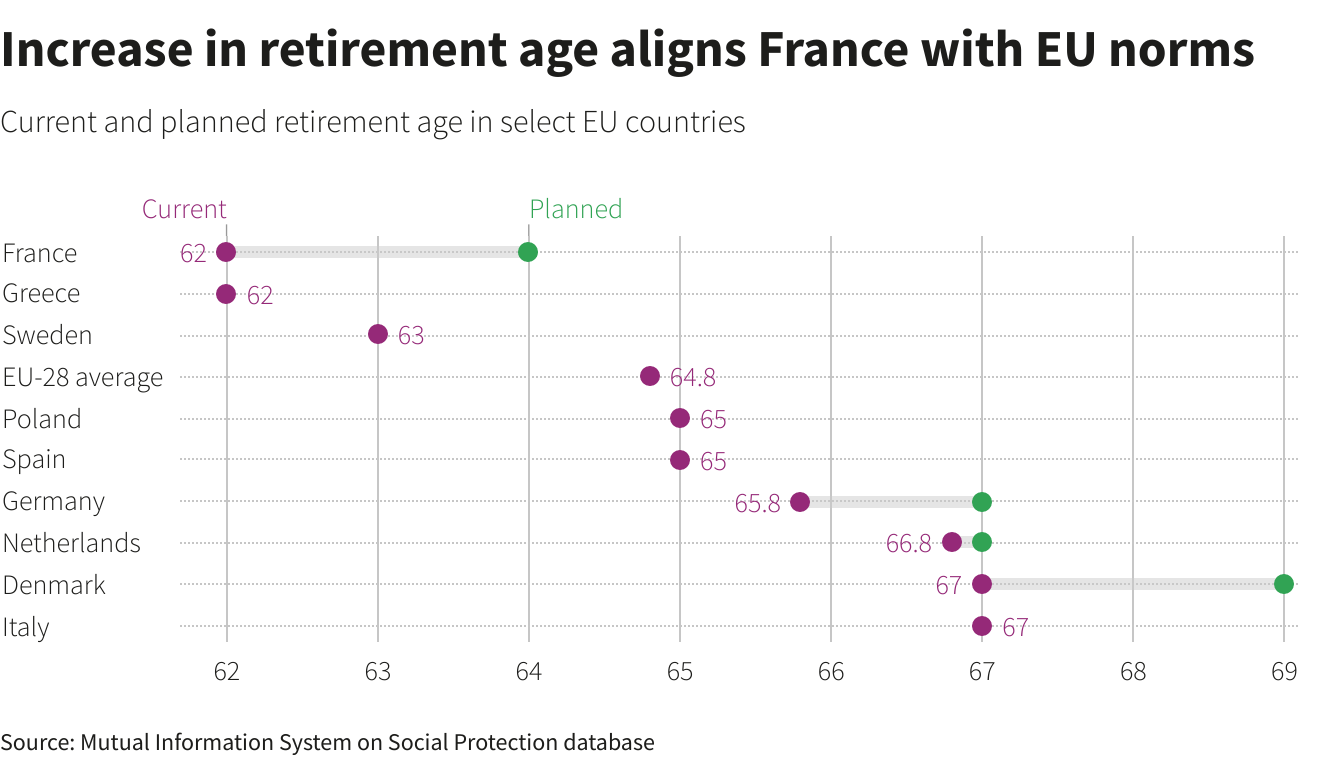
Some foreign commentators wondered why there were so many protests. His pension plan simply brought France in line with the European Union.
This does not take into account the fact that the French regarded the 62-year-old retirement age as an important social benefit, nor the concern of many workers who were excluded due to their personal circumstances and face a later retirement.
CAN THE FRENCH RETIRED EARLIER THAN OTHERS?
Theoretically, yes. France, along with Greece, has the lowest retirement age of the European Union. The average for the 27 member states is 64.8.
According to the Organisation for Economic Cooperation and Development, the French retire longer than most other countries due to their relatively lower retirement and higher life expectancy.
According to the OECD, a Frenchman spends on average 23.5 years retired. This is second only behind Luxembourgers who spend 24 years retired and far above the 20-year retirement period that men in Britain or Germany experience.
ARE THEY BETTER OFF THAN OTHER PENSIONERS?
The French pension payment as a percentage of earnings before retirement is higher than anywhere else. According to the OECD, a French retiree’s post-tax pension income is nearly three quarters of his or her pre-retirement earning. This compares with 58% for Brits and 53% for Germans.
This generosity comes with a price. France spends almost 14% of its economic output on pensions. This is almost double the OECD's average of 7.7%. Only Italy and Greece spend more than France.
France has the lowest poverty rate among developed countries for retirees, at 4% compared to an OECD average 13%. Inequality rates are also lower.
Does Everyone Benefit?
Not exactly. France is known for having a low retirement age. However, this picture is not as clear-cut as it seems.
Macron's reform moves the target date for 43-year-old workers to 2027, from 2035.
According to the independent council that analyses pensions for the government, more than a third of French workers are already leaving the workforce after 62.
Many people who have started their careers late due to higher education or took time off to raise children, are forced to continue working well beyond the age of 62. After Macron's reform, anyone can retire at 67 and receive a full pension no matter how long they have paid in.
According to the OECD, the average retirement age of a Frenchman who began working at the age of 22 is 64.5. This is slightly higher than the EU's average of 64.3 years but still behind Germany's 65.7%.
In many countries, however, the legal minimum age for retirement is lower because of the exceptions that many countries make to early retirement. Some people even retire before they have earned a full pension.
In France, the average age at which people leave the labor market is 60.4, significantly lower than the OECD's average of 63.8.
What now?
In a prime time televised speech on Monday, Macron explained that "working longer, like our European neighbors have done", would create more wealth and allow for greater levels of investments.
The opposition parties and unions claim that Macron's plan is a violent attack on the welfare model of the country, which relies heavily on taxes and pension contributions to fund generous social benefits.
Macron's government claims that raising retirement age will fill a shortfall of 13.5 billion euros the pension system otherwise would be experiencing by 2030.
A study released on Tuesday (18 April) by Rexecode, an economics think-tank, suggested that the expected gains of the government were too optimistic and there would still be a deficit.
Share this article:
EU Reporter publishes articles from a variety of outside sources which express a wide range of viewpoints. The positions taken in these articles are not necessarily those of EU Reporter. Please see EU Reporter’s full Terms and Conditions of publication for more information EU Reporter embraces artificial intelligence as a tool to enhance journalistic quality, efficiency, and accessibility, while maintaining strict human editorial oversight, ethical standards, and transparency in all AI-assisted content. Please see EU Reporter’s full A.I. Policy for more information.



The South Caucasus at a historic turning point: Between lasting peace and renewed confrontation

As Ireland chairs the EU Presidency, what impact has over fifty years of EU membership had on Ireland

British political shifts and the future of UK-China ties

The Digital Markets Act Is Hurting Europeans. It’s Time to Put Progress, Free Markets, and Competition First

Become a European Commission trainee – applications are now open

Commission outlines measures to strengthen Europe's banking sector and support growth

JoinCare explores scientific exchange during visit to Japan’s National Institute of Infectious Diseases

From Ukraine to Suez: Why the Mediterranean has become the strategic centre of gravity

Commission approves €54 million Luxembourgish state aid for road and rail transport firms facing increased fuel prices

Commission invites comments on draft new rescue and restructuring state aid guidelines

Commission proposes more than €410,000 from the European Globalisation Adjustment Fund to support dismissed car industry workers in Finland

Commission welcomes the Council's adoption of a renewed Interim Regulation to detect child sexual abuse online

Commission provides €1.5 billion in macro-financial assistance to Egypt

ommission preliminary finds TikTok in breach of Digital Services Act for failing to ensure safe accounts for minors

Europe’s AI crossroads: Regulation and the race to keep up

Freedom holding corp: How Kazakhstan is turning a transit corridor into a global logistics hub

Kazakhstan reforms under scrutiny at Brussels Press Club round table

Japan should face up to history and contribute more to regional peace

Ambassador calls for 'speeding up' of co-operation between EU and Kazakhstan

Timur Turlov at Smart Moves Summit 2025: How chess can transform global education

Shevtsova’s case: Out-of-court sanctions dismantling trust in Ukrainian cause

The future of European transport

Trump Vs Trueman

US 'no longer' an 'unconditional ally' for Europe - MEP
-
 South Caucasus4 days ago
The South Caucasus at a historic turning point: Between lasting peace and renewed confrontation
-
 EU Presidency4 days ago
As Ireland chairs the EU Presidency, what impact has over fifty years of EU membership had on Ireland
-
 China4 days ago
British political shifts and the future of UK-China ties
-
 Digital economy5 days ago
The Digital Markets Act Is Hurting Europeans. It’s Time to Put Progress, Free Markets, and Competition First