Hungary
Hungary government submits first anti-graft bill to avoid losing EU funds


During the general session of the Conservative Political Action Conference in Dallas, Texas (USA), 4 August, 2022, Viktor Orban, prime minister of Hungary, waves at the audience.
Hungary's government submitted Monday's (19 September) first of several anticorruption bills to Parliament as Budapest tries to keep billions of euro in European Union funding.
Sunday's European Union executive recommendation was to suspend funds in the amount of €7.5 billion (or $7.48bn) because it believes Hungary has failed to fight corruption and uphold the rule law.
The European Commission set forth additional requirements that Hungary must meet to continue accessing the funding. This included new legislation.
Judit Varga, Justice Minister, stated on her Facebook page that she had presented the first bill to Parliament. The government will now "focus on drafting (and implementing) the EU commitments (to be implemented in the coming weeks and months".
Varga stated that Hungary could enter 2023 without having to lose any EU funds.
This bill modifies legislation relating Hungary's co-operation to the EU anti-fraud officer OLAF. It ensures that OLAF receives support from Hungarian tax authorities officials in its investigation of EU-funded project investigations and has access to relevant data.
It also changes the rules governing state asset foundations, making them explicit to issue public procurement tenders and tightening conflict-of-interest rules.
Hungary's case is first to be heard in the EU as a result of a new EU sanction that aims to improve the rule-of-law and fight corruption within the bloc of 27 nations.
Since 2010, Viktor Orban, the nationalist prime minister, has been at odds with Brussels over his policies it considers to be eroding Hungary's democracy.
The veteran prime minister is willing to meet EU demands to create institutions that reduce corruption risks in EU-funded projects, despite the challenges of rising energy costs, double-digit inflation, weak forint, and slowing economy.
"The recent developments in Brussels are certainly a bad time to Orban, who is currently struggling with a wide range of political and economic issues caused by both global problems, most notably rising oil prices. So he is likely go further to satisfy Brussels’ demands," Mujtaba Rahman (Managing Director Europe, Eurasia Group).
He stated that Budapest would be likely to secure the pending agreement, but this would not resolve all outstanding disputes over other EU funds.
Rahman stated that Orban's biggest problem is the money in the Recovery Fund. Rahman explained that the Commission has greater control over whether or not it grants the green light.
Last year, Hungary submitted its blueprint detailing how it would use EU grant money to improve its economy's environmental and high-tech capabilities following the COVID-19 pandemic. This has not yet been approved.
The forint, which has fallen 8% this year, will likely fall further if Budapest doesn't receive EU funds. This will complicate efforts to curb inflation and expose Hungarian assets to negative sentiment shifts.
Tibor Navracsics (the EU's Development Minister) stated that Hungary will fulfill all 17 of the commitments it made to the Commission to avoid any funding cuts.
($1 = €1.0025)
Share this article:
EU Reporter publishes articles from a variety of outside sources which express a wide range of viewpoints. The positions taken in these articles are not necessarily those of EU Reporter. Please see EU Reporter’s full Terms and Conditions of publication for more information EU Reporter embraces artificial intelligence as a tool to enhance journalistic quality, efficiency, and accessibility, while maintaining strict human editorial oversight, ethical standards, and transparency in all AI-assisted content. Please see EU Reporter’s full A.I. Policy for more information.



Open letter to president of the European Commission on the Schengen Entry/Exit System (EES)

EU policy toward Azerbaijan: Why Brussels must move beyond political dialogue

The Iran war changed Pakistan's strategic value, not its political trajectory

PMI defends AI consultation tool as scrutiny grows over EU tobacco rules review

Democracy cannot be selective: Why Europe must apply the same standards abroad that it demands at home

Civil society from across the EU gathers in Cork to reinforce Europe’s sustainability agenda

Majority think EU is a 'place of stability in a troubled world'

Rating of American Express casino sites in the UK

Energy Union: New Spain-Portugal electricity interconnection inaugurated

Timing of the publication of the EU ETS auction calendar

Commissioner Šuica travels to Cairo to strengthen euro-mediterranean parliamentary cooperation and youth engagement

Commission seeks feedback on targeted amendment of EMFAF

Commission proposes five joint defence projects to strengthen Europe's industrial capabilities

Study: Europe's defense runs on American servers

The ancient myths that tourism boards (and slot designers) can't stop selling

Europe must double down on nuclear progress to achieve its long-term ambitions

Kazakhstan reforms under scrutiny at Brussels Press Club round table

Japan should face up to history and contribute more to regional peace

Ambassador calls for 'speeding up' of co-operation between EU and Kazakhstan

Timur Turlov at Smart Moves Summit 2025: How chess can transform global education

Shevtsova’s case: Out-of-court sanctions dismantling trust in Ukrainian cause

The future of European transport

Trump Vs Trueman

US 'no longer' an 'unconditional ally' for Europe - MEP
-
 Schengen4 days ago
Open letter to president of the European Commission on the Schengen Entry/Exit System (EES)
-
 Azerbaijan4 days ago
EU policy toward Azerbaijan: Why Brussels must move beyond political dialogue
-
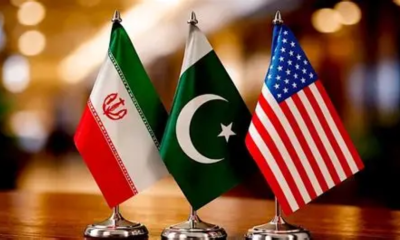 Iran4 days ago
The Iran war changed Pakistan's strategic value, not its political trajectory
-
 European Commission4 days ago
PMI defends AI consultation tool as scrutiny grows over EU tobacco rules review