Iran
Iran: Reza Pahlavi’s European tour and the problem of legitimacy

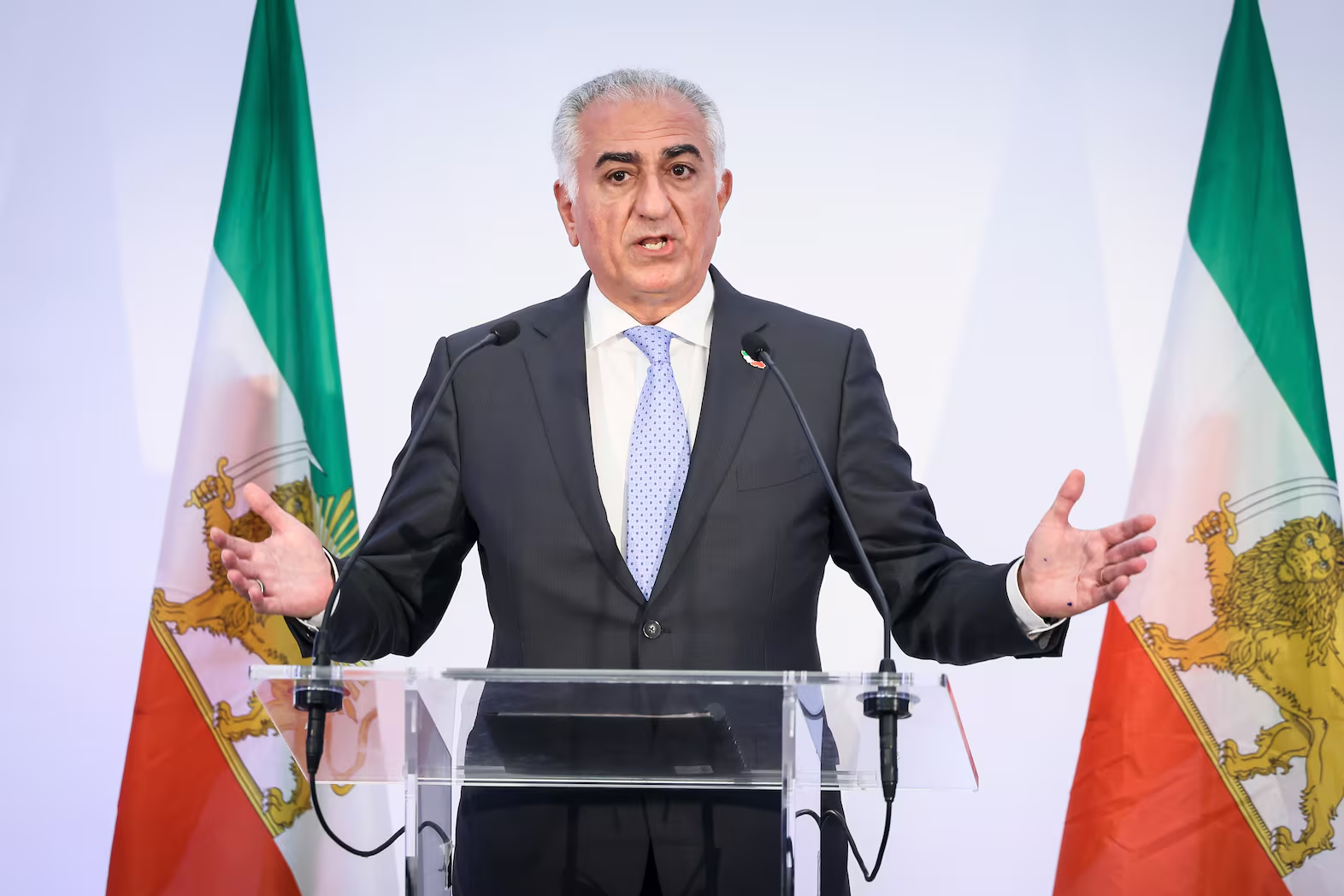
In April 2026, Reza Pahlavi (pictured)—the son of the deposed Shah of Iran—undertook a high-profile tour of Europe, visiting Sweden, Italy, and Germany. The stated aim was to mobilize political support, engage policymakers, and position himself as a leading figure within Iran’s fragmented opposition. Rather than consolidating legitimacy, the tour exposed the gap between visibility and political credibility, writes Firouz Mahvi, Iranian opposition-NCRI.
Across all three countries, his appearances were marked by protests, institutional distance, and critical media scrutiny.
The culmination in Berlin—where he was denied official meetings and became the subject of a symbolic protest—crystallised a broader pattern: visibility without legitimacy.
Sweden: Visibility amid polarization
Pahlavi’s tour began in Sweden, where he met with several MPs at the Riksdag in mid-April 2026.. The invitation itself was controversial, driven largely by specific parliamentary factions rather than broad parliamentary consensus.
While his speech emphasised human rights and criticised European engagement with Tehran, reactions revealed deep divisions. Demonstrations in Stockholm reflected a polarised Iranian diaspora, widely reported in Swedish and international media.
The underlying issue was historical memory. As the son of Mohammad Reza Shah—overthrown in 1979 amid accusations of authoritarian repression—Pahlavi remains tied to a contested past. Critics note that he has not clearly distanced himself from the authoritarian record of his father and grandfather. During his recent European tour, he instead reiterated in several interviews that he remains “proud” of his family and its history—remarks that have reinforced concerns among observers about his political positioning.
His rhetoric further amplified tensions, particularly statements perceived as supportive of external military pressure, which alienated segments of European opinion.
The visit increased visibility but reinforced his image as a divisive figure.
Italy: Limited engagement and growing criticism
In Italy, the tone shifted to relative indifference, combined with targeted criticism. Pahlavi held parliamentary-level meetings and media appearances but secured no meaningful engagement with senior government officials.
This absence reflected a broader European reluctance to recognise him as a legitimate interlocutor.
Criticism became more explicit. Italian political voices, including Senator Giulio Terzi, questioned his credibility, citing unresolved ties to the monarchy and perceived reliance on foreign backing.
Civil society groups echoed these concerns, stressing that democratic legitimacy requires a clear break from past authoritarianism. Critics highlighted contradictions between his democratic claims and his failure to condemn abuses under the Shah, alongside positions interpreted as supportive of external military intervention.
The Italian visit underscored a key limitation: visibility without institutional recognition.
Germany: Political rejection and public confrontation
If Sweden revealed polarisation and Italy hesitation, Germany delivered clear political rejection.
Pahlavi’s Berlin visit in late April 2026—intended as the tour’s centrepiece—became its most damaging episode.
The German government declined to meet him, effectively treating him as a private individual rather than a recognised political actor. This was widely interpreted as a deliberate refusal to grant legitimacy. In diplomatic terms, the absence of official engagement amounted to a clear signal of non-recognition. This distinction is central to how European governments approach Iranian opposition figures.
Although some Bundestag members met him privately, these contacts did not translate into institutional endorsement.
His press conference at the Bundespressekonferenz exposed further tensions. Journalists questioned his legitimacy, opposition fragmentation, and programme. Reports indicate he responded defensively, criticising the media rather than addressing concerns.
Such exchanges, poorly received in a political culture valuing scrutiny, reinforced scepticism rather than credibility.
The defining moment came on 23 April 2026, when Pahlavi was splashed with red liquid—reported as tomato juice—after leaving a press event.
The attacker was detained and Pahlavi unharmed, but the symbolic impact was significant. Widely circulated images became emblematic of the hostility surrounding the visit.
Reporting linked the protest to opposition to his political positions, including perceived support for external military action.
Simultaneous demonstrations by supporters and opponents highlighted deep diaspora fragmentation. German media framed this division as evidence of a lack of unified opposition leadership.
Prominent German figures also warned against granting him a platform, arguing it risked legitimising authoritarian alternatives.
Together, these elements produced a clear outcome: political marginalisation combined with public controversy.
Why the tour failed
The tour’s difficulties reflect deeper structural constraints.
Pahlavi’s continued association with the pre-1979 monarchy remains a central obstacle. European strategic priorities—focused on diplomacy and stability—diverge from his support for external pressure.
His confrontational approach toward media and policymakers further risks alienating key audiences, illustrating a disconnect between his expectations and European political realities.
Conclusion
Reza Pahlavi’s 2026 European tour was designed to translate visibility into political legitimacy; instead, it underscored how little of that legitimacy he commands.
In Sweden, he gained visibility but deepened divisions. In Italy, he encountered indifference and criticism. In Germany, he faced institutional rejection, media scrutiny, and symbolic public confrontation.
The pattern is clear: visibility alone has not yielded legitimacy. In the absence of both internal consensus and external recognition, his claim to leadership lacks the foundations required to be treated as a credible political alternative. In European capitals, that conclusion has already been drawn.
Share this article:

EU Reporter publishes articles from a variety of outside sources which express a wide range of viewpoints. The positions taken in these articles are not necessarily those of EU Reporter. Please see EU Reporter’s full Terms and Conditions of publication for more information EU Reporter embraces artificial intelligence as a tool to enhance journalistic quality, efficiency, and accessibility, while maintaining strict human editorial oversight, ethical standards, and transparency in all AI-assisted content. Please see EU Reporter’s full A.I. Policy for more information.



Setting a new benchmark in premium travel

Survey on an EU Blueprint for intellectual property licensing and spinoff creation

Burnham as PM? 'Wait and see'

Statement by the Ministry of Foreign Affairs of the Republic of Kazakhstan

Rule of law report strengthens EU democracy and fundamental rights

Kazakhstan and Belgium: Building a Partnership for the Future

Kazakhstan: Central Election Committee reviews the results of the nomination of candidates for the deputies of Kurultai

Ban on destruction of unsold clothes and shoes enters into application

The Digital Markets Act Is Hurting Europeans. It’s Time to Put Progress, Free Markets, and Competition First

From Ukraine to Suez: Why the Mediterranean has become the strategic centre of gravity

Commission sends Statements of Objections to several companies and trade associations in suspected construction chemicals cartel

Commission endorses Latvia’s €617 million Social Climate Plan to support vulnerable households and transport users in the clean transition

Commission fines AliExpress €550 million for breaching the Digital Services Act

Astana Hub unveils infrastructure to support AI innovation in health care

The security environment of the South Caucasus amid changing geopolitical realities

Why the US is losing its legitimacy as a global superpower and the trust of the comity of nations

Kazakhstan reforms under scrutiny at Brussels Press Club round table

Japan should face up to history and contribute more to regional peace

Ambassador calls for 'speeding up' of co-operation between EU and Kazakhstan

Timur Turlov at Smart Moves Summit 2025: How chess can transform global education

Shevtsova’s case: Out-of-court sanctions dismantling trust in Ukrainian cause

The future of European transport

Trump Vs Trueman

US 'no longer' an 'unconditional ally' for Europe - MEP
-
 Aviation/airlines4 days ago
Setting a new benchmark in premium travel
-
 Intellectual Property Rights4 days ago
Survey on an EU Blueprint for intellectual property licensing and spinoff creation
-
 Labour4 days ago
Burnham as PM? 'Wait and see'
-
 Kazakhstan4 days ago
Statement by the Ministry of Foreign Affairs of the Republic of Kazakhstan