Russia
Russia-Ukraine crisis: UK sending weapons to defend Ukraine, says defence secretary


Britain is supplying Ukraine with short-range anti-tank missiles for self-defence after Russia amassed about 100,000 troops on its border, the defence secretary said, writes Joseph Lee, Ukraine conflict.
Ben Wallace told MPs a small team of British troops would also be sent to Ukraine to provide training.
He said there was "legitimate and real cause for concern" the Russian troops could be used for an invasion.
Russia denies any invasion plans and accuses the West of aggression.
Dozens of British troops have been in Ukraine since 2015 to help train their armed forces, and the UK has also made a commitment to help rebuild Ukraine's navy following Russia's invasion of Crimea in 2014.
But Wallace said the UK would be providing extra help with security in the light of Russia's "increasingly threatening behaviour".
The first batch of light anti-armour weapons was sent on Monday (17 January), although the defence secretary did not specify the type.
"Ukraine has every right to defend its borders and this new package of aid further enhances its ability to do so," he told MPs.
"Let me be clear: this support is for short-range and clearly defensive weapon capabilities; they are not strategic weapons and pose no threat to Russia; they are to use in self-defence."
He said there is "a package of international sanctions ready to go" if Russia should take any "destabilising action" in Ukraine.
Any invasion would be viewed as an "occupation" which "could lead to a huge loss of life on all sides", the defence secretary said.
He said: "We wish to be friends with the Russian people as we have been for hundreds of years. And there is a world in which we can establish a mutually beneficial relationship with Russia.
"I still remain hopeful that diplomacy will prevail. It is President Putin's choice whether to choose diplomacy and dialogue, or conflict and the consequences."
The Ukrainian ambassador to the UK welcomed Britain's decision to send weapons and extra troops, but told the BBC the biggest problem was that as they were not a member of NATO.
Conflict between Russian-backed separatists in eastern Ukraine and the Ukrainian military has continued since 2014, although a shaky ceasefire is in place.
Western and Ukrainian intelligence services have suggested an invasion or incursion could happen some time in early 2022, after Russian forces amassed on the border.
Meanwhile, Russia has accused NATO countries of "pumping" Ukraine with weapons and said the US is stoking tensions in the region.
Its main demand is to stop any expansion of Nato to the east, with Deputy Foreign Minister Sergei Ryabkov saying after recent talks that it is "absolutely mandatory to ensure that Ukraine never, ever becomes a member of NATO.
Share this article:

EU Reporter publishes articles from a variety of outside sources which express a wide range of viewpoints. The positions taken in these articles are not necessarily those of EU Reporter. Please see EU Reporter’s full Terms and Conditions of publication for more information EU Reporter embraces artificial intelligence as a tool to enhance journalistic quality, efficiency, and accessibility, while maintaining strict human editorial oversight, ethical standards, and transparency in all AI-assisted content. Please see EU Reporter’s full A.I. Policy for more information.




Bangladeshis waking up to reality of Yunus government

From imitation to leadership: The production-based rise of Japan and China

Copernicus: Europe’s air quality improves despite persistent pollution episodes

What the latest data reveals about labour market imbalances across Europe

Commission approves €402 million Spanish state aid for road transport companies facing increased fuel prices

Ensuring fairness and safety: €3 customs duty for low-value parcels

EU delivers emergency aid and organises a humanitarian flight in response to earthquakes in Venezuela

High Representative Kallas with Commissioners Kos and Brunner in Türkiye to advance bilateral cooperation

Kyrgyzstan launches Tamchy SFIT: a new international jurisdiction as a gateway to Eurasia

Kazakhstan’s dombyra: the two-stringed instrument that carries the soul of the steppe

Europe must double down on nuclear progress to achieve its long-term ambitions

Solana Company Partners with Kazakhstan on $6B Alatau Crypto Megacity

Astana's congress of world religions: A global platform for dialogue in an age of division

How Schuman lost Its way

Rating of American Express casino sites in the UK

PMI defends AI consultation tool as scrutiny grows over EU tobacco rules review

Kazakhstan reforms under scrutiny at Brussels Press Club round table

Japan should face up to history and contribute more to regional peace

Ambassador calls for 'speeding up' of co-operation between EU and Kazakhstan

Timur Turlov at Smart Moves Summit 2025: How chess can transform global education

Shevtsova’s case: Out-of-court sanctions dismantling trust in Ukrainian cause

The future of European transport

Trump Vs Trueman

US 'no longer' an 'unconditional ally' for Europe - MEP
-
 Bangladesh4 days ago
Bangladeshis waking up to reality of Yunus government
-
 China4 days ago
From imitation to leadership: The production-based rise of Japan and China
-
 Air quality4 days ago
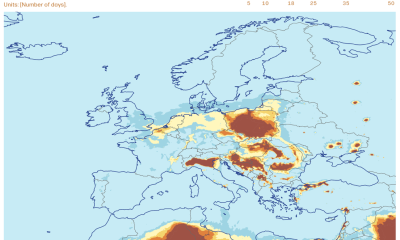
Copernicus: Europe’s air quality improves despite persistent pollution episodes
-
 Employment4 days ago
What the latest data reveals about labour market imbalances across Europe