Decarbonization
RES4Africa lays out a possible decarbonization road map for South Africa in a targeted study


South Africa's efforts to scale down its intensive reliance on carbon are a starting point, but more needs to be done. This is the main takeaway of the last study Possible Decarbonization road map for South Africa, developed by RES4Africa Foundation in collaboration with AFRY. The analysis, presented today during an online event which saw the participation of AFRY, NERSA, South Africa's Presidential Climate Commission, European Commission DG for climate action, IEA, Nedbank, and Enel Green Power, proposes a "Green Development Scenario" as more ambitious and achievable roadmap aiming at supporting the country's efforts towards economy-wide decarbonization.
Despite a recognisable effort in promoting GHG emissions, South Africa is still one of the most carbon-intensive economies worldwide, as well as the only G20 country with a rising power carbon intensity: more than 50% of the country's emissions come from power generation, which is widely dominated by coal reliance. In order to contrast this trend, the government undertook a series of decarbonisation initiatives, keeping national GHG emissions within a range from 398 - 614 Mt CO2-eq by 2030, reducing coal dependence in electricity generation (to 55% in 2030 and 11% in 2050), and progressively decommissioning coal-fired power plants (roughly 11MW by 2030 and 35MW by 2050).
However, according to the findings of RES4Africa’s study, this agenda might be insufficient, since it doesn't seem to be ambitious enough to meet the internationally-agreed climate targets (Paris, COP26), synthesised in the goal of maintaining the average global temperature rise to below 1.5 °C.
The "Green Development Scenario" foresees a 32% reduction of GHG emissions by 2030, increasing to a 73% reduction by 2050 through targeted interventions consisting of financial and non-financial policy measures. Building blocks for such a shift are a progressive penetration of renewables within the energy generation segment, and greater energy efficiency across the electricity value chain. Additionally, the report calls for an extension of a decarbonisation agenda to other sectors of the South African economy (agriculture, industry, real estate, public and private transport, urban planning). Finally, the implementation of new energy sources should be explored: hydrogen is a key example, as it could further reduce GHG emissions, especially for those hard-to-abate industrial sectors (I.e: heavy trucks segments, steel and glass processing, etc.).
RES4Africa Foundation (Renewable Energy Solutions for Africa) envisions the sustainable transformation of Africa’s electricity systems to ensure reliable and affordable electricity access for all, enabling the continent to achieve its full, resilient, inclusive and sustainable development. The Foundation’s mission is to create favourable conditions for scaling up investments in clean energy technologies to accelerate the continent’s just energy transition and transformation. See more.
Share this article:

EU Reporter publishes articles from a variety of outside sources which express a wide range of viewpoints. The positions taken in these articles are not necessarily those of EU Reporter. Please see EU Reporter’s full Terms and Conditions of publication for more information EU Reporter embraces artificial intelligence as a tool to enhance journalistic quality, efficiency, and accessibility, while maintaining strict human editorial oversight, ethical standards, and transparency in all AI-assisted content. Please see EU Reporter’s full A.I. Policy for more information.




Bangladeshis waking up to reality of Yunus government

Copernicus: Europe’s air quality improves despite persistent pollution episodes

What the latest data reveals about labour market imbalances across Europe

From imitation to leadership: The production-based rise of Japan and China

Commission approves €402 million Spanish state aid for road transport companies facing increased fuel prices

Ensuring fairness and safety: €3 customs duty for low-value parcels

EU delivers emergency aid and organises a humanitarian flight in response to earthquakes in Venezuela

European Inventor Award 2026 winners announced: Honouring the innovators shaping tomorrow

Kyrgyzstan launches Tamchy SFIT: a new international jurisdiction as a gateway to Eurasia

Kazakhstan’s dombyra: the two-stringed instrument that carries the soul of the steppe

Europe must double down on nuclear progress to achieve its long-term ambitions

Solana Company Partners with Kazakhstan on $6B Alatau Crypto Megacity

Astana's congress of world religions: A global platform for dialogue in an age of division

How Schuman lost Its way

Rating of American Express casino sites in the UK

PMI defends AI consultation tool as scrutiny grows over EU tobacco rules review

Kazakhstan reforms under scrutiny at Brussels Press Club round table

Japan should face up to history and contribute more to regional peace

Ambassador calls for 'speeding up' of co-operation between EU and Kazakhstan

Timur Turlov at Smart Moves Summit 2025: How chess can transform global education

Shevtsova’s case: Out-of-court sanctions dismantling trust in Ukrainian cause

The future of European transport

Trump Vs Trueman

US 'no longer' an 'unconditional ally' for Europe - MEP
-
 Bangladesh4 days ago
Bangladeshis waking up to reality of Yunus government
-
 Air quality4 days ago
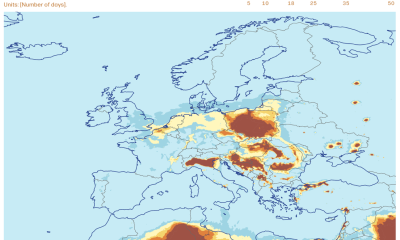
Copernicus: Europe’s air quality improves despite persistent pollution episodes
-
 Employment4 days ago
What the latest data reveals about labour market imbalances across Europe
-
 China4 days ago
From imitation to leadership: The production-based rise of Japan and China