Uzbekistan
Uzbek heritage: A visit to Khiva

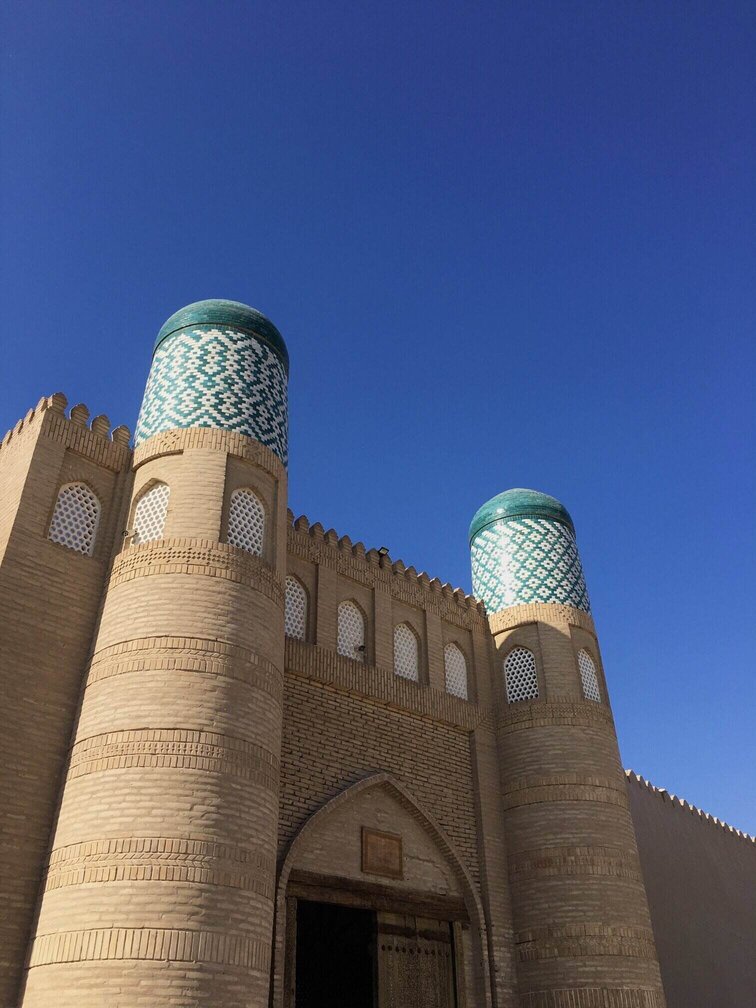
I had the pleasure of visiting one of Uzbekistan’s oldest, most treasured cities while on my travels to the country for the 2021 Presidential elections, writes Tori Macdonald.
Khiva is an enchanting city in the west of Uzbekistan, located in the region of Khorezm. Although it is small and rural, Khiva is rich in culture and history which span back more than a millennium.

I began my journey into Khiva’s pure magic by stopping at a local polling station to observe how the pre-election process had been unfolding in this part of the country. (Learn more about the 2021 elections in my article here.) This polling station was dedicated to the memory of Xudaybergan Devonov, an Uzbek photographer and the first photographer in Central Asia who lived between 1878-1940. He captured many well-known Uzbek actors, artists, and celebrities at the time. The theatre in this polling station was recently built in Devonov’s memory in the classical, turn of the century style.
I then went to begin diving into the exquisite heritage by exploring a couple of the old palace buildings with the help of my incredibly friendly and well-read guides, Shahnoza, my interpreter and language student, Murod a manager at a local construction bank and Sevara, a local journalist.
Khiva is composed of two parts: the inner part, or “Ichan Kala”, and the outer part, “Desha Kala”. I began by visiting some of the palace buildings in the outer part of the city.
One of the palaces contained a couple of small exhibitions on Khivan culture, one dedicated to art and the other, Devonov which contained infographics and copies of iconic shots he had taken, as well as some original artefacts such as the camera he used to capture his first photos.
One of the buildings, Nurillaboy Palace, was constructed between 1884-1912, overlapping the last two kings of Khiva. King Feruz (Muhammad Rahimhon II) or “Feruzxon” in Uzbek, lived from 1845-1910. He was a literature and arts specialist, a musician, and a composer. He was known for writing much of his poetry on love. He was acceded by his son, Isfandiyar Khan (Muhammad Rahim Khan II) after his death, who ruled until 1918. Khan was also a Major General in the Russian Empire. Despite wearing several hats, Khan wasn’t regarded as fitting for the role of king unlike his father. Khan was responsible for the construction of several buildings in the southeast of the inner city, including the largest minaret in Central Asia and smallest Madrasa (a religious; educational institution). He received a great deal of financial and material aid for construction from a vizier named Islam Khodja. 1 million Persians and an unknown number of Russians were ordered to facilitate the constructions.
Khan was the subject of the first ever documentary in Uzbekistan, shot by the photographer, Devanov.

I then ventured into the inner part of Khiva for a guided tour around the Royal Court, or “Ichan Kala” in Uzbek. It reminded me a lot of Samarkand, Uzbekistan’s second city which is famous for its tall, turquoise domed buildings such as the Registan. Like in Samarkand, Khiva’s inner quarter is adorned with a strong Persian influence which is visible through the architecture. The classic Islamic style buildings, predominantly made up of patterns called “Majolica” in a colour scheme of a variety of blues doesn’t hold back in beauty and mesmerising intricate detail. Arabic lettering which contains excerpts from the Coran can be seen on parts of the buildings, intertwined amongst the various patterns. These impressive buildings were famously quoted on by Amir Temur, the 14th century ruler of Samarkand and founder of the Temurid Empire, who said “If anyone doubts our power, let them look at the buildings we have created.”

My friendly tour guide who spoke English very well, even with a hint of English accent despite never having left the country, took me round the inner city, shedding light on the tales and tragedies that had occurred over its history.
One big mausoleum in the centre is a solid representation of the timeline of the old city as one of its striking features is the difference in the thick columns by which it is composed. Some are intricately patterned and detailed whereas others more minimal. The former having been erected during the 11th century whilst the others were much more recent, during the 19th and 20th centuries during the time of Khan’s rule.An interesting addition to the building is the two holes carved out in the walls either side of the platform where the king would make his speeches. These were to create an echo when he spoke, allowing his voice to carry further.
The Ichan Kala also features mosques and further “Madrasas” among its many buildings. As you can imagine, this was a prosperous time in history and much of Kiva’s wealth was due to its status as a trade depot on the Silk Road. The main exports were cotton, craftsmanship in the form of stone and wood, carpet making and embroidery. The inner city also boasted a powerful fortress, and it was, (and still is) one of the best examples of well-preserved Islamic architecture.
But as the 20th century elapsed and social norms began to change in the surrounding world, Young Khivans started demanding reforms to move with the times. Many of the upcoming generation were inspired by what was happening with the Tsarist regime in Russia and soa representational body called the Majlis was created in 1917 which continues to this day. This meant Khan’s power became limited, however because progress was slow regarding the development of these changes, Khan managed to cancel the reforms. But not for too long…
With social changes continuing in Russia, Khan was overthrown in 1920 by the Red Army and the Khorezm dynasty lost political importance when Sovietism was fully integrated in 1924.
Learning about Khiva was one of the most poignant cultural experiences I’ve had. The architecture is of course iconic enough on its own, however, uncovering the crucial historical moments along the way which completely transformed centuries of the city’s social, religious and political culture made for some fascinating storytelling. It’s always a pleasure to learn more about the world’s cultures, however now reflecting on my second trip to Uzbekistan, it’s quite remarkable that many in the world today remain unaware or perhaps a better description would be unintroduced to the wonders of Central Asian heritage.
I hope following my travels to Uzbekistan I can help spread its merited recognition in tandem with the country’s own recent achievements. It will be interesting to watch the continuing developments as Uzbekistan works to grow in presence in the modern world.
Share this article:
EU Reporter publishes articles from a variety of outside sources which express a wide range of viewpoints. The positions taken in these articles are not necessarily those of EU Reporter. Please see EU Reporter’s full Terms and Conditions of publication for more information EU Reporter embraces artificial intelligence as a tool to enhance journalistic quality, efficiency, and accessibility, while maintaining strict human editorial oversight, ethical standards, and transparency in all AI-assisted content. Please see EU Reporter’s full A.I. Policy for more information.



Astana's congress of world religions: A global platform for dialogue in an age of division

Protect children from online sexual abuse: Call for urgent negotiations and permanent solution

Solana company partners with Kazakhstan on $6B Alatau Crypto Megacity

Will the Gulf monarchies rise above internecine disputes in the interest of collective security?

Europe must double down on nuclear progress to achieve its long-term ambitions

International Plastic Bag Free Day – from single use to reuse

Study: Europe's defense runs on American servers

Commission proposes five joint defence projects to strengthen Europe's industrial capabilities

Safer cars, safer roads: New rules take effect

Survey of city economic experts: Cities are driving Draghi’s competitiveness agenda, but need EU recognition to scale action

Europe's Cloud moment: The DMA must now deliver

EU-Mexico: While others build walls, Europe builds bridges

New EU strategy must help farmers move toward a more humane food system

Kashmir's 9,765 missing women and girls demand international attention

Quarterly reports show a surge in solar energy and e-vehicles, with record highs in 2025

EU deploys wildfire support to face multiple fires across Portugal and France

Kazakhstan reforms under scrutiny at Brussels Press Club round table

Japan should face up to history and contribute more to regional peace

Ambassador calls for 'speeding up' of co-operation between EU and Kazakhstan

Timur Turlov at Smart Moves Summit 2025: How chess can transform global education

Shevtsova’s case: Out-of-court sanctions dismantling trust in Ukrainian cause

The future of European transport

Trump Vs Trueman

US 'no longer' an 'unconditional ally' for Europe - MEP
-
 Kazakhstan4 days ago
Astana's congress of world religions: A global platform for dialogue in an age of division
-
 Child sexual abuse4 days ago
Protect children from online sexual abuse: Call for urgent negotiations and permanent solution
-
 Kazakhstan4 days ago
Solana company partners with Kazakhstan on $6B Alatau Crypto Megacity
-
 Iran4 days ago
Will the Gulf monarchies rise above internecine disputes in the interest of collective security?