Uzbekistan
A landlocked country in the heart of Central Asia, Uzbekistan is a country that stands at a crossroads


Upcoming parliamentary elections represent the possibility of further change for Uzbekistan, writes Martin Banks.
But how much progress has been made since the last elections in 2019?
The consensus is that there has been significant development in some areas while work is still needed in others such as in the field of human rights.
What is clear, though, is that the Uzbek government has ploughed serious money into efforts to project the country onto the world stage.
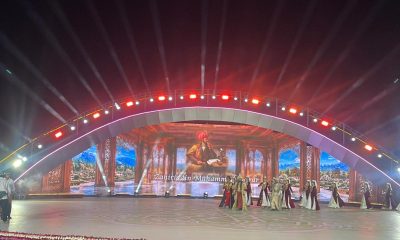
It has invested heavily in a series of ambitious arts and architecture projects in recent years to promote Uzbek art on a world stage.
Perhaps more significantly, there have also been several key political and economic reforms.
They include opening up to foreign investment and tourism, lowering trade barriers and making it easier for companies to do business.
Efforts have also been made since 2019 to open the country’s foreign exchange market.
A measure of the most recent concrete development came with the adoption of a presidential decree, issued a few days ago, supporting further development of civil society in Uzbekistan.This provides for the necessary legal and practical conditions for their active participation in state and public administration.
For the first time in the history of Uzbekistan, the “concept for the development of civil society” has been adopted.
As a result of the new measures it is estimated that about 10,000 NGOs will be able to operate across a range of areas, from protecting citizens’ rights to education, medicine and culture.
Some 12 times more support has been invested in supporting civil society in the past seven years compared with the previous eight years.
An Uzbek source said, “The decree will define high standards of transparency and help take the system of state support for civil society institutions to a new level. Most importantly, it will open up new opportunities for direct participation of citizens and civil society institutions in state and public administration, in particular and increase the effectiveness of public control over the activities of state bodies.
“This decree is an important significant step towards strengthening the role of NGOs in the process of fundamental transformations in the country, protecting the rights and interests of citizens, expressing their will and aspirations.”
Many argue this and other moves demonstrate positive developments in Uzbekistan.
To many all this was unthinkable during the time when the country was part of the old Soviet Union.
After the former President Islam Karimov led Uzbekistan to independence from Moscow he stayed in power for 25 years until his death in 2016.
Since then, the most populous country in Central Asia has, many would agree, changed and, in many ways, for the better.
Citizens will head to the polls on October 27 to elect a total of 150 parliamentary deputies and almost 6,000 members of local councils.
The election represents the first time since 2019 that parliamentarians have had to seek a new mandate from voters, and the first since the 2023 constitutional referendum, which vested more power in the parliament than ever before.
On December 22, 2019, parliamentary elections were held in Uzbekistan for the first time after Mirziyoyev succeeded Karimov, the country’s long-serving leader.
On the eve of the 2019 elections, the Economist, coincidentally, named Uzbekistan the country of the year.
This contributed to increased outside interest in Uzbekistan’s elections.
One of the observers to that election was Asset Ordabayev, a research fellow at the Eurasian Institute of the International H.A Yassawi Kazakh-Turkish University.
He said the Uzbek leadership, up to then, had demonstrated “openness, the focus on democratization, and the improvement of the human rights situation.”
In particular, the gender equality theme was actively exploited, and a mandatory quota for female candidates was introduced, with each party obliged to have at least 30% of women in its nomination list.
As a result, women received 48 seats in the legislative chamber, or 32% of the total.
The upcoming elections are significant in several ways and also make a change from an exclusively "first past the post" method to a majority-proportional (mixed) system.
This time, 75 of the 150 deputies of the Legislative Chamber will be elected from single-member constituencies under the "first past the post" system, while the remaining 75 will be chosen through proportional representation; that is, on the basis of votes given to party lists, with a threshold of 7%.
Speaking exclusively to this website, David McAllister, a senior German MEP and chairman of the influential Foreign Affairs Committee in the European Parliament, gave his reflections on the elections and Uzbekistan today.
Crucially, he calls for the “further advancement of the democratic reforms.”
The centre right deputy said: "Since 2016, Uzbekistan has been on an ambitious reform path launched by President Mirziyoyev, including on the electoral process. The new constitution, adopted a year ago by a nation-wide referendum, has embedded a number of democratic features and increased the role of the Oliy Majlis.
“On 27 October, Uzbekistan will hold its first parliamentary election under the new electoral system. I welcome the fact that OSCE / ODIHR will observe the elections and take note of its recent assessment of the pre-electoral situation in Uzbekistan.”
He added: “The European Parliament has called on the Uzbek authorities to implement the standing OSCE / ODIHR recommendations. These would contribute to the establishment of a genuinely pluralistic political environment. I look forward to seeing a further advancement of the democratic reforms in Uzbekistan and of the partnership with the EU."
Further comment comes from Peter Stano, EU spokesperson for Foreign Affairs and Security Policy.
He told this site: “Ahead of the upcoming Parliamentary elections, the European Union welcomes that Uzbekistan reviewed its electoral legal framework in line with OSCE/ODIHR recommendations.
“The European Union hopes that the new mixed electoral system, which has been introduced following the adoption of a new constitution on 1 May 2023, will give a bigger role to political parties and strengthen women’s participation in Uzbek politics.
“The EU also supports OSCE/ODIHR’s recommendations to deploy election observation mission, conducted by OSCE/ODIHR, for the parliamentary elections.”
Share this article:
EU Reporter publishes articles from a variety of outside sources which express a wide range of viewpoints. The positions taken in these articles are not necessarily those of EU Reporter. Please see EU Reporter’s full Terms and Conditions of publication for more information EU Reporter embraces artificial intelligence as a tool to enhance journalistic quality, efficiency, and accessibility, while maintaining strict human editorial oversight, ethical standards, and transparency in all AI-assisted content. Please see EU Reporter’s full A.I. Policy for more information.



EU foreign ministers to discuss options for restricting trade with Israeli communities in Judea and Samaria

European operation dismantles €10 million illicit cigarette network in Spain

Srebrenica's lesson is prevention. Why isn't the world applying It to Kashmir?

ALROSA Re-elects Supervisory Board with Minimal Changes

AIFC to host Astana Finance Days 2026 in September

Energy Union Task Force takes stock of oil and gas security of supply in the EU

Joint statement by High Representative/Vice-President Kallas and Commissioner Kos on the 31st anniversary of the Srebrenica genocide

Commission preliminarily finds the addictive design of Instagram and Facebook in breach of the Digital Services Act

Britain’s leadership crisis is a symptom, not the disease

Chinese “leadership and coordination”

Shared commitment to advance EOSC through new EOSC Nodes and EOSC projects

Why young jobseekers struggle to find roles abroad that fit their expertise

Farmers, fair markets and consumers: new report highlights the role of EU competition rules in agriculture

EU and South Africa kick off intergovernmental dialogue on Clean Trade and Investment Partnership

Seveso - 50 years on: EU strengthens its commitment to industrial safety in a changing landscape of risk

Commission opens formal investigation into possible gun jumping in XXXLutz's acquisition of Porta

Kazakhstan reforms under scrutiny at Brussels Press Club round table

Japan should face up to history and contribute more to regional peace

Ambassador calls for 'speeding up' of co-operation between EU and Kazakhstan

Timur Turlov at Smart Moves Summit 2025: How chess can transform global education

Shevtsova’s case: Out-of-court sanctions dismantling trust in Ukrainian cause

The future of European transport

Trump Vs Trueman

US 'no longer' an 'unconditional ally' for Europe - MEP
-
 Israel4 days ago
EU foreign ministers to discuss options for restricting trade with Israeli communities in Judea and Samaria
-
 Cigarettes3 days ago
European operation dismantles €10 million illicit cigarette network in Spain
-
 Kashmir3 days ago
Srebrenica's lesson is prevention. Why isn't the world applying It to Kashmir?
-
 Economy2 days ago
ALROSA Re-elects Supervisory Board with Minimal Changes