Uzbekistan
Praise for Uzbekistan elections but still room for improvement


Uzbekistan has been praised for its “technically well-prepared” parliamentary elections at the weekend, writes Martin Banks.
International observers also welcomed other “positive developments”, including an increased gender quota for parliamentary candidates.
In the keenly-awaited elections on Sunday (27 October), three quarters of the population voted.
The Liberal Democrats increased their share in the seat Oliy Majlis (Parliament) from 53 to 64 seats and their coalition partner, the National Revival Democratic Party, declined from 36 to 29 seats. This enables the Liberal Democrats to maintain the current coalition arrangement, aligned with the reform agenda of Uzbek President Shavkat Mirzoyoyev, who won his 2nd mandate last year.
Turnout was higher than expected, reaching nearly 75% by the time the polls closed, comprising over 15 million votes cast. The Central Election Commission cited the presence of more than 850 foreign and international observers, as well as 55,000 observers from political parties and more than 10,000 observers from citizens' self-government bodies.
The National Revival Democratic Party got 29 seats (19.3pc), Adolat (Justice) Social Democratic Party won 21 seats (13pc), the People's Democratic Party 20 seats (14pc) and the Environmental Party 16 seats (10.7pc).
There were reports of huge queues outside many of the 10,000 polling stations which some take as an indication of reflecting a new chapter in the country's evolving politicization and democratization. The CEC also praised the IT system launched on the eve of the poll, that enabled the digitization of many procedures to reduce bureaucratic obstacles and increase transparency.
The weekend poll marked the first time in Uzbekistan that a legislative election was conducted using a hybrid model similar to that of Germany, in which half of the 150 seats are selected by constituency “first past the post”. The other half of the seats are selected proportionally via national party lists, for which all of the participating parties crossed the 7% threshold.
Women constituted nearly 45pc percent of candidates running for the parliamentary elections and 42 percent of those contesting local council seats. The new 40 percent quota applicable for parliamentary and local elections is an increase from 30 percent under previous legislation.
Commenting on the outcome, Anda Bela, an international observer from Germany, stated: "I am pleased to participate as an observer in this election process. The new system being implemented in the elections – the digitalization processes – deserves recognition as a major step towards the country's development. Candidates with physical disabilities are also participating in the elections, which demonstrates that every citizen in Uzbekistan can freely exercise their constitutional rights.
“A special 'e-saylov' (e-election) information system has been created for the elections, which allows everyone to familiarize themselves with the biographies of all candidates. This serves as another demonstration of transparency."
Observers from scores of countries were in Uzbekistan to monitor the elections, including from Türkiye which commended what it calls “the peaceful conclusion of Uzbekistan’s parliamentary elections.”
“We are pleased the elections have been concluded peacefully and hope results will benefit Uzbekistan,” its foreign ministry said.
Further reaction comes from Azay Guliyev, special co-ordinator and leader of the Office for Democratic Institutions and Human Rights short term observers at the election.
The Office expressed several serious concerns but is also positive about some aspects of the elections.
Guliyev said the elections took place amid ongoing reforms, adding, “These elections were held under a new mixed electoral system, reflecting significant constitutional amendments and a revised electoral code as part of Uzbekistan's ongoing reform efforts.”
These reforms, he added “represent progress in enhancing human rights provisions”.
The country’s election-related laws have “gradually evolved and the elections were technically well-prepared,” said the OSCE statement adding, “All five registered political parties were able to campaign freely and with legally enforced equal conditions.Positively, women were well represented among candidates and in election administration.”
Commenting on the new gender goals, Sargis Khandanyan, head of the OSCE PA delegation, said the increased gender quota for parliamentary candidates “marks a positive development.”
“We are hopeful that this will further boost women's participation in public and political life in line with OSCE commitments.”
The changes to election-related laws included a revised electoral system, new party list registration rules, modified rules on election management bodies and an increased gender quota.
But, amid some concerns about the elections, the OSCE says that “the relatively short timeframe for implementing these changes raised questions about compliance with international good practices.”
On a more positive note, the statement notes that private television channels organized election debates and election preparations “at all levels were administered efficiently”.
It says the Central Election Commission held regular live-streamed sessions and swiftly published its decisions, “contributing to transparency”.
International organizations, political parties, Mahallas and accredited media were entitled to observe the elections and election day was “calm and orderly” with the CEC registering some 851 international observers.
Douglas Wake, Head of the Election Observation Mission from the OSCE Office for Democratic Institutions and Human Rights, said, “Uzbekistan’s authorities have partially addressed some prior ODIHR recommendations through recent legislative changes.”
Wake added: “Much more must be done to enhance transparency and confidence in the officially announced turnout and results and ODIHR looks forward to further co-operation with Uzbekistan’s authorities, including on the recommendations that will come in our final report.”
Criticisms include claims that media coverage was “limited by restrictions on free expression” and there was “a lack of real choice” for voters.
On Monday (28 October), an EU spokesperson in Brussels told this site: “The EU takes note of Sunday’s parliamentary elections in Uzbekistan, held under the new electoral legal framework more in line with OSCE/ODIHR recommendations.
“The elections were observed by the OSCE/ODIHR International Election Observation Mission, and we look forward to its preliminary findings to be published.
“While waiting for the ODIHR’s preliminary findings we can already say that based on the available information, we note that elections featured a 40% quota for women candidates and were conducted for the first time under the new mixed electoral system. At the same time, the political environment still lacks genuine competition and some ODIHR recommendations remain unaddressed.”
Share this article:
EU Reporter publishes articles from a variety of outside sources which express a wide range of viewpoints. The positions taken in these articles are not necessarily those of EU Reporter. Please see EU Reporter’s full Terms and Conditions of publication for more information EU Reporter embraces artificial intelligence as a tool to enhance journalistic quality, efficiency, and accessibility, while maintaining strict human editorial oversight, ethical standards, and transparency in all AI-assisted content. Please see EU Reporter’s full A.I. Policy for more information.



Can digital sovereignty survive an open trading system?

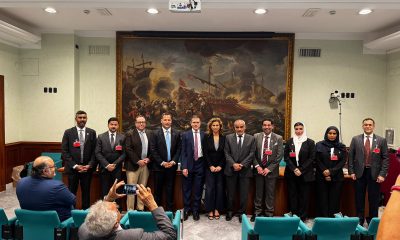
Friedman Institute and Trends Group at the Italian parliament: Countering the Muslim brotherhood

EU deploys wildfire support to face multiple fires across Portugal and France

From a remote island to shelves around the world: The story of Azorean canned fish

Europe’s job market is shifting, and EURES is ready to lead the way into 2030

EU agricultural markets remain robust despite uncertainties and rising input costs

Commission report highlights achievements of EU rules on animal health

Deposits to Swiss banks from Bangladeshi nationals nearly tops all time peak

EU foreign ministers to discuss options for restricting trade with Israeli communities in Judea and Samaria

Safer cars, safer roads: New rules take effect

Survey of city economic experts: Cities are driving Draghi’s competitiveness agenda, but need EU recognition to scale action

Europe's Cloud moment: The DMA must now deliver

EU-Mexico: While others build walls, Europe builds bridges

New EU strategy must help farmers move toward a more humane food system

Kashmir's 9,765 missing women and girls demand international attention

Quarterly reports show a surge in solar energy and e-vehicles, with record highs in 2025

Kazakhstan reforms under scrutiny at Brussels Press Club round table

Japan should face up to history and contribute more to regional peace

Ambassador calls for 'speeding up' of co-operation between EU and Kazakhstan

Timur Turlov at Smart Moves Summit 2025: How chess can transform global education

Shevtsova’s case: Out-of-court sanctions dismantling trust in Ukrainian cause

The future of European transport

Trump Vs Trueman

US 'no longer' an 'unconditional ally' for Europe - MEP
-
 Digital economy4 days ago
Can digital sovereignty survive an open trading system?
-
 Islam4 days ago
Friedman Institute and Trends Group at the Italian parliament: Countering the Muslim brotherhood
-
 Wildfires4 days ago
EU deploys wildfire support to face multiple fires across Portugal and France
-
 Maritime4 days ago
From a remote island to shelves around the world: The story of Azorean canned fish