Uzbekistan
The Uzbek challenge: building a modern economy amid ancient traditions


Central Asia’s most populous country, Uzbekistan, is embarking on a programme of rapid economic growth. In one sense, the aim is to transform society but an enduring aspect of Uzbek life down the centuries is central to the strategy, writes Political Editor Nick Powell.
The ambition cannot be doubted. The goals of Uzbekistan’s development strategy for 2022-2026 include massively boosting the business sector, with stock market turnover increasing from $200 million to $7 billion a year. Private enterprise is expected to deliver 80% of GDP and 60% of exports.
Farm incomes will double and nine million foreign tourists will be welcomed every year. Samarkand, on the Silk Road, is certainly well worth a visit and epitomises the rich heritage of this proud and ancient nation. In the fifteenth century, there was a flowering of science and art, of medicine and astronomy. Now Uzbekistan intends to not just celebrate those achievements but replicate them.
Since elections last year, the country has entered a period of rapid change, with legal and political reforms that will underpin the development strategy. At a recent presentation at the Brussels Press Club, hosted by Uzbekistan’s ambassador to the EU Dilyor Khakimov, the executive director of the Development Strategy Centre in Tashkent, Eldor Tulyakov, emphasised the importance of the reform of justice, including the strengthening of property rights.
But if the ambitions of President Shavkat Mirziyoyev are to be delivered, the reforms will need the support of wider society. Out of a population of well over 30 million, more than a third are less than 14 years old. But Uzbeks are loyal to their communities and traditions, perhaps epitomised by the mahallas, community institutions that have been part of Uzbek life since at least the twelfth century.
As Eldor Tulyakav put it, mahallas are self-governing bodies, very much independent from the state bureaucracy. “Uzbeks, whenever they have a problem, whenever they have an issue, they don’t want to address it to the official level. People come to their mahalla to solve a problem”. He explained that the president had noted the importance of increasing the potential of mahallas.
The state will support mahallas financially, especially in key sectors such as textiles and agriculture.
Dr Umid Abidhadjaev, from the Ministry of Economic Development, told the press club that the mahallas enabled a more granular approach, with a focus at the local level. He cited the roll out of solar powered boilers to provide hot water in schools as the ideal way of persuading first the children and then their parents of the benefits of such technological innovation.
Such benefits bring the popular buy-in that ambitious government plans require. A five year development strategy might sound like a very top-down approach but in fact its success depends on grass roots support. It’s the most traditional of Uzbek institutions that will play a vital role in delivering modernisation and economic progress.
Share this article:
EU Reporter publishes articles from a variety of outside sources which express a wide range of viewpoints. The positions taken in these articles are not necessarily those of EU Reporter. Please see EU Reporter’s full Terms and Conditions of publication for more information EU Reporter embraces artificial intelligence as a tool to enhance journalistic quality, efficiency, and accessibility, while maintaining strict human editorial oversight, ethical standards, and transparency in all AI-assisted content. Please see EU Reporter’s full A.I. Policy for more information.





New migration and asylum rules enter into application: What is changing?

The Earth is accumulating heat at an accelerating rate: Global warming reached 1.37°C in 2025

EU and Republic of Korea bolster strategic partnership with new areas of cooperation

Are you prepared for the safety risks of the modern workplace?

Commission proposes €540 million in financial relief and other supports for farmers facing fertiliser crisis

EU finance ministers back EIB Group strategy for a stronger, more secure Europe in a more stable world

European Sustainable Energy Week 2026: That’s a wrap

CBAM webinar follow up: 'How to make your decarbonization efforts pay off'

Commission defends Urban Wastewater Directive against EPP-ECR challenge

The CIA director’s warning and the illusion of peace with Iran

Hands of our nature, hands off Albania

Act of Remembrance honours war dead buried in Belgium

No democracy without equality!

Going down a treat - that's Belgian wine

Azerbaijan and the emerging alliance reshaping the Middle East

Fire extinguishers and fire extinguisher stands: Are you up to date?

Kazakhstan reforms under scrutiny at Brussels Press Club round table

Japan should face up to history and contribute more to regional peace

Ambassador calls for 'speeding up' of co-operation between EU and Kazakhstan

Timur Turlov at Smart Moves Summit 2025: How chess can transform global education

Shevtsova’s case: Out-of-court sanctions dismantling trust in Ukrainian cause

The future of European transport

Trump Vs Trueman

US 'no longer' an 'unconditional ally' for Europe - MEP
-
 Asylum policy4 days ago
New migration and asylum rules enter into application: What is changing?
-
 Climate change4 days ago
The Earth is accumulating heat at an accelerating rate: Global warming reached 1.37°C in 2025
-
 South Korea4 days ago
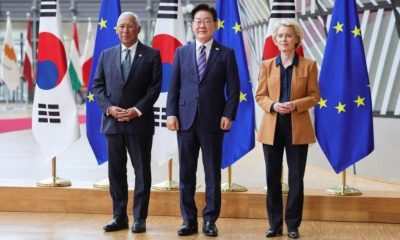
EU and Republic of Korea bolster strategic partnership with new areas of cooperation
-
 Safety3 days ago
Are you prepared for the safety risks of the modern workplace?