Transport
The European capital cities with the best metro systems

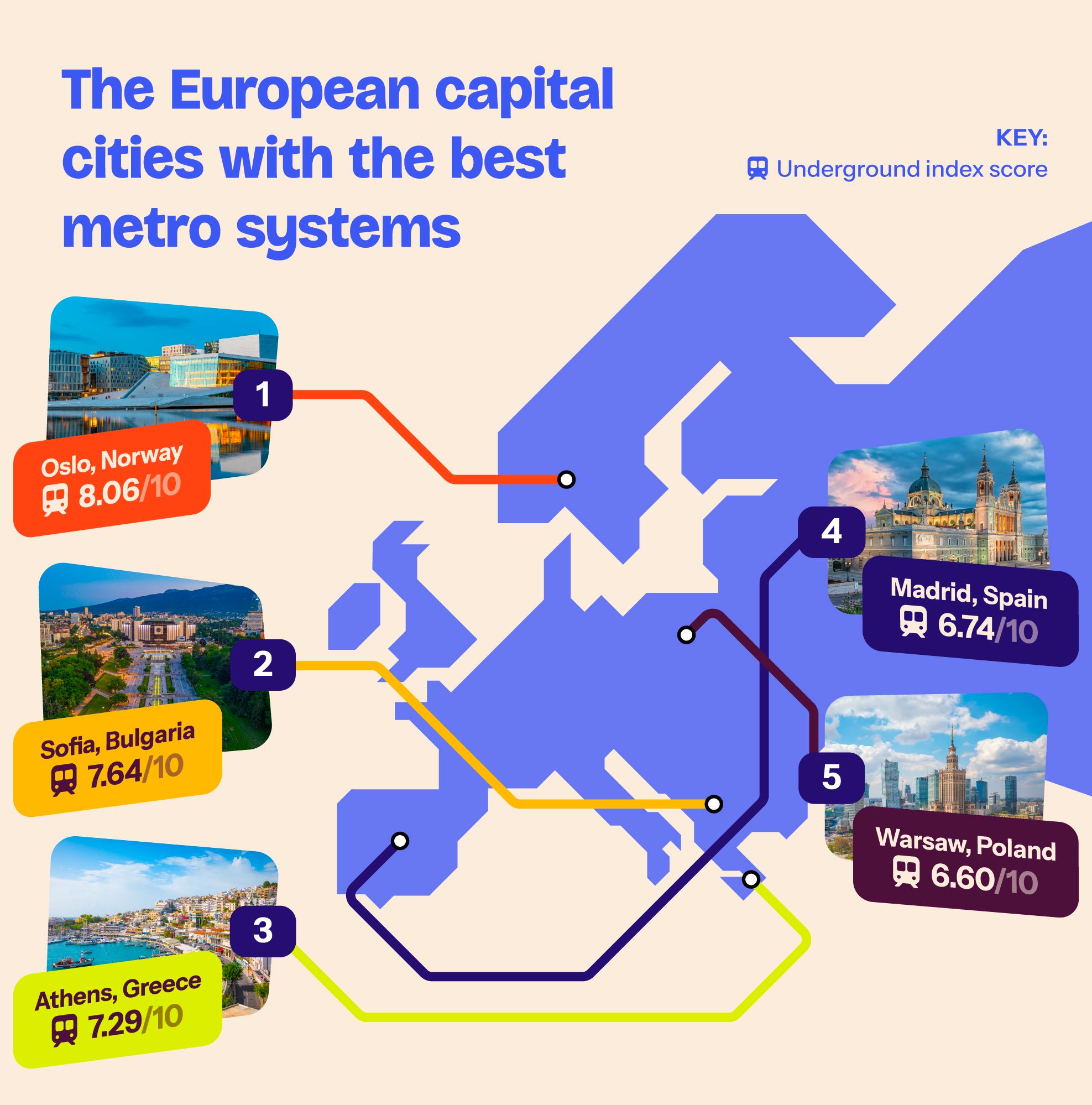
| Rank | Capital City,Country | Metro Name | Total Number of Stations | Total Length of Metro (Miles) | Annual Ridership | "Angry" Reactions | "Love" Reactions | Average Google Review Score | Underground Index Score |
| 1 | Oslo, Norway | Oslo MetroOslo T-Bane | 101 | 52.8 | 74,000,000 | 7.00% | 22.00% | 4.13 | 8.06 |
| 2 | Sofia, Bulgaria | Sofia MetroСофийски Mетрополитен | 47 | 32.3 | 164,200,000 | 0.00% | 95.00% | 4.28 | 7.64 |
| 3 | Athens, Greece | Athens MetroΜετρό Αθήνας | 62 | 44.1 | 259,200,000 | 7% | 33% | 4.10 | 7.29 |
| 4 | Madrid, Spain | Madrid MetroMetro de Madrid | 242 | 179.3 | 355,600,000 | 14.00% | 23.00% | 4.03 | 6.74 |
| 5 | Warsaw, Poland | Warsaw MetroMetro Warszawskie | 39 | 25.7 | 195,400,000 | 17.00% | 35.00% | 4.37 | 6.60 |
Oslo has the best metro system in Europe, with an underground index score of 8.06 out of 10. The Oslo Metro, known locally as either the “Oslo T-Bane” or “T-banen i Oslo,” has 101 stations covering 52.8 miles of track and serves all 15 city boroughs, as well as extending part-way into the neighbouring Baerum municipality, writes Harry Judd, Bounce.
The Sofia Metro, or “Софийски Mетрополитен” in Bulgarian, is the second-highest-scoring metro system in our study, with a score of 7.64 out of 10. Serving the Bulgarian capital of Sofia, it is the only metro system in the country and one of the youngest in our study, only opening to passengers in 1998.
The European capital cities with the worst metro systems:
| Rank | Capital City,Country | Metro Name | Total Number of Stations | Total Length of Metro (Miles) | Annual Ridership | "Angry" Reactions | "Love" Reactions | Average Google Review Score | Underground Index Score |
| 1 | Budapest,Hungary | Budapest MetroBudapesti Metró | 48 | 24.7 | 382,600,000 | 75% | 1% | 4.05 | 3.13 |
| 2 | Brussels,Belgium | Brussels MetroMétro de BruxellesBrusselse Metro | 59 | 24.8 | 87,600,000 | 26% | 11% | 3.82 | 3.2 |
| 3 | Rome,Italy | Rome MetroMetropolitana di Roma | 73 | 36.9 | 320,000,000 | 34.00% | 9.00% | 3.60 | 3.75 |
| 4 | Amsterdam,Netherlands | Amsterdam MetroAmsterdamse Metro | 39 | 26.5 | 111,300,000 | 47% | 9% | 4.03 | 4.03 |
| 5 | Paris,France | Paris MétroMétro de Paris | 320 | 152.6 | 1,411,000,000 | 41.00% | 4.00% | 4.40 | 4.38 |
| 5 | Berlin,Germany | Berlin U-BahnU-Bahn Berlin | 175 | 96.6 | 596,000,000 | 33% | 7% | 3.86 | 4.38 |
Budapest Metro, or “Budapesti Metró” in Hungarian, is the lowest-rated metro system in our study with a score of 3.13 out of 10. The Budapest metro system is relatively small, with 48 stations across just 24.7 miles of track, and even though the average Google review score across all metro stations was a respectable 4.05 out of 5, 75% of online reactions to articles about the metro system were “hate,” while just 1% of reactions were “love.”
Brussels Metro has the second-lowest underground index score of 3.20 out of 10, performing just slightly better than Budapest. It has 59 stations along 24.8 miles of track covering the wider Brussels metropolitan area. The Google review scores for stations on the Brussels Metro are also underwhelming, with an average score of 3.80 out of 5.
Rome Metro had the third-lowest underground index score of 3.75 out of 10. The Italian capital’s metro system is more extensive than those of Budapest and Brussels, with 36.9 miles of track accessible via 73 stations. The average Google review score of metro stations is just 3.60 out of 5, with only 13.21% of stations receiving a score of four or above. Additionally, 34% of online reactions to news articles about the Rome Metro are “angry,” while “love” reactions account for just 9%.
You can view the full research here.
Share this article:

EU Reporter publishes articles from a variety of outside sources which express a wide range of viewpoints. The positions taken in these articles are not necessarily those of EU Reporter. Please see EU Reporter’s full Terms and Conditions of publication for more information EU Reporter embraces artificial intelligence as a tool to enhance journalistic quality, efficiency, and accessibility, while maintaining strict human editorial oversight, ethical standards, and transparency in all AI-assisted content. Please see EU Reporter’s full A.I. Policy for more information.



Libya’s fuel crisis offers lessons for energy security on both sides of the Mediterranean

EU Cybersecurity Act could expose member states to costly investment treaty claims, legal opinion warns

Outrage of Iranian exiles and opposition of MEPs to inviting Reza Pahlavi to the European Parliament

Health sector hails EU vote on workforce crisis as ‘major step forward’

ECDC chief warns MEPs more health threats require more resources

Kazakhstan cuts water use by 874 mln m³ through new technologies

490+ experts call for €10 billion ring-fenced health allocation in EU budget

Impasse in European Union Tobacco Tax Reform: The Swedish veto

Western investors eye Russian assets again as sanctions discounts persist

EU green jobs: Which activities employ the most people?

Podcast: The story behind data on hazardous chemicals

EU's labour productivity slightly increased in Q1 2026

Government gross debt of eurozone largely in euro

Commission calls for equal pay rules to become a reality across the EU

EU disburses nearly €2.8 billion to support Ukraine's financial stability and reform efforts

EU Drugs Agency warns of new health risks, including a rising trend in ketamine use

Kazakhstan reforms under scrutiny at Brussels Press Club round table

Japan should face up to history and contribute more to regional peace

Ambassador calls for 'speeding up' of co-operation between EU and Kazakhstan

Timur Turlov at Smart Moves Summit 2025: How chess can transform global education

Shevtsova’s case: Out-of-court sanctions dismantling trust in Ukrainian cause

The future of European transport

Trump Vs Trueman

US 'no longer' an 'unconditional ally' for Europe - MEP
-
 Libya5 days ago
Libya’s fuel crisis offers lessons for energy security on both sides of the Mediterranean
-
 Law4 days ago
EU Cybersecurity Act could expose member states to costly investment treaty claims, legal opinion warns
-
 Iran5 days ago
Outrage of Iranian exiles and opposition of MEPs to inviting Reza Pahlavi to the European Parliament
-
 Health5 days ago
Health sector hails EU vote on workforce crisis as ‘major step forward’