Environment
Commission invites feedback on future simplification of environmental legislation


The Commission opened a call for evidence on how to simplify environmental legislation, by cutting red tape while upholding and better achieving the EU's environmental objectives of this legislation.
The upcoming environmental omnibus proposal will present measures to simplify legislation concerning the circular economy, industrial emissions and waste management. This proposal builds further on previous, widespread stakeholder engagement. Yesterday's call serves to identify EU environmental policies that could be simplified for businesses without affecting the EU's environmental objectives or the protection of human health.
All stakeholders are encouraged to respond using the Have Your Say portal. The feedback period for the Call for Evidence is open until 10 September 2025.
Environment, Water Resilience and a Competitive Circular Economy Jessika Roswall, who is leading the initiative, said: “Our objective is to gather insights from stakeholders and citizens on how to simplify environmental legislation without compromising our high environmental standards. Reducing the administrative burden of environmental laws will help make them more effective and ensure better environmental protection in the long run.”
The initiative is aligned with key EU initiatives, such as the Competitiveness Compass, and with the Commission's work programme for 2025, which set the target of cutting administrative burden by at least 25% for all companies and at least 35% for small and medium-sized enterprises (SMEs). The Compass also calls for accelerated permitting for sectors in transition to a clean and digital economy.
Share this article:
EU Reporter publishes articles from a variety of outside sources which express a wide range of viewpoints. The positions taken in these articles are not necessarily those of EU Reporter. Please see EU Reporter’s full Terms and Conditions of publication for more information EU Reporter embraces artificial intelligence as a tool to enhance journalistic quality, efficiency, and accessibility, while maintaining strict human editorial oversight, ethical standards, and transparency in all AI-assisted content. Please see EU Reporter’s full A.I. Policy for more information.



The Earth is accumulating heat at an accelerating rate: Global warming reached 1.37°C in 2025

New migration and asylum rules enter into application: What is changing?

EU and Republic of Korea bolster strategic partnership with new areas of cooperation

Are you prepared for the safety risks of the modern workplace?

Commission proposes €540 million in financial relief and other supports for farmers facing fertiliser crisis

EU finance ministers back EIB Group strategy for a stronger, more secure Europe in a more stable world

European Sustainable Energy Week 2026: That’s a wrap

CBAM webinar follow up: 'How to make your decarbonization efforts pay off'

Commission defends Urban Wastewater Directive against EPP-ECR challenge

The CIA director’s warning and the illusion of peace with Iran

Hands of our nature, hands off Albania

Act of Remembrance honours war dead buried in Belgium

No democracy without equality!

Going down a treat - that's Belgian wine

Azerbaijan and the emerging alliance reshaping the Middle East

Fire extinguishers and fire extinguisher stands: Are you up to date?

Kazakhstan reforms under scrutiny at Brussels Press Club round table

Japan should face up to history and contribute more to regional peace

Ambassador calls for 'speeding up' of co-operation between EU and Kazakhstan

Timur Turlov at Smart Moves Summit 2025: How chess can transform global education

Shevtsova’s case: Out-of-court sanctions dismantling trust in Ukrainian cause

The future of European transport

Trump Vs Trueman

US 'no longer' an 'unconditional ally' for Europe - MEP
-
 Climate change4 days ago
The Earth is accumulating heat at an accelerating rate: Global warming reached 1.37°C in 2025
-
 Asylum policy4 days ago
New migration and asylum rules enter into application: What is changing?
-
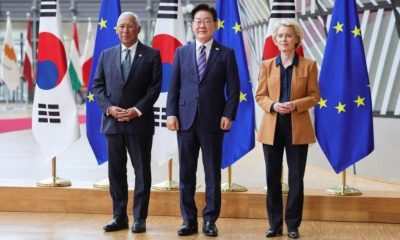 South Korea4 days ago
EU and Republic of Korea bolster strategic partnership with new areas of cooperation
-
 Safety3 days ago
Are you prepared for the safety risks of the modern workplace?