Economy
Vote: Implementing microfinancing in the EU

 With the employment committee voting this Tuesday (10 November) on a report concerning microloans, what are they exactly? Generally associated with South Asia and Latin America, where the first initiatives were launched four decades ago, microloans are growing in the EU. They aim to assist people in difficult social circumstances to find their way out of unemployment and poverty. In 2010, the EU launched the European Progress Microfinance Facility to improve conditions for borrowers to obtain small loans.
Disadvantaged groups, including the long-term unemployed, social welfare recipients, those living in deprived rural areas, migrants or ethnic minorities, often encounter difficulties in accessing conventional finance. Microfinance offers them the possibility to obtain very small loans not generally provided by banks in order to assist them to start or develop their own small businesses.
In 2006 Muhammad Yunus and his Grameen Bank won the Nobel Peace Prize for offering such credit to the poorest in Bangladesh. In Europe on the other hand, the European Progress Microfinance Facility is funded by the EU budget and the European Investment Bank, and aims to improve the conditions under which borrowers can get loans. It also makes financing available for those who would not otherwise be able to obtain it.
The EU does not finance the entrepreneurs themselves but enables banks and non-bank financial institutions to grant more loans thanks to guarantees totalling €200 million.
This Tuesday Parliament's employment committee votes on a report on the implementation so far of the microfinance facility. Speaking this week, the author of that report German EPP member Sven Schulze referred to microfinance as a "sustainable social policy" and noted the importance of offering other assistance in addition to loans, including help with creating business plans or with bookkeeping.
Schulze added: "The instrument works as a whole but unfortunately sufficient funding is not always guaranteed. The Commission must therefore find a solution quickly in order to make Progress Microfinance even better in the future."
Find out more about the work of the employment committee.
Microloans are loans under €25,000.
Microenterprises employ fewer than 10 people with annual turnover not exceeding €2 million
Goal: To disburse €500 million in the form of 46,000 microloans by 2020
Banks and non-bank institutions in 22 member states offer microloans via the European Progress Microfinance Facility
The Facility runs until April 2016. Microcredits will then be covered by the Programme for Employment and Social Innovation (EaSI) (2014-2020).
More information
Share this article:
EU Reporter publishes articles from a variety of outside sources which express a wide range of viewpoints. The positions taken in these articles are not necessarily those of EU Reporter. Please see EU Reporter’s full Terms and Conditions of publication for more information EU Reporter embraces artificial intelligence as a tool to enhance journalistic quality, efficiency, and accessibility, while maintaining strict human editorial oversight, ethical standards, and transparency in all AI-assisted content. Please see EU Reporter’s full A.I. Policy for more information.



Kazakhstan: Central Election Committee reviews the results of the nomination of candidates for the deputies of Kurultai
The South Caucasus at a historic turning point: Between lasting peace and renewed confrontation

Setting a new benchmark in premium travel

The security environment of the South Caucasus amid changing geopolitical realities

Survey on an EU Blueprint for intellectual property licensing and spinoff creation

Burnham as PM? 'Wait and see'

Rule of law report strengthens EU democracy and fundamental rights

Ban on destruction of unsold clothes and shoes enters into application

JoinCare Explores Scientific Exchange During Visit toJapan’s National Institute of Infectious Diseases

New episode – DGT podcast: Languages and Technology

Become a European Commission trainee – applications are now open

Commission outlines measures to strengthen Europe's banking sector and support growth

British political shifts and the future of UK-China ties
The South Caucasus at a historic turning point: Between lasting peace and renewed confrontation

As Ireland chairs the EU Presidency, what impact has over fifty years of EU membership had on Ireland

The Digital Markets Act Is Hurting Europeans. It’s Time to Put Progress, Free Markets, and Competition First

Kazakhstan reforms under scrutiny at Brussels Press Club round table

Japan should face up to history and contribute more to regional peace

Ambassador calls for 'speeding up' of co-operation between EU and Kazakhstan

Timur Turlov at Smart Moves Summit 2025: How chess can transform global education

Shevtsova’s case: Out-of-court sanctions dismantling trust in Ukrainian cause

The future of European transport

Trump Vs Trueman

US 'no longer' an 'unconditional ally' for Europe - MEP
-
 Kazakhstan5 days ago
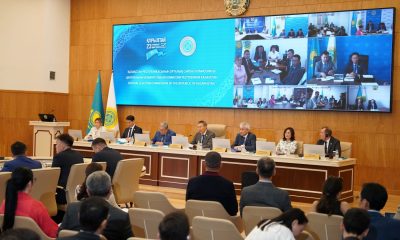
Kazakhstan: Central Election Committee reviews the results of the nomination of candidates for the deputies of Kurultai
-
South Caucasus12 hours ago
The South Caucasus at a historic turning point: Between lasting peace and renewed confrontation
-
 Aviation/airlines4 days ago
Setting a new benchmark in premium travel
-
 South Caucasus1 day ago
The security environment of the South Caucasus amid changing geopolitical realities