Frontpage
#Kazakhstan - a reliable and strong partner for the EU


EU-Kazakhstan relations are “stronger than ever” and set to strengthen further still, according to the country’s deputy foreign minister. Speaking exclusively to this website, Roman Vassilenko also said he expects talks to start soon with the EU about a visa facilitation programme with the Central Asian nation.
He told EU Reporter: “We are a reliable and strong partner for the EU and one that also provides a critical link between Asia and Europe.”
 Roman Vassilenko
The minister was speaking after the 17th EU-Kazakhstan Cooperation Committee in Brussels earlier on Wednesday. He later took part in a roundtable discussion about the meeting and relations between his country and the EU.
In the interview, he voiced optimism that the Enhanced Partnership and Cooperation Agreement (EPCA), a second generation agreement which has been in provisional force since May 2016 and has been ratified by 25 member states, will finally come into effect by the end of this year.
Three EU countries – Cyprus, Italy and the Netherlands – are still to ratify but he says he sees “no problem with this.”
Discussions about a “roadmap” for implementing the EPCA took place at the meeting in Brussels on Wednesday.
This will pave the way for full implementation of “29 areas of cooperation” across a diverse range of sectors, including trade, health, fighting terrorism and support for SMEs, said Vassilenko.
He expects the visa negotiations to start, although he accepts what he calls the “charged issue” of migration in Europe at present.
He added, “I understand the debate about migration but Kazakhstan does not pose any sort of problems in this area.”
He pointed out that annually some 100,000 Kazakh citizens travel to Europe for business, tourism and to study and a visa facilitation scheme will further enhance such “people to people” contact.
The EU is his country’s biggest trading partner and investor, accounting for 50 per cent of each, but oil makes up no less than 88 per cent of all Kazakh exports to Europe.
Since its independence, there has been $300bn foreign direct investment in his country but, again, the “lion’s share” of this went to extractive industries.
“This is why,” he said, “we are so keen to diversify our economy, trade and exports. It is also why we are increasingly promoting Kazakh exports, other than oil, abroad.”
The minister also noted that his country was in the middle of a major economic reform process which includes digitilization and expansion of its transport network. This alone has seen rail links between the landlocked nation and Europe double in the last year.
Another speaker, Luc Devigne, deputy MD for Europe and Central Asia at the EEAS, noted the current close relations, pointing to the 2,000 Kazakh students who benefit from the Erasmus programme and the 40 projects between universities in Europe and Kazakhstan.
“I would say relations are good, deep and diversified,” he told the high level forum. “We share major objectives such as fighting terrorism and climate change and illegal migration… Migration is not a problem for Kazakhstan but it is a problem in the region.”
He said the commission expects to launch this year the new Central Asia strategy that, he said, will focus on transparency in the tendering process.
“For too long the region has suffered from under investment but we want to have a positive role in Central Asia, with no hidden agenda.”
Another speaker, Latvian ALDE MEP Iveta Grigule-Peterse, chair of the DCAS in the European Parliament, focused on security issues and hailed the Kazakhs for closing its Soveit-era nuclear weapons testing site.
“EU relations with countries in the region have traditionally been very complex but they are improving significantly,” she said.
Latvian Socialist MEP Andrejs Mamikins, a foreign affairs committee member, praised Kazakhstan for its “comprehensive and structured approach” to security, tackling terrorism and “promoting social and economic values.”
He told the meeting that this was “outstanding” the country could also be seen as a “global player, pointing out that it had forged “dynamic relations” both with the EU and its neighbour Russia.
He said, “It has shown that it is possible to work with both the EU and Russia, and this is a lesson others would do well to heed.”
After its term as a non permanent member of the UN Security Council in 2017-2018, the EU sees the country as a key contributor to make relations with Central Asia stronger and deeper.
Share this article:
EU Reporter publishes articles from a variety of outside sources which express a wide range of viewpoints. The positions taken in these articles are not necessarily those of EU Reporter. Please see EU Reporter’s full Terms and Conditions of publication for more information EU Reporter embraces artificial intelligence as a tool to enhance journalistic quality, efficiency, and accessibility, while maintaining strict human editorial oversight, ethical standards, and transparency in all AI-assisted content. Please see EU Reporter’s full A.I. Policy for more information.





New migration and asylum rules enter into application: What is changing?

The Earth is accumulating heat at an accelerating rate: Global warming reached 1.37°C in 2025

EU and Republic of Korea bolster strategic partnership with new areas of cooperation

Are you prepared for the safety risks of the modern workplace?

Commission proposes €540 million in financial relief and other supports for farmers facing fertiliser crisis

EU finance ministers back EIB Group strategy for a stronger, more secure Europe in a more stable world

European Sustainable Energy Week 2026: That’s a wrap

CBAM webinar follow up: 'How to make your decarbonization efforts pay off'

Commission defends Urban Wastewater Directive against EPP-ECR challenge

The CIA director’s warning and the illusion of peace with Iran

Hands of our nature, hands off Albania

Act of Remembrance honours war dead buried in Belgium

No democracy without equality!

Going down a treat - that's Belgian wine

Azerbaijan and the emerging alliance reshaping the Middle East

Fire extinguishers and fire extinguisher stands: Are you up to date?

Kazakhstan reforms under scrutiny at Brussels Press Club round table

Japan should face up to history and contribute more to regional peace

Ambassador calls for 'speeding up' of co-operation between EU and Kazakhstan

Timur Turlov at Smart Moves Summit 2025: How chess can transform global education

Shevtsova’s case: Out-of-court sanctions dismantling trust in Ukrainian cause

The future of European transport

Trump Vs Trueman

US 'no longer' an 'unconditional ally' for Europe - MEP
-
 Asylum policy4 days ago
New migration and asylum rules enter into application: What is changing?
-
 Climate change5 days ago
The Earth is accumulating heat at an accelerating rate: Global warming reached 1.37°C in 2025
-
 South Korea5 days ago
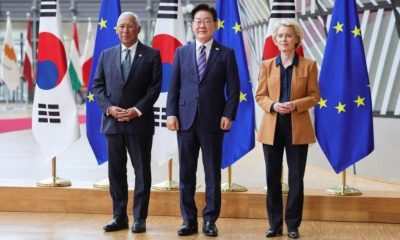
EU and Republic of Korea bolster strategic partnership with new areas of cooperation
-
 Safety4 days ago
Are you prepared for the safety risks of the modern workplace?