EU
#Italy says it won't seek fight with EU, amid talk of government crisis


The Italian government is confident it can reach a compromise with Brussels and avoid sanctions over its deteriorating public finances, the economy minister said as talk of a looming government crisis grew, write Giselda Vagnoni and Silvia Aloisi.
The European Commission wrote to Italy last week asking it to explain why its public debt rose in 2018 instead of falling as required, a move that set the stage for a possible legal clash with the ruling Eurosceptic coalition in Rome.
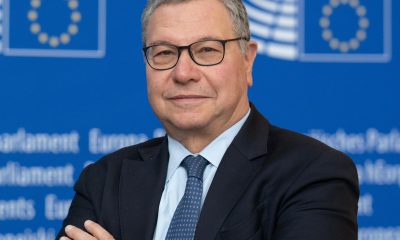
In his response to Brussels, Economy Minister Giovanni Tria (pictured) blamed an economic downturn for the rising debt and vowed to respect the EU’s fiscal rules in the next budget.
But a report in the La Repubblica daily on Sunday (2 June) said the Commission had found Tria’s letter too vague and non-committal, and was likely to take the first steps towards a disciplinary procedure this week.
Speaking to Reuters on the sidelines of a ceremony at the presidential palace in Rome on Saturday night, Tria said he believed the government could still avert such punitive measures.
“Italy does not want to clash with the European Commission, and I hope the opposite is also true, that is to say that no one in Brussels intends to engage in a fight with us,” he said.
“Our position is reasonable and I think we will eventually reach a compromise with the Commission,” he added.
He also reiterated a pledge that the 2019 budget deficit would come in below a government forecast of 2.4% of gross domestic product - a level the Commission deems too high.
Tria is a former academic with no affiliation to either of the two ruling parties governing Italy - the right-wing League and the anti-establishment 5-Star Movement, which are both backing tax cuts that would likely inflate the deficit.
The League’s anti-EU rhetoric in particular has gone up a notch after its victory in European parliamentary elections, with its chief Matteo Salvini insisting that Rome should cut taxes to boost growth, rather than abide by “obsolete” EU fiscal rules that could choke the economy.
The League won 34.3% of the vote in last week’s European elections, trouncing its coalition partner and fuelling speculation it might ditch 5-Star and seek a fresh national election at the head of a bloc of smaller conservative parties.
La Repubblica said the start of an EU disciplinary procedure against Italy this week was “almost inevitable” unless the government could come up with a convincing set of commitments to keep its rising debt and deficit in check.
The EU Commission declined to comment on Sunday, saying it would publish its views on Italy’s public finances on Wednesday.
If it says on Wednesday (5 June) that there is room to launch a disciplinary procedure that would be the first step in a drawn-out legal process that could lead to financial sanctions and a stricter oversight of the country’s fiscal policy.
Economic Commissioner Pierre Moscovici said on Sunday that he preferred dialogue to sanctions as a means to enforce the bloc’s budget rules.
“If they do not respect the rules at all, it will be necessary for the European Commission and the European states to take their responsibilities. Europe is also a co-ownership, there are rules that everyone must respect,” he said on FranceInter radio, when asked about Italy.
“For now my motto is: dialogue, dialogue, dialogue,” Moscovici said.
Rome recorded public debt of 132.2% of gross domestic product last year, up from 131.4% in 2017, the highest in the EU after Greece. Italy’s debt is also set to expand this year and next, according to the Commission’s forecasts.
Daily Il Messaggero’s front-page headline on Sunday read “Government crisis around the corner”, adding Salvini could use the fight with the EU to sink the ruling coalition, which has been in power since last year, and seek early elections.
Salvini has pledged that the government would serve its full five-year term, but a League minister told Reuters on condition of anonymity that he did not expect the executive to last another year.
Share this article:

EU Reporter publishes articles from a variety of outside sources which express a wide range of viewpoints. The positions taken in these articles are not necessarily those of EU Reporter. Please see EU Reporter’s full Terms and Conditions of publication for more information EU Reporter embraces artificial intelligence as a tool to enhance journalistic quality, efficiency, and accessibility, while maintaining strict human editorial oversight, ethical standards, and transparency in all AI-assisted content. Please see EU Reporter’s full A.I. Policy for more information.




ECR MEPs question the European Commission on cardiovascular health and diet promoting the Mediterranean diet as an alternative to ultra-processed foods as key to tackling obesity

Falling in love with the Maldives

Kurmuk gold project highlights Africa’s changing investment landscape

Albania's Vlora airport standoff tests investor confidence as EU accession clock ticks

Iran’s regime in crisis: Negotiations, internal divisions and growing resistance

EU steps up international support for Palestinians with major initiative for Gaza's early recovery and stronger international coordination

Commission adds exemptions to rules on removability of portable batteries

Commission approves French state aid to support offshore wind energy

Kazakhstan and Belgium: Building a Partnership for the Future

New court ruling questions 'proportionality' of Mayor Erion Veliaj’s detention

Rome–Washington Axis: Italian Diplomat Zanardi Landi to Help Save Bosnia

Burnham as PM? 'Wait and see'

Ban on destruction of unsold clothes and shoes enters into application

Survey on an EU Blueprint for intellectual property licensing and spinoff creation

Rule of law report strengthens EU democracy and fundamental rights

EU launches Ukraine defence industrial partnership, Drone Deal and disburses €1 billion for drones *

Kazakhstan reforms under scrutiny at Brussels Press Club round table

Japan should face up to history and contribute more to regional peace

Ambassador calls for 'speeding up' of co-operation between EU and Kazakhstan

Timur Turlov at Smart Moves Summit 2025: How chess can transform global education

Shevtsova’s case: Out-of-court sanctions dismantling trust in Ukrainian cause

The future of European transport

Trump Vs Trueman

US 'no longer' an 'unconditional ally' for Europe - MEP
-
 Italy3 days ago
ECR MEPs question the European Commission on cardiovascular health and diet promoting the Mediterranean diet as an alternative to ultra-processed foods as key to tackling obesity
-
 Tourism5 days ago
Falling in love with the Maldives
-
 China4 days ago
Kurmuk gold project highlights Africa’s changing investment landscape
-
 Albania3 days ago
Albania's Vlora airport standoff tests investor confidence as EU accession clock ticks