/media/None/YSerhan_Headshot-1/original.png)
So far, the answer has been, well, nothing. For while the EU has long been regarded (particularly by its detractors) as an entity that has become all too powerful—able to set rules that national parliaments must accept, implementing bloc-wide standards that must be adhered to—this pandemic is proving the exact opposite: that, in the face of a global crisis in which nation-states are leading the response, a multinational force such as the EU is largely powerless. As norms have been overturned to contain the coronavirus, the EU, which is built on, and gains strength from, promoting and upholding a rules-based order, has demonstrated itself incapable of keeping up.


/media/img/mt/2020/04/WebArt_Coronavirus_LOL_01/original.png)
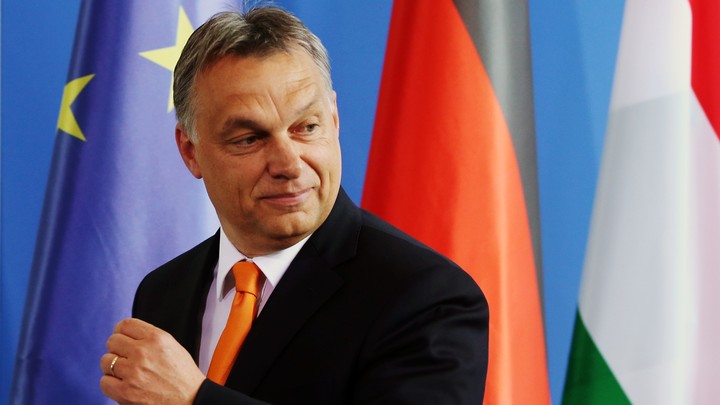
In the outbreak of the coronavirus and the disease it spreads, COVID-19—which has infected more than 950,000 people worldwide, including at least 585 people in Hungary—Orbán has found an ideal pretext for his latest power grab. Under the new emergency legislation, his far-right Fidesz party can effectively govern unchallenged, bypassing both Parliament and existing laws. It also permits the government to hand out jail terms for those deemed to be spreading misinformation. Though other countries have imposed their own emergency measures to combat the crisis, Hungary’s are among the most far reaching—and the most permanent. Though the Hungarian government insists that these measures will last only as long as the crisis does, the duration is entirely up to Orbán. After all, the emergency powers can be lifted only with the support of two-thirds of Parliament (a majority that Orbán holds).
Read: The people in charge see an opportunity
The Hungarian crisis probably couldn’t have come at a more difficult time for the EU, which, in addition to facing a huge public-health disaster, must now contend with one of its members taking advantage of the pandemic. So far, the bloc’s response has been relatively muted. European Commission President Ursula von der Leyen expressed concern about the situation in Hungary, telling reporters today that emergency measures must be proportionate to the pandemic and subject to scrutiny (a notable step up from her initial statement on the matter, in which she did not mention Hungary by name). A statement by 13 EU countries—not even a majority of the bloc’s member states—warned that such measures would risk undermining rule of law, democracy, and fundamental rights (though this statement also failed to mention Hungary specifically).
Part of the EU’s hesitation to clamp down on Hungary is political. Orbán extracts a great deal from the bloc—including money (much of which is siphoned off to his cronies). But he also benefits from Fidesz’s membership in the European People’s Party (EPP), a center-right grouping in the European Parliament that also includes German Chancellor Angela Merkel, Irish Prime Minister Leo Varadkar, and both the current and former presidents of the European Commission. The EPP has thus far been relatively reticent to punish Fidesz or Orbán, worried that isolating him politically or forcing him out, as was called for this week by Donald Tusk, the EPP leader and former European Council president, could risk hurting the group’s overall influence. “In his political family, in the EPP, there is a view that Orbán delivers a large number of votes,” Mujtaba Rahman, the managing director for Europe at the Eurasia Group, a research firm and consultancy, told me. Isolating Orbán by revoking his membership of the EPP, for example, would also go against the consensus that has governed how the EU has responded to Hungary’s democratic backsliding up to now: put simply, “to hold your enemies close,” Rahman said. “The German position has long been that we’ve got to work as a unit. Poland has been drifting, Hungary has been drifting, but ultimately they’ll come back into the European fold.”
The other options at the EU’s disposal are similarly fraught. Though the bloc could limit the amount of funding allocated to Hungary in its next long-term budget, which is currently being negotiated, that’s not so simple. For one, “the European Commission doesn’t have the relevant powers” to withhold funding unilaterally, Walshe said. It would require the support of EU heads of state and the European Parliament, which brings with it further challenges. “If you introduce a mechanism that can limit funding to Hungary or divert funding away from Hungary, other countries will be looking at that and asking, ‘Well, can that happen to me at some point in the future?” Rahman said. “And that’s where the reluctance comes in.”
A final alternative for the EU would be to begin infringement proceedings against Hungary—in other words, to take Hungary to court. The European Commission can refer the matter to the European Court of Justice, the bloc’s highest legal body, which could in turn impose financial penalties. (Previous fines have totaled up to €100,000, or about $110,000, a day.) The problem with this approach is that it takes time, by which point action may be too little, too late. “Time is on the side of the autocratic governments,” Petra Bárd, a law professor and researcher at the Central European University, which has in the past been targeted by Orbán, told me. “Once constitutional capture happens, it’s very, very difficult to undo it.”
Read: A letter from wartime France
Europe has been at the center of this health crisis, with countries such as France, Italy, and Spain struggling to cope. Yet it is undoubtedly also an existential crisis for the EU. It’s challenging, after all, to preach the values of democracy and rule of law when one of your own is openly flouting them. There is nothing to stop politicians in other EU member states, such as Italy’s Matteo Salvini—now in the opposition, but once his country’s deputy prime minister and now seeking the premiership—from thinking that they may one day be capable of doing the same. Perhaps a better question than what the EU should be doing to prevent Hungary undermining democracy, is whether the bloc is even capable of doing so.
“The EU seems to be a paper tiger,” Bárd said. “What we’ve seen in the past 10 years in Hungary is that there has been a continuous decline … I think the EU has already given up on Hungary a long time ago.”