Business
Q2 2024: Bankruptcies go up, registrations decrease


In the second quarter of 2024, the number of bankruptcy declarations of EU businesses increased by 3.1% compared with the first quarter of 2024.
At the same time, business registrations were down by 2.1% compared with the first quarter of 2024.
This information comes from data on business registrations and bankruptcies published by Eurostat today. This article presents a handful of findings from the more detailed Statistics Explained article.
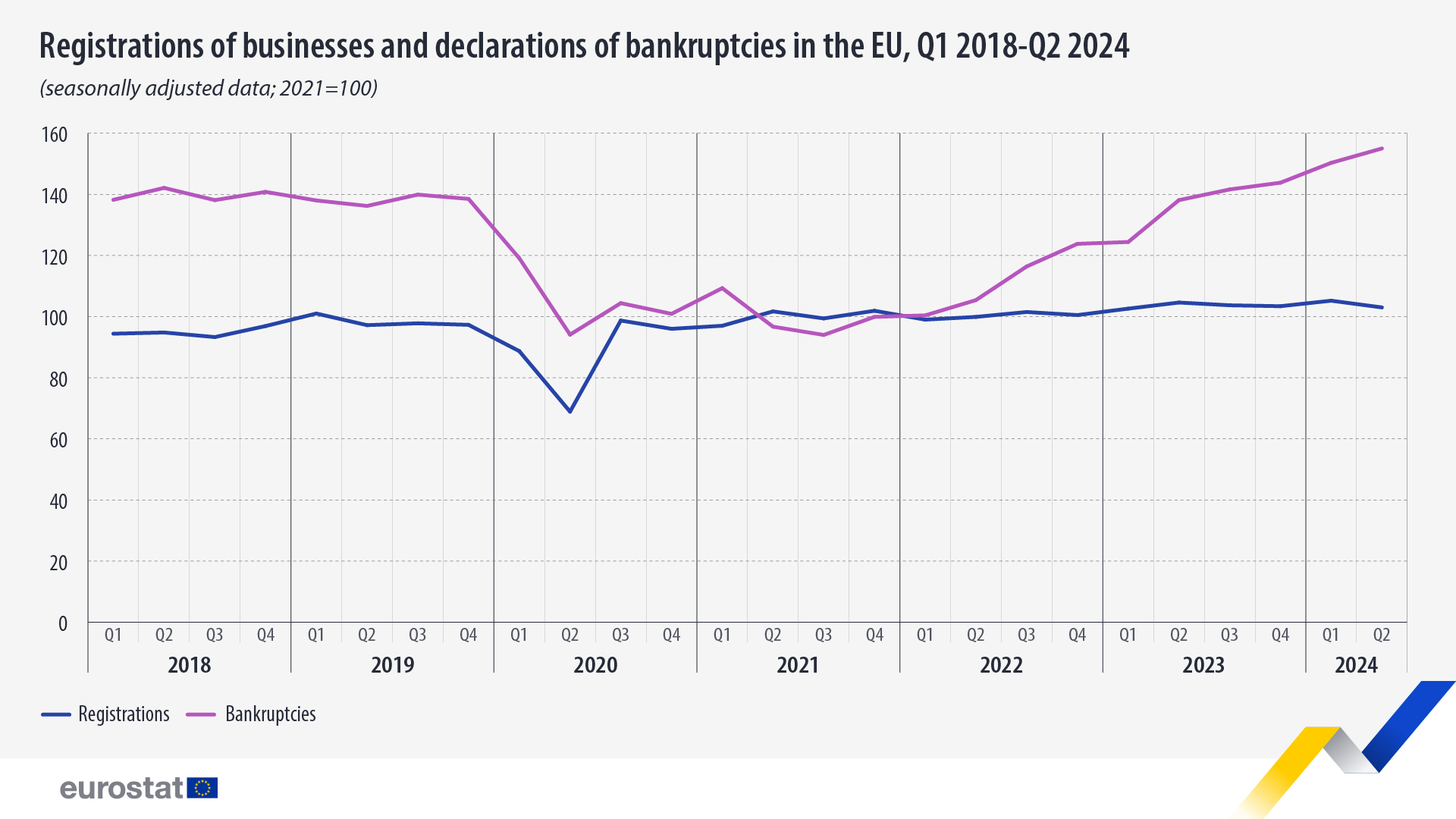
Source dataset: sts_rb_q
Business registrations decrease in all sectors
Data show that the number of business registrations went down in all sectors of the economy. When compared with the previous quarter, the highest decreases in the second quarter of 2024 were in trade (-4.7%), industry (-3.6%) and education and social activities (-3.4%). The smallest decrease was registered in financial activities (-0.7%).
Different trends across the sectors of the economy for bankruptcies
While the overall number of bankruptcy declarations increased, the individual sectors of the economy behaved differently. Compared with the previous quarter, in the second quarter of 2024, bankruptcies decreased in 4 sectors: information and communication (-4.8%), transport (-1.6%), accommodation and food services (-1.1%) and education and social activities (-1.0%). On the other hand, bankruptcy declarations increased in 4 other sectors: construction (+3.8%), financial activities (+2.6%), trade (+2.4%) and industry (+1.6%).
For more information
- Statistics Explained article on quarterly registrations of new businesses and declarations of bankruptcies
- Thematic section on short-term business statistics
- Database on short-term business statistics
Share this article:
EU Reporter publishes articles from a variety of outside sources which express a wide range of viewpoints. The positions taken in these articles are not necessarily those of EU Reporter. Please see EU Reporter’s full Terms and Conditions of publication for more information EU Reporter embraces artificial intelligence as a tool to enhance journalistic quality, efficiency, and accessibility, while maintaining strict human editorial oversight, ethical standards, and transparency in all AI-assisted content. Please see EU Reporter’s full A.I. Policy for more information.




The South Caucasus at a historic turning point: Between lasting peace and renewed confrontation

Commission endorses Latvia’s €617 million Social Climate Plan to support vulnerable households and transport users in the clean transition

Commission sends Statements of Objections to several companies and trade associations in suspected construction chemicals cartel

As Ireland chairs the EU Presidency, what impact has over fifty years of EU membership had on Ireland

Commission fines AliExpress €550 million for breaching the Digital Services Act

British political shifts and the future of UK-China ties

The Digital Markets Act Is Hurting Europeans. It’s Time to Put Progress, Free Markets, and Competition First

Become a European Commission trainee – applications are now open

Commission welcomes the Council's adoption of a renewed Interim Regulation to detect child sexual abuse online

Commission provides €1.5 billion in macro-financial assistance to Egypt

ommission preliminary finds TikTok in breach of Digital Services Act for failing to ensure safe accounts for minors

Europe’s AI crossroads: Regulation and the race to keep up

Freedom holding corp: How Kazakhstan is turning a transit corridor into a global logistics hub

Oil Coordination Group confirms no immediate supply concerns in the EU

EU adopts 21st package of sanctions against Russia

Why Vučić is stepping down

Kazakhstan reforms under scrutiny at Brussels Press Club round table

Japan should face up to history and contribute more to regional peace

Ambassador calls for 'speeding up' of co-operation between EU and Kazakhstan

Timur Turlov at Smart Moves Summit 2025: How chess can transform global education

Shevtsova’s case: Out-of-court sanctions dismantling trust in Ukrainian cause

The future of European transport

Trump Vs Trueman

US 'no longer' an 'unconditional ally' for Europe - MEP
-
 South Caucasus4 days ago
The South Caucasus at a historic turning point: Between lasting peace and renewed confrontation
-
 European Commission5 days ago
Commission endorses Latvia’s €617 million Social Climate Plan to support vulnerable households and transport users in the clean transition
-
 European Commission5 days ago
Commission sends Statements of Objections to several companies and trade associations in suspected construction chemicals cartel
-
 EU Presidency4 days ago
As Ireland chairs the EU Presidency, what impact has over fifty years of EU membership had on Ireland