Economy
Most vulnerable need fundamental shift in attitudes and service provision says Mental Health Europe


In newly published paper, Mental Health Europe (MHE) calls for social investment and comprehensive EU strategy. When dealing with the massive problem of the ever increasing poverty sweeping through Europe, it has become obvious that the so called austerity measures have perpetuated, rather than solved the economic and social crisis.
The increase of homelessness is a dramatic proof that more and more people are finding themselves in extreme precariousness and exclusion, conditions which are incompatible with the core values of the European Union - human rights, solidarity and cohesion. It is widely documented that the cuts to public spending that national governments employed in trying to speed up recovery have failed, and that more and more people are falling under the poverty line and through the increasing cracks of already overburdened health and social care systems. Unless effective access to quality services is guaranteed for all, we can only expect a further tragic deterioration of the homelessness phenomenon and the mental health issues that inevitably go with it.
On the International Day for the Eradication of Poverty (17 October), MHE called on European institutions and national governments to take an individualized approach to tackling poverty, considering the needs of the most excluded groups in society.
More than 120 million Europeans are currently living in, or at risk of, poverty. Among these, a newly published MHE position paper estimates that more than 500,000 people are homeless. MHE reports that 30% of homeless people experience mental health problems in their serious, chronic form. Thus, more than 150,000 people with severe mental health issues are homeless on the EU territory, undoubtedly experiencing the most extreme form of exclusion. Their position on the brink of society engenders a loss of trust in social care on behalf of the general public, along with high emergency services costs. For the homeless people themselves, living on the streets with no support is associated with developing mental health problems, which may even result in death. Indeed, in Denmark, homeless men were found to be 7.3 times more likely to take their own lives than the general population, and homeless women were an astonishing 14.8 times more likely to do so.
The MHE position paper identifies the lack of access to services as the root cause and enabling factor in the extreme exclusion of homeless people with mental health problems, and stigma as playing a crucial role in perpetuating rejection.
To address the issue of homelessness, MHE therefore believes that all member states, guided by European institutions, should invest in integrated, personalised, relationship-based services underpinned by a legal environment promoting human rights and equal access. A secure home and adequate income are the bases for all interventions necessary to build trust and achieve true social participation in line with the individual’s needs. Thus, user empowerment and a genuine sense of social solidarity should be underlying all measures. At EU level specifically, MHE calls for an EU Strategy on Homelessness with a comprehensive mental health perspective to strengthen the Union’s initiatives on this issue.
While engaging with the worst cases of poverty and exclusion can be daunting, systemic changes in service provision and in dealing with the most vulnerable are bound to offer valuable lessons that would help the population at large. It is high time that governments stopped looking for quick fixes and started searching for viable long-term solutions for recovery. Starting with the most vulnerable might just be the way to go!
Share this article:
EU Reporter publishes articles from a variety of outside sources which express a wide range of viewpoints. The positions taken in these articles are not necessarily those of EU Reporter. Please see EU Reporter’s full Terms and Conditions of publication for more information EU Reporter embraces artificial intelligence as a tool to enhance journalistic quality, efficiency, and accessibility, while maintaining strict human editorial oversight, ethical standards, and transparency in all AI-assisted content. Please see EU Reporter’s full A.I. Policy for more information.



Burnham as PM? 'Wait and see'

Kazakhstan: Central Election Committee reviews the results of the nomination of candidates for the deputies of Kurultai
The South Caucasus at a historic turning point: Between lasting peace and renewed confrontation

Setting a new benchmark in premium travel

The security environment of the South Caucasus amid changing geopolitical realities

Rule of law report strengthens EU democracy and fundamental rights

Survey on an EU Blueprint for intellectual property licensing and spinoff creation

Ban on destruction of unsold clothes and shoes enters into application

JoinCare Explores Scientific Exchange During Visit toJapan’s National Institute of Infectious Diseases

New episode – DGT podcast: Languages and Technology

Become a European Commission trainee – applications are now open

Commission outlines measures to strengthen Europe's banking sector and support growth

British political shifts and the future of UK-China ties
The South Caucasus at a historic turning point: Between lasting peace and renewed confrontation

As Ireland chairs the EU Presidency, what impact has over fifty years of EU membership had on Ireland

The Digital Markets Act Is Hurting Europeans. It’s Time to Put Progress, Free Markets, and Competition First

Kazakhstan reforms under scrutiny at Brussels Press Club round table

Japan should face up to history and contribute more to regional peace

Ambassador calls for 'speeding up' of co-operation between EU and Kazakhstan

Timur Turlov at Smart Moves Summit 2025: How chess can transform global education

Shevtsova’s case: Out-of-court sanctions dismantling trust in Ukrainian cause

The future of European transport

Trump Vs Trueman

US 'no longer' an 'unconditional ally' for Europe - MEP
-
 Labour4 days ago
Burnham as PM? 'Wait and see'
-
 Kazakhstan5 days ago
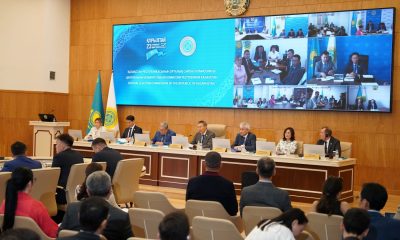
Kazakhstan: Central Election Committee reviews the results of the nomination of candidates for the deputies of Kurultai
-
South Caucasus13 hours ago
The South Caucasus at a historic turning point: Between lasting peace and renewed confrontation
-
 Aviation/airlines5 days ago
Setting a new benchmark in premium travel