Animal welfare
European Ombudsman calls for greater openness from European Chemicals Agency on animal testing


In an important ruling for openness, the European Ombudsman has issued a draft recommendation that the European Chemicals Agency (ECHA) in Helsinki should disclose all the background documents to its decisions to order particular animal tests. The request was made by the BUAV.
Under REACH, the EU chemicals legislation, companies have to get permission from ECHA before carrying out animal tests on chemicals sold at particular quantities. In 2012, ECHA accepted proposals for the animal-testing of three chemicals to assess whether they might damage people’s ability to reproduce. The BUAV was concerned that the decisions appeared contrary to REACH rules and therefore asked to see the background documents.
ECHA rejected the request, arguing that disclosing background documents would undermine its decision-making and lead to unfair lobbying of Member State representatives. Representatives would be likely to self-censor if they knew draft decisions and amendment proposals might become public. Releasing complicated material could also mislead the public. The BUAV countered that it was an insult to the scientific integrity of decision-makers to suggest they would give anything other than their honest opinion, and in any event there would be no point lobbying decision-makers after a decision had been taken.
In her draft recommendation, the European Ombudsman Emily O’Reilly has roundly rejected ECHA’s arguments. Denying the public information simply because they might not understand it could appear "overbearing and paternalistic". EU institutions release complicated documents on a daily basis, and ECHA could always publish explanations when disclosing documents. O’Reilly also said that it was ‘entirely legitimate’ for NGOs and others to seek to influence ECHA with scientific arguments, and this could indeed lead to better decision-making.
ECHA must now decide whether to accept the draft recommendation.
Dr Katy Taylor, BUAV head of science, said: "We warmly welcome the Ombudsman’s approach. The BUAV has long been concerned that ECHA does not fulfil its obligations of ensuring that animal testing under REACH only takes place as a last resort. Opening up the decision-making process is key to ensuring that it does."
The Ombudsman’s draft recommendation can be found here.
The BUAV requested three draft ECHA decisions, comments on them by companies registering the chemicals, proposals by Member States to amend the draft decisions and cover letters for the final decisions. The request was made under the EU freedom of information legislation, Regulation 1049/2001.
Share this article:
EU Reporter publishes articles from a variety of outside sources which express a wide range of viewpoints. The positions taken in these articles are not necessarily those of EU Reporter. Please see EU Reporter’s full Terms and Conditions of publication for more information EU Reporter embraces artificial intelligence as a tool to enhance journalistic quality, efficiency, and accessibility, while maintaining strict human editorial oversight, ethical standards, and transparency in all AI-assisted content. Please see EU Reporter’s full A.I. Policy for more information.



Burnham as PM? 'Wait and see'

Kazakhstan: Central Election Committee reviews the results of the nomination of candidates for the deputies of Kurultai
The South Caucasus at a historic turning point: Between lasting peace and renewed confrontation

Setting a new benchmark in premium travel

The security environment of the South Caucasus amid changing geopolitical realities

Rule of law report strengthens EU democracy and fundamental rights

Survey on an EU Blueprint for intellectual property licensing and spinoff creation

Ban on destruction of unsold clothes and shoes enters into application

JoinCare Explores Scientific Exchange During Visit toJapan’s National Institute of Infectious Diseases

New episode – DGT podcast: Languages and Technology

Become a European Commission trainee – applications are now open

Commission outlines measures to strengthen Europe's banking sector and support growth

British political shifts and the future of UK-China ties
The South Caucasus at a historic turning point: Between lasting peace and renewed confrontation

As Ireland chairs the EU Presidency, what impact has over fifty years of EU membership had on Ireland

The Digital Markets Act Is Hurting Europeans. It’s Time to Put Progress, Free Markets, and Competition First

Kazakhstan reforms under scrutiny at Brussels Press Club round table

Japan should face up to history and contribute more to regional peace

Ambassador calls for 'speeding up' of co-operation between EU and Kazakhstan

Timur Turlov at Smart Moves Summit 2025: How chess can transform global education

Shevtsova’s case: Out-of-court sanctions dismantling trust in Ukrainian cause

The future of European transport

Trump Vs Trueman

US 'no longer' an 'unconditional ally' for Europe - MEP
-
 Labour5 days ago
Burnham as PM? 'Wait and see'
-
 Kazakhstan5 days ago
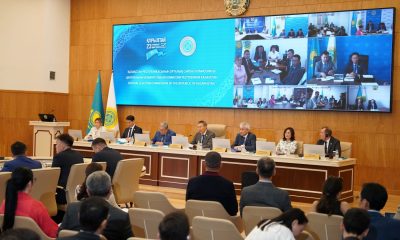
Kazakhstan: Central Election Committee reviews the results of the nomination of candidates for the deputies of Kurultai
-
South Caucasus18 hours ago
The South Caucasus at a historic turning point: Between lasting peace and renewed confrontation
-
 Aviation/airlines5 days ago
Setting a new benchmark in premium travel