Arctic
Ice melting in #Antarctic could triple sea level rise of previous century: study


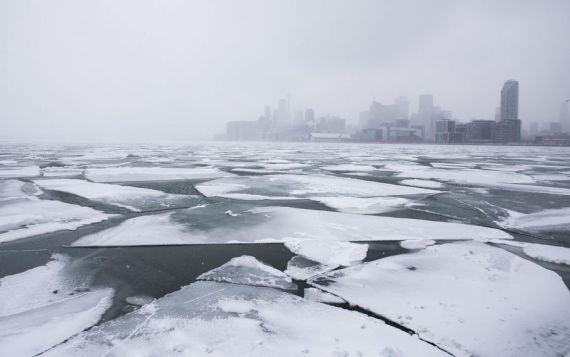 Toronto skyline is seen with floating ice on Lake Ontario in Toronto, Canada. (Xinhua/Zou Zheng)
The scientists believe that the Antarctic would now become the biggest factor in sea level rise, writes .
Within this century, ice melting in the Antarctic alone could cause the global sea level to rise up to three times as much as it did in the entire last century, the Potsdam Institute of Climate Impact Research (PIK) has announced.
“While we saw about 19 centimetres of sea-level rise in the past 100 years, Antarctic ice-loss could lead to up to 58 centimetres within this century,” said lead-author of the study Anders Levermann from the PIK and Columbia University’s Lamont-Doherty Earth Observatory (LDEO) in New York.
According to the PIK, other factors that would lead to a further rise of the sea level were the thermal expansion of the ocean water under global warming and the melting of mountain glaciers which had caused most of the sea level rise so far.
 Ice and snow are seen on the Canadian side of Niagara Falls in Ontario, Canada. (Xinhua/Zou Zheng)
The scientists believe that the Antarctic would now become the biggest factor in sea level rise, according to the study published in the journal Earth System Dynamics of the European Geosciences Union (EGU) on Friday.
“The Antarctica factor turns out to be the greatest risk, and also the greatest uncertainty, for sea-levels around the globe,” said Levermann.
Assuming a scenario with constant greenhouse gas emissions, a “very likely” range of sea level rise in this century caused by Antarctic ice melting would be between 6 and 58 centimeters.
If greenhouse gas emissions were to be “reduced rapidly”, the range would only be between 4 and 37 centimeters, according to the study.
The Antarctic ice sheet has the potential to raise global sea levels by tens of meters. “What we know for certain,” said Levermann, “is that not stopping the burning of coal, oil and gas will drive up the risks for coastal metropolises from New York to Mumbai, Hamburg or Shanghai.”
Share this article:

EU Reporter publishes articles from a variety of outside sources which express a wide range of viewpoints. The positions taken in these articles are not necessarily those of EU Reporter. Please see EU Reporter’s full Terms and Conditions of publication for more information EU Reporter embraces artificial intelligence as a tool to enhance journalistic quality, efficiency, and accessibility, while maintaining strict human editorial oversight, ethical standards, and transparency in all AI-assisted content. Please see EU Reporter’s full A.I. Policy for more information.



Energy Union Task Force takes stock of oil and gas security of supply in the EU

AIFC to host Astana Finance Days 2026 in September

ALROSA Re-elects Supervisory Board with Minimal Changes

EU launches a Team Gaza Initiative to support early recovery in Gaza with an initial amount of nearly €900 million

Public consultation on Joint Undertakings, Art. 185 initiatives, and thematic priorities for European Partnerships under Horizon Europe 28-34

Poland sees new research and changes to policies on migrant integration

NESBp: Strengthening maritime spatial planning across the North Sea and Baltic Sea

EU and South Africa kick off intergovernmental dialogue on Clean Trade and Investment Partnership

Kazakhstan seeks regional AI leadership as economic partnership with China enters new phase

Starmer’s problem? 'He is not a politician'

Why a Brussels–Nicosia–Eastern Mediterranean strategic affairs platform would benefit the European Union

Albania's Vlora airport standoff tests investor confidence as EU accession clock ticks

ECR MEPs question the European Commission on cardiovascular health and diet promoting the Mediterranean diet as an alternative to ultra-processed foods as key to tackling obesity

Kazakhstan's fixed capital investment tops 9.5 trillion tenge in H1 2026

Commission adopts simpler rules for EU agri-food promotion policy

Commission approves €659 million German state aid for four new semiconductor facilities

Kazakhstan reforms under scrutiny at Brussels Press Club round table

Japan should face up to history and contribute more to regional peace

Ambassador calls for 'speeding up' of co-operation between EU and Kazakhstan

Timur Turlov at Smart Moves Summit 2025: How chess can transform global education

Shevtsova’s case: Out-of-court sanctions dismantling trust in Ukrainian cause

The future of European transport

Trump Vs Trueman

US 'no longer' an 'unconditional ally' for Europe - MEP
-
 Energy market5 days ago
Energy Union Task Force takes stock of oil and gas security of supply in the EU
-
 Kazakhstan5 days ago
AIFC to host Astana Finance Days 2026 in September
-
 Economy4 days ago
ALROSA Re-elects Supervisory Board with Minimal Changes
-
 Gaza Strip5 days ago
EU launches a Team Gaza Initiative to support early recovery in Gaza with an initial amount of nearly €900 million