Brexit
#Brexit - 'Good Friday Agreement will be fiercely defended by the US Congress' Pelosi


Speaker of the US House of Congress Nancy Pelosi meets Jean-Claude Juncker in Brussels
Speaker of the United States Congress Nancy Pelosi fires off a statement in support of the Good Friday Agreement a day after the US National Security Adviser John Bolton’s visit to London where he met with British Prime Minister Boris Johnson, writes Catherine Feore.
Bolton said that the UK would be "first in line" for a trade deal with the US, this was in sharp contrast with Barack Obama’s statement that the UK would be at the back of the queue. Obama stressed that this was because it was more important for the US to complete a trade deal with a large bloc like the EU, rather than the smaller market the UK would represent by comparison.
John Bolton said the US supported a no-deal Brexit and suggested that the US and UK could take a "sector-by-sector" basis, looking at manufacturing and then moving in to other fields, such as agriculture and financial services. He was confident that this could be agreed on swiftly by the United States Congress.
Pelosi’s response, reiterated the commitment already made in March to the United States' continued support for a seamless border between Ireland and Northern Ireland, stating that Brexit could not be allowed to imperil the Good Friday Agreement: “The Good Friday Agreement serves as the bedrock of peace in Northern Ireland and as a beacon of hope for the entire world. After centuries of conflict and bloodshed, the world has witnessed a miracle of reconciliation and progress made possible because of this transformative accord…
“If Brexit undermines the Good Friday accord, there will be no chance of a US-UK trade agreement passing the Congress. The peace of the Good Friday Agreement is treasured by the American people and will be fiercely defended on a bicameral and bipartisan basis in the United States Congress.”
Questions have arisen over whether the sector-by-sector approach would be compatible with the World Trade Organization's (WTO) rules.
Share this article:
EU Reporter publishes articles from a variety of outside sources which express a wide range of viewpoints. The positions taken in these articles are not necessarily those of EU Reporter. Please see EU Reporter’s full Terms and Conditions of publication for more information EU Reporter embraces artificial intelligence as a tool to enhance journalistic quality, efficiency, and accessibility, while maintaining strict human editorial oversight, ethical standards, and transparency in all AI-assisted content. Please see EU Reporter’s full A.I. Policy for more information.





The South Caucasus at a historic turning point: Between lasting peace and renewed confrontation
The security environment of the South Caucasus amid changing geopolitical realities

Kazakhstan and Belgium: Building a Partnership for the Future

Commission registers two European Citizens' Initiatives on education and housing

Why the US is losing its legitimacy as a global superpower and the trust of the comity of nations

Commission sends Statements of Objections to several companies and trade associations in suspected construction chemicals cartel

Commission endorses Latvia’s €617 million Social Climate Plan to support vulnerable households and transport users in the clean transition

Rome–Washington Axis: Italian Diplomat Zanardi Landi to Help Save Bosnia

JoinCare explores scientific exchange during visit to Japan’s National Institute of Infectious Diseases

New episode – DGT podcast: Languages and Technology

Become a European Commission trainee – applications are now open

Commission outlines measures to strengthen Europe's banking sector and support growth

British political shifts and the future of UK-China ties
The South Caucasus at a historic turning point: Between lasting peace and renewed confrontation

As Ireland chairs the EU Presidency, what impact has over fifty years of EU membership had on Ireland

The Digital Markets Act Is Hurting Europeans. It’s Time to Put Progress, Free Markets, and Competition First

Kazakhstan reforms under scrutiny at Brussels Press Club round table

Japan should face up to history and contribute more to regional peace

Ambassador calls for 'speeding up' of co-operation between EU and Kazakhstan

Timur Turlov at Smart Moves Summit 2025: How chess can transform global education

Shevtsova’s case: Out-of-court sanctions dismantling trust in Ukrainian cause

The future of European transport

Trump Vs Trueman

US 'no longer' an 'unconditional ally' for Europe - MEP
-
 South Caucasus1 day ago
The South Caucasus at a historic turning point: Between lasting peace and renewed confrontation
-
South Caucasus2 days ago
The security environment of the South Caucasus amid changing geopolitical realities
-
 Belgium5 days ago
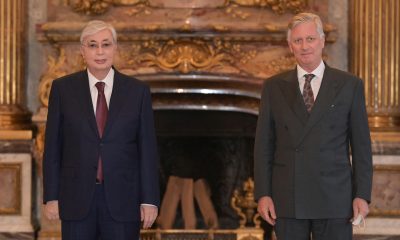
Kazakhstan and Belgium: Building a Partnership for the Future
-
 European Citizens' Initiative4 days ago
Commission registers two European Citizens' Initiatives on education and housing