EU
EU counter-terrorism chief car robbed

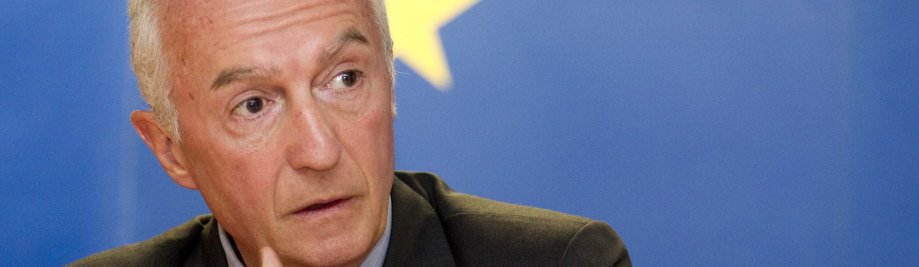
The EU's counter-terrorism chief Gilles de Kerchove (pictured) has himself become a victim of crime. The top official, whose job is to spearhead Europe's fight against Islamic terrorism, revealed that thieves smashed into his parked car in Brussels and stole a briefcase containing his diplomatic passport and two I-Pads.
But he says he was relieved was when police told him later that the briefcase had been recovered in the Bois le Cambre park, minus the I-Pads and passport but containing the “most valuable item” – his notebook.
The break-in happened after he had left his car in a Brussels street to attend an event nearby.
He told this website: “They smashed the car window and took the briefcase. Luckily, the most valuable item, my notebook, was still there when the case was later recovered. That was quite a relief, I can tell you."
He was speaking after revealing that Europol, the European police agency based in The Hague, will create a new unit next month to discover and dismantle social media accounts used by Islamist radicals to spread their message and recruit foreigners.
The unit will have about 15 officers of Europol and national police forces at first, and will be gradually enlarged over the next year.
The task is to scour the Internet for accounts set up by radicals, including those from the Islamic State, for propaganda and recruitment.
The so called European Union Internet Referral Unit (EU IRU) will grow in number and capability reaching full maturity by July 2016,
The number of Facebook, Twitter and other social media accounts connected to the Islamic State is estimated to be in the tens of thousands, the agency said, and the Twitter accounts send out as many as 100,000 posts a day.
In March, the Justice and Home Affairs Council of the European Union mandated that Europol establish such a unit to reduce the level and impact of terrorist and violent extremist propaganda on the Internet.
De Kerchove said that the EU IRU will respond to the terrorist groups which “challenge our security.”
“We have also built a constructive new partnership with relevant social media and other private companies,” he said.
“Together we will deliver a determined response to this problem affecting the safety and liberty of the internet."
Member states such as Britain, France, Belgium and Germany have been especially concerned by recruitment efforts that entice young Muslims to slip away from their families and travel to Syria or Iraq to join the Islamic State, as either fighters or wives.
“Jihadist groups, in particular, have demonstrated a sophisticated understanding of how social networks operate. They have launched well-organized, concerted social media campaigns to recruit followers and to promote or glorify acts of terrorism or violent extremism,” Europol said.
According to the agency, the EU IRU will cooperate with law enforcement authorities particularly across the EU, with the private sector and the onsite Europol Liaison Officers' network.
National governments have expressed concern that some of those Westerners who go to the Middle East to fight will return home to carry out violent attacks in the name of jihad.
Just last week in both France and Tunisia, young men proclaiming allegiance to the Islamic State carried out terrorist attacks that attracted huge publicity.
Share this article:
EU Reporter publishes articles from a variety of outside sources which express a wide range of viewpoints. The positions taken in these articles are not necessarily those of EU Reporter. Please see EU Reporter’s full Terms and Conditions of publication for more information EU Reporter embraces artificial intelligence as a tool to enhance journalistic quality, efficiency, and accessibility, while maintaining strict human editorial oversight, ethical standards, and transparency in all AI-assisted content. Please see EU Reporter’s full A.I. Policy for more information.



The South Caucasus at a historic turning point: Between lasting peace and renewed confrontation
The security environment of the South Caucasus amid changing geopolitical realities

Commission sends Statements of Objections to several companies and trade associations in suspected construction chemicals cartel

As Ireland chairs the EU Presidency, what impact has over fifty years of EU membership had on Ireland

Commission fines AliExpress €550 million for breaching the Digital Services Act

Commission endorses Latvia’s €617 million Social Climate Plan to support vulnerable households and transport users in the clean transition

EU and Portugal team up to keep brightest tech talents at home

British political shifts and the future of UK-China ties

Tokayev urges Putin to 'freeze' Ukraine war in rare public appeal for peace

JoinCare explores scientific exchange during visit to Japan’s National Institute of Infectious Diseases

New episode – DGT podcast: Languages and Technology

Become a European Commission trainee – applications are now open

Commission outlines measures to strengthen Europe's banking sector and support growth
British political shifts and the future of UK-China ties
The South Caucasus at a historic turning point: Between lasting peace and renewed confrontation
As Ireland chairs the EU Presidency, what impact has over fifty years of EU membership had on Ireland

Kazakhstan reforms under scrutiny at Brussels Press Club round table

Japan should face up to history and contribute more to regional peace

Ambassador calls for 'speeding up' of co-operation between EU and Kazakhstan

Timur Turlov at Smart Moves Summit 2025: How chess can transform global education

Shevtsova’s case: Out-of-court sanctions dismantling trust in Ukrainian cause

The future of European transport

Trump Vs Trueman

US 'no longer' an 'unconditional ally' for Europe - MEP
-
 South Caucasus3 days ago
The South Caucasus at a historic turning point: Between lasting peace and renewed confrontation
-
South Caucasus4 days ago
The security environment of the South Caucasus amid changing geopolitical realities
-
 European Commission4 days ago
Commission sends Statements of Objections to several companies and trade associations in suspected construction chemicals cartel
-
 EU Presidency3 days ago
As Ireland chairs the EU Presidency, what impact has over fifty years of EU membership had on Ireland