EU
MEPs reject Commission blacklist of states at risk of #MoneyLaundering
SHARE:

 MEPs have voted to return to the Commission its blacklist of countries deemed to be at risk of money laundering and terrorist financing. The list is too limited, and should be expanded, e.g. to include territories that facilitate tax crimes, they said before voting the resolution on Thursday (19 January).
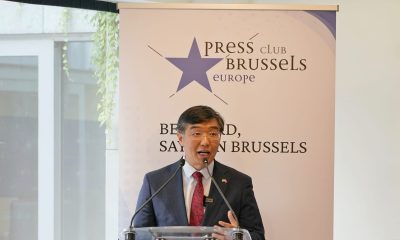
Judith Sargentini (Greens/EFA, NL) (pictured) who prepared the resolution and is a co-rapporteur on the underlying legislation, said “the strength of the vote reflects the strength of feeling in Parliament about the inadequacy of this current list. We now hope that the Commission will be more ambitious in its revisions, so as to create a blacklist which is fit-for-purpose.”
Krišjānis Karins (EPP, LV), another co-rapporteur on the underlying legislation, abstained in the vote, saying “A country should be placed on the ‘blacklist’ only when there is clear evidence of a systematic threat of money laundering and terrorist financing. The Commission needs to have a straightforward and transparent algorithm that can withstand public scrutiny.”The Commission lists eleven countries, including Afghanistan, Iraq, Bosnia and Herzegovina, and Syria, which it judges to be deficient in countering money laundering and terrorist financing. People and legal entities from blacklisted countries face tougher than usual checks when doing business in the EU.
Following the vote, an existing inventory of third countries thought to fall short in the area of anti-money laundering and terrorism finance will remain in force while the Commission considers any revisions.
More information
Krišjānis Karins (EPP, LV), another co-rapporteur on the underlying legislation, abstained in the vote, saying “A country should be placed on the ‘blacklist’ only when there is clear evidence of a systematic threat of money laundering and terrorist financing. The Commission needs to have a straightforward and transparent algorithm that can withstand public scrutiny.”The Commission lists eleven countries, including Afghanistan, Iraq, Bosnia and Herzegovina, and Syria, which it judges to be deficient in countering money laundering and terrorist financing. People and legal entities from blacklisted countries face tougher than usual checks when doing business in the EU.
Following the vote, an existing inventory of third countries thought to fall short in the area of anti-money laundering and terrorism finance will remain in force while the Commission considers any revisions.
The resolution was passed by 393 votes to 67 votes, with 210 abstentions.
More information
Share this article:
EU Reporter publishes articles from a variety of outside sources which express a wide range of viewpoints. The positions taken in these articles are not necessarily those of EU Reporter. Please see EU Reporter’s full Terms and Conditions of publication for more information EU Reporter embraces artificial intelligence as a tool to enhance journalistic quality, efficiency, and accessibility, while maintaining strict human editorial oversight, ethical standards, and transparency in all AI-assisted content. Please see EU Reporter’s full A.I. Policy for more information.






South Caucasus2 days ago
The South Caucasus at a historic turning point: Between lasting peace and renewed confrontation
South Caucasus3 days ago
The security environment of the South Caucasus amid changing geopolitical realities

European Commission3 days ago
Commission sends Statements of Objections to several companies and trade associations in suspected construction chemicals cartel

European Commission3 days ago
Commission endorses Latvia’s €617 million Social Climate Plan to support vulnerable households and transport users in the clean transition

EU Presidency2 days ago
As Ireland chairs the EU Presidency, what impact has over fifty years of EU membership had on Ireland

Digital Services Act3 days ago
Commission fines AliExpress €550 million for breaching the Digital Services Act

Horizon Europe4 days ago
EU and Portugal team up to keep brightest tech talents at home

China2 days ago
British political shifts and the future of UK-China ties

Kazakhstan6 hours ago
Tokayev urges Putin to 'freeze' Ukraine war in rare public appeal for peace

Japan2 days ago
JoinCare explores scientific exchange during visit to Japan’s National Institute of Infectious Diseases

Artificial intelligence2 days ago
New episode – DGT podcast: Languages and Technology

European Commission2 days ago
Become a European Commission trainee – applications are now open

Banking2 days ago
Commission outlines measures to strengthen Europe's banking sector and support growth
China2 days ago
British political shifts and the future of UK-China ties
South Caucasus2 days ago
The South Caucasus at a historic turning point: Between lasting peace and renewed confrontation
EU Presidency2 days ago
As Ireland chairs the EU Presidency, what impact has over fifty years of EU membership had on Ireland

Kazakhstan3 months ago
Kazakhstan reforms under scrutiny at Brussels Press Club round table

Japan7 months ago
Japan should face up to history and contribute more to regional peace

Kazakhstan8 months ago
Ambassador calls for 'speeding up' of co-operation between EU and Kazakhstan

World12 months ago
Timur Turlov at Smart Moves Summit 2025: How chess can transform global education

Ukraine1 year ago
Shevtsova’s case: Out-of-court sanctions dismantling trust in Ukrainian cause

Transport1 year ago
The future of European transport

Politics1 year ago
Trump Vs Trueman

US1 year ago
US 'no longer' an 'unconditional ally' for Europe - MEP
-
 South Caucasus2 days ago
The South Caucasus at a historic turning point: Between lasting peace and renewed confrontation
-
South Caucasus3 days ago
The security environment of the South Caucasus amid changing geopolitical realities
-
 European Commission3 days ago
Commission sends Statements of Objections to several companies and trade associations in suspected construction chemicals cartel
-
 European Commission3 days ago
Commission endorses Latvia’s €617 million Social Climate Plan to support vulnerable households and transport users in the clean transition