Circular economy
#Plastic in the ocean: The facts, effects and new EU rules


 Plastic waste in our oceans poses an environmental risk ©AP Images/European Union-EP
 Find out key facts about plastic in the ocean with infographics, as well discover their impact and how the EU is acting to reduce plastic litter in the seas.
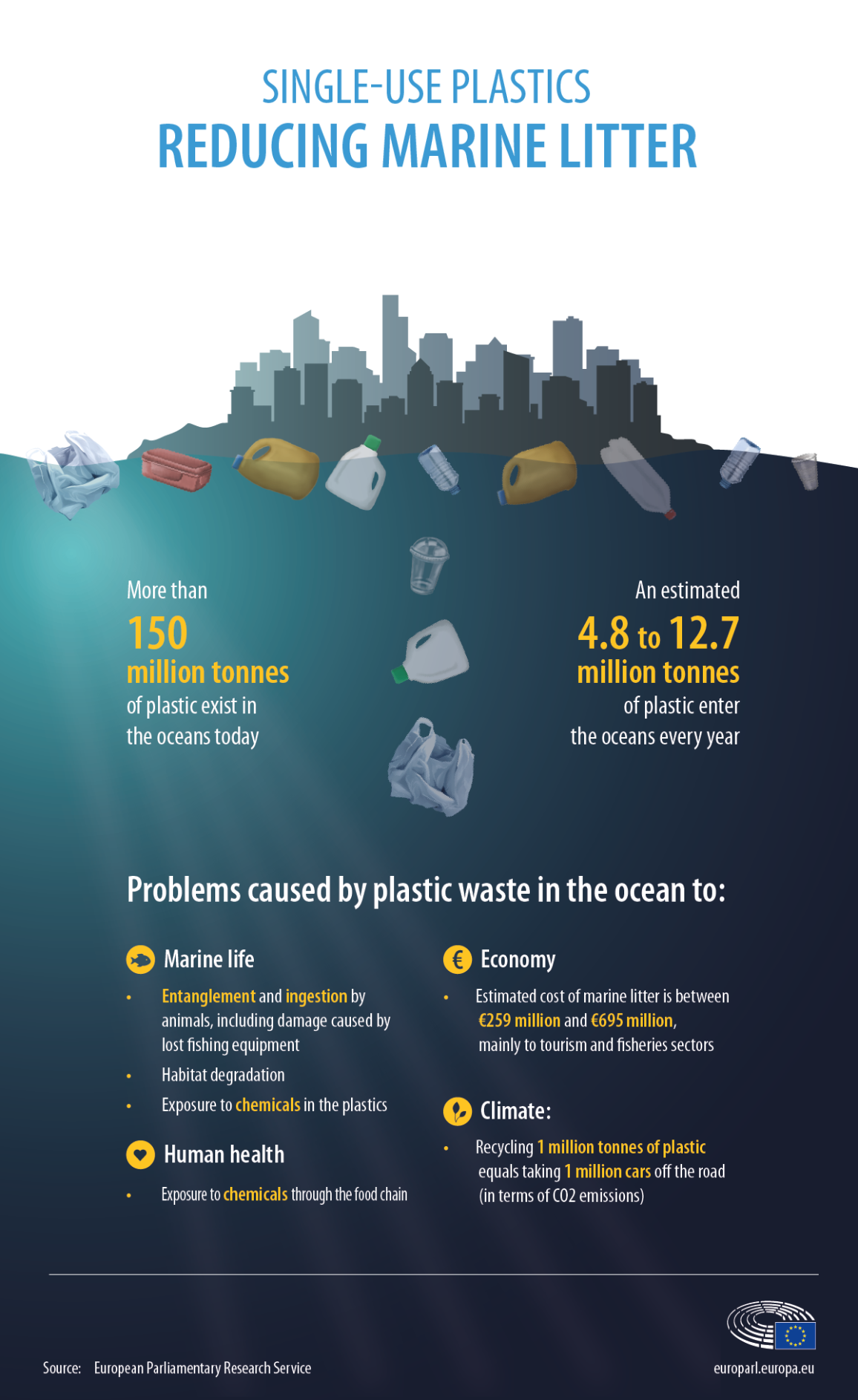
The results of today’s single-use, throw-away plastic culture can be seen on sea shores and in oceans everywhere. Plastic waste is increasingly polluting the oceans and according to one estimation, by 2050 the oceans could contain more plastic than fish by weight.
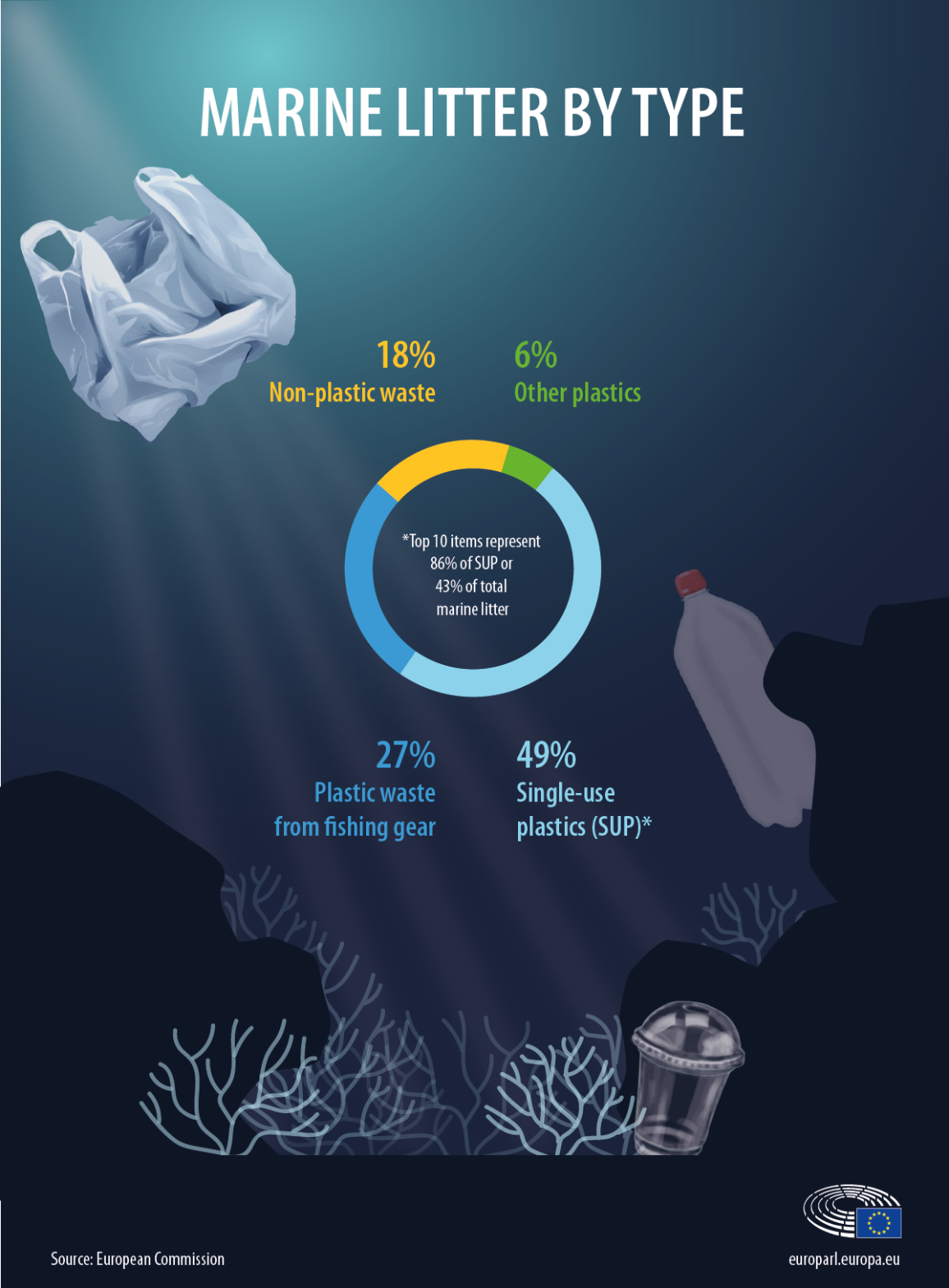
New EU rules, adopted by MEPs on 24 October, tackle lost fishing gear and the 10 single-use plastic products most widely found on European shores. Together these two groups account for 70% of marine litter.
Problem
Plastic doesn’t just make a mess on the shores, it also hurts marine animals who get entangled in larger pieces and mistake smaller pieces for food. Ingestion of plastic particles can prevent them from digesting normal food and might attract toxic chemical pollutants to their organisms.
Humans eat plastic through the food chain. How this affects our health is unknown.
Sea litter causes economic losses for sectors and communities dependent on the sea but also for manufacturers: only about 5% of the value of plastic packaging stays in the economy – the rest is literally dumped, showing the need for a approach focused more on recycling and reusing materials.
What needs to be done?
The most effective way to tackle the problem is to prevent more plastic getting in the ocean.
Single-use plastic items are the biggest single group of waste found on sea shores: products such as plastic cutlery, drink bottles, cigarette butts or cotton buds make up almost half of all sea litter.

Proposed measures
A total ban is proposed for single-use plastic items for which alternatives in other materials are already readily available: cotton buds, cutlery, plates, straws, drink stirrers and balloon sticks. MEPs also added oxo-degradable plastic products and fast food containers made out of polystyrene to the list .
For the rest, a range of other measures is proposed:
- Consumption reduction targets of 25% by 2025 for food containers and 50% by 2025 for cigarette filters containing plastic;
- obligations for producers of items such as wrappers, cigarette filters, wet wipes etcetera to cover the costs of waste-management and clean-up (so called extended producer responsibility);
- collection target of 90% by 2025 for drink bottles (for example through deposit refund systems);
- labelling requirements for sanitary towels, wet wipes and balloons to alert users to their correct disposal, and;
- awareness-raising.
For fishing gear, which accounts for 27% of sea litter, producers would need to cover the costs of waste management from port reception facilities. EU countries should also collect at least 50% of lost fishing gear per year and recycle 15% of it by 2025.
Next steps
The Council will now need to vote on its position before Parliament can start negotiations with member states.
Share this article:
EU Reporter publishes articles from a variety of outside sources which express a wide range of viewpoints. The positions taken in these articles are not necessarily those of EU Reporter. Please see EU Reporter’s full Terms and Conditions of publication for more information EU Reporter embraces artificial intelligence as a tool to enhance journalistic quality, efficiency, and accessibility, while maintaining strict human editorial oversight, ethical standards, and transparency in all AI-assisted content. Please see EU Reporter’s full A.I. Policy for more information.





EU and South Africa kick off intergovernmental dialogue on Clean Trade and Investment Partnership

Seveso - 50 years on: EU strengthens its commitment to industrial safety in a changing landscape of risk

Why young jobseekers struggle to find roles abroad that fit their expertise

Commission opens formal investigation into possible gun jumping in XXXLutz's acquisition of Porta

Farmers, fair markets and consumers: new report highlights the role of EU competition rules in agriculture

Shared commitment to advance EOSC through new EOSC Nodes and EOSC projects

Falling in love with the Maldives

ECR MEPs question the European Commission on cardiovascular health and diet promoting the Mediterranean diet as an alternative to ultra-processed foods as key to tackling obesity

STATEMENT by the Ministry of Foreign Affairs of the Republic of Kazakhstan

Kazakhstan seeks regional AI leadership as economic partnership with China enters new phase

Starmer’s problem? 'He is not a politician'

Why a Brussels–Nicosia–Eastern Mediterranean strategic affairs platform would benefit the European Union

Albania's Vlora airport standoff tests investor confidence as EU accession clock ticks
ECR MEPs question the European Commission on cardiovascular health and diet promoting the Mediterranean diet as an alternative to ultra-processed foods as key to tackling obesity

Kazakhstan's fixed capital investment tops 9.5 trillion tenge in H1 2026

Commission adopts simpler rules for EU agri-food promotion policy

Kazakhstan reforms under scrutiny at Brussels Press Club round table

Japan should face up to history and contribute more to regional peace

Ambassador calls for 'speeding up' of co-operation between EU and Kazakhstan

Timur Turlov at Smart Moves Summit 2025: How chess can transform global education

Shevtsova’s case: Out-of-court sanctions dismantling trust in Ukrainian cause

The future of European transport

Trump Vs Trueman

US 'no longer' an 'unconditional ally' for Europe - MEP
-
 South Africa5 days ago
EU and South Africa kick off intergovernmental dialogue on Clean Trade and Investment Partnership
-
 Disasters5 days ago
Seveso - 50 years on: EU strengthens its commitment to industrial safety in a changing landscape of risk
-
 Employment4 days ago
Why young jobseekers struggle to find roles abroad that fit their expertise
-
 European Commission5 days ago
Commission opens formal investigation into possible gun jumping in XXXLutz's acquisition of Porta