Brexit
#Brexit - quest for Plan B goes on

 Was that it then? Some local media are reporting that Theresa May’s efforts to push cross-party talks for a Brexit consensus are pretty much dead in the water, only a few days after she proposed them, write Mark John and Mike Dolan.
If true, that would be due in part to her refusal to budge on her red lines and in part Labour leader Jeremy Corbyn's demand that no-deal Brexit be taken off the table before he takes part. That would suggest the only game in town remains May's drive to persuade hard-line Brexiters in her own party and the Northern Irish DUP that her deal isn't that bad after all.
Speculation grew at the weekend about moves that would replace the Irish border backstop with some kind of UK-Irish treaty, but Dublin has quickly dismissed such talk. This then is the unpromising background against which May will present a "plan B".
Perhaps just as significant are two amendments which may get introduced: one that would seek to preclude a no-deal Brexit via a generous extension of Article 50; the other allowing parliament to hold a series of non-binding votes to see whether any compromise at all has the support of the majority. Suspicious Brexiteers see an ambush attempt by Remainers.
The bread-and-butter business of the European Union meanwhile goes on as usual with two ministerial meetings in Brussels today. National foreign ministers must decide how strongly to raise their concerns about DR Congo's deeply flawed election. So far it has suggested - with some understatement - that "doubts remain" on the election's credibility.
Finance ministers of the euro zone nations meet to discuss bolstering the international role of the euro and to launch the procedure to nominate a replacement to European Central Bank chief economist Peter Praet, a key post in the Bank.
The policy direction of two Nordic nations come into focus as Swedish PM Lofven delivers a statement of government policy to parliament and Norway PM Erna Solberg presents her new government.
Lofven in particular has a fine line to tread to keep his coalition allies happy - look out for a shift right in economic policy; Solberg’s presentation will be watched for significant personnel changes in key ministries, including oil and energy.
Given all the recent global growth scares, China’s latest economic health-check has been a cause for some relief.
Although full-year 2018 GDP growth in China was the slowest since 1990, the 6.4 percent annual rate of the fourth-quarter expansion – itself a near 10-year low - was in line with forecasts and December industrial and retail figures were slightly ahead of expectations.
So while there’s little gloss on the absolute numbers, they have at least assuaged some of the fears from December trade figures of a cliff-edge in activity in the final months of the year and there’s also heightened speculation of further policy stimulus to offset the slowdown. So despite weekend denials of Friday’s reports of a U.S. plan to reverse its tariffs on China, the market mood remains upbeat.
Shanghai and Hong Kong stocks were both up about 0.5%, with Tokyo and Seoul just in the black, too. China’s offshore yuan was steady near Friday’s close and the Australian dollar was also little changed.
Emerging-market currencies such as Indonesia’s rupiah, South Korea’s won and Turkey’s lira were weaker. Emerging-market equities, on the other hand, briefly hit three-month highs early on Monday. The dollar’s DXY index was lower, with the yen leading the way, as attempts to break the U.S. government shutdown failed over the weekend.
US markets were closed on Monday (21 January) for Martin Luther King Day, and trading volumes will be sapped around the world as a result. Euro/dollar was firmer against the dollar despite a sub-forecast German producer price report for December and as traders eye this week’s European Central Bank meeting and stepped-up European earnings season. European stock futures were down about 0.3% first thing.
Sterling backed off further from last week’s two-month highs as UK PM Theresa May is expected to deliver her 'Plan B' on how to proceed with Brexit after her withdrawal agreement with the European Union was heavily defeated in parliament last Tuesday (15 January).
Cross-party talks on the next steps appear to have failed over the weekend, with traders now eyeing today’s statement to parliament, possible amendments to rule out a “no deal” exit from the bloc and even reports on government attempts to re-open the backstop agreement on the Irish border.
Share this article:

EU Reporter publishes articles from a variety of outside sources which express a wide range of viewpoints. The positions taken in these articles are not necessarily those of EU Reporter. Please see EU Reporter’s full Terms and Conditions of publication for more information EU Reporter embraces artificial intelligence as a tool to enhance journalistic quality, efficiency, and accessibility, while maintaining strict human editorial oversight, ethical standards, and transparency in all AI-assisted content. Please see EU Reporter’s full A.I. Policy for more information.





Kazakhstan seeks regional AI leadership as economic partnership with China enters new phase

Setting a new benchmark in premium travel

Survey on an EU Blueprint for intellectual property licensing and spinoff creation

Burnham as PM? 'Wait and see'

Rule of law report strengthens EU democracy and fundamental rights

Statement by the Ministry of Foreign Affairs of the Republic of Kazakhstan

Kazakhstan and Belgium: Building a Partnership for the Future

Kazakhstan: Central Election Committee reviews the results of the nomination of candidates for the deputies of Kurultai

Commission sends Statements of Objections to several companies and trade associations in suspected construction chemicals cartel

Commission endorses Latvia’s €617 million Social Climate Plan to support vulnerable households and transport users in the clean transition

Commission fines AliExpress €550 million for breaching the Digital Services Act

Astana Hub unveils infrastructure to support AI innovation in health care

The security environment of the South Caucasus amid changing geopolitical realities

Why the US is losing its legitimacy as a global superpower and the trust of the comity of nations

Commission launches EU-Ukraine Drone Alliance to boost drone and counter-drone technology

EU and Portugal team up to keep brightest tech talents at home

Kazakhstan reforms under scrutiny at Brussels Press Club round table

Japan should face up to history and contribute more to regional peace

Ambassador calls for 'speeding up' of co-operation between EU and Kazakhstan

Timur Turlov at Smart Moves Summit 2025: How chess can transform global education

Shevtsova’s case: Out-of-court sanctions dismantling trust in Ukrainian cause

The future of European transport

Trump Vs Trueman

US 'no longer' an 'unconditional ally' for Europe - MEP
-
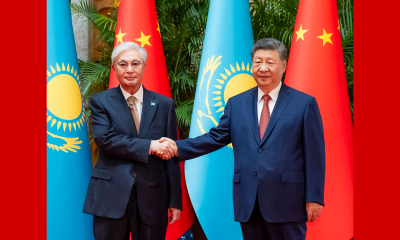 China5 days ago
Kazakhstan seeks regional AI leadership as economic partnership with China enters new phase
-
 Aviation/airlines3 days ago
Setting a new benchmark in premium travel
-
 Intellectual Property Rights3 days ago
Survey on an EU Blueprint for intellectual property licensing and spinoff creation
-
 Labour3 days ago
Burnham as PM? 'Wait and see'