Belgium
Belgium in the front line to reconstruct foreign policy of EU

On Thursday, 30 July, a court in Antwerp, Belgium held the second preliminary hearing on the case of Assadollah Assadi, the clerical regime’s diplomat, who, was in the process of carrying out the terrorist bombing of the major gathering of Iranians on 30 June, 2018 in Villepinte, Paris. Along with Assadi, his three accomplices Amir Saadouni, Nasimeh Naami and Mehrdad Arefani will be tried too, writes Ali Bagheri.
The three-judge panel referred the case of the four jailed terrorists to the Antwerp Special Counter-Terrorism Branch. This marked the completion of the preliminary stages of the trial of Assadi and his accomplices, which the Iranian regime had spared no effort to prevent from happening. The trial will begin on 27 November, 2020.
Earlier on 15 July, the first session of the court upheld the indictment of the federal prosecutor against these terrorists, and agreed with the request of the federal prosecutor to put Assadi and his accomplices on trial on two charges of "attempted terrorist act with intention of murder" and "participation in a terrorist group.” This is the first time that a diplomat in Europe is being prosecuted for direct involvement in terrorism.
Iran protests put the clerics at gunpoint
The clerical regime in Tehran, is in a crippling situation inside and outside the country. December 2017 and Nov 2019 uprisings forced the regime to cut down the Internet for 1 week and also reports show the regime has killed at least 1,500 unarmed protesters. These protests completely destroyed Iranian regime legitimacy inside the country.
Recently, the Iranian regime has sentenced several of detainees with death penalty. Such an action received a huge opposition in social media to stop execution in Iran. Following these massive campaigns and rallies of Iranians in US, and EU countries, the Iranian regime step back and has postponed these verdicts until now.
Trump wants the Iranian regime on its knees
The US sanctions which were imposed after the decision of US president, Donald Trump, to pull out of Iran Nuclear Deal confronted the Iranian regime with a critical situation. According to Reuters, Iran’s oil export has dropped below 100,000 barrels per day. Iran was exporting more than 2 million barrels per day after JCPOA which lifted oil sanctions on Iran. Consequently, Iran GDP has shrieked by 7.6% in the first 9 months of 2019/20. It has also caused the Iran currency, Rial, to plunge drastically, each USD is more valuable than 230,000 Rials now.
EU must pay a lot to keep the same policy towards Iran
The prosecution of the Iranian diplomat for terrorist activities can disperse the limited number of voices who try to keep financial and political bonds with this regime. In fact, Belgium is going to play a historical role in EU foreign policy. The outcome of Assadollah Assdid terrorism can lead to several scenarios that each of them is a milestone away from what we observe today.
In summary, France expelled Iranian ambassador and another member of the Iran embassy in Paris. Albania, the country that hosts MEK, the main opposition group, has expelled the Iran ambassador and several embassy charge d’affaires for their activities in terror plots. Netherlands has expelled 2 other Iranian diplomats. All these has happened since 2018.
The EU policy since the past decades promotes the Iranian regime key points and the so-called moderate parties, president Hassan Rohani and the FM Javad Zarif, are well known figures of the so-called moderates in Iran. Ironically, they made a dreadful record in executions and human right violations.
The trial of Assadollah Asadi is getting more important when we have a look on the other side of the case. The National Council of Resistance of Iran provided documents to the court which shows Asadi received his orders directly from the ministry of Intelligence and security (MOIS) and he was the head of MOIS in Europe. In addition, he is directly working under the directives of the ministry of foreign affairs of Iran. Consequently, his conviction in the Belgium court will also impact two major ministries of Iran which are part of the state. Therefore it can lead to designate the Iranian regime not just as a state sponsor of terrorism, but as a terrorist state which has its own consequences.
Firstly, all of the privileges and resources that the regime relies on to carry out its terrorist acts in Europe must be taken away from it. The regime's embassies must be closed. Annual report released in June 2019, the Federal Office for the Protection of the Constitution of Germany (BfV) said: "In Germany, the headquarters of the Ministry of Intelligence at the Iranian embassy in Berlin plays an important role in intelligence operations. In addition to independent intelligence operations, this agency also supports activities undertaken by the Ministry of Intelligence [in Tehran]."
Secondly, the front companies, cultural and educational centers, religious associations and so-called mosques that are funded and supported by the Iranian regime are all centers that sustain the regime's espionage and terrorist activities, and so they must be exposed and closed down.
Next, the regime's agents and operatives who function under the cover of commercial, cultural, or religious activities, or pretend to be journalists or opponents, refugees, or citizens, must be expelled from European countries.
These actions will significantly impact the criminal network of a terrorist state which are permitted to work legally even now. In addition, these are needed to guarantee if EU can protect its boarders and its residents from a terrorist state which uses all its assets to conduct terrorism. As it is stated by Claude Moniquet, co-founder and CEO of the European Strategic Intelligence and Security Center, terrorism when it comes to the Iranian regime in foreign policy is not an accident but a method.
Europe seeks a new approach
Until today we have observed an appeasement approach towards Iran. Despite a massive human right violation, massive interference of the Iranian regime in the region, still EU countries do not want to mess up things with Iran. They try to support moderate voices and bring the regime to the negotiation table for several times. However, the terrorist case in Antwerp court can change the known policy for the past 40 years. Western governments, in order to protect their security and intelligence services must prevent from communicating or contacting the regime's notorious Intelligence Ministry or its Qods Force, an exchange that only facilitates the entry of the regime's agents into Europe.
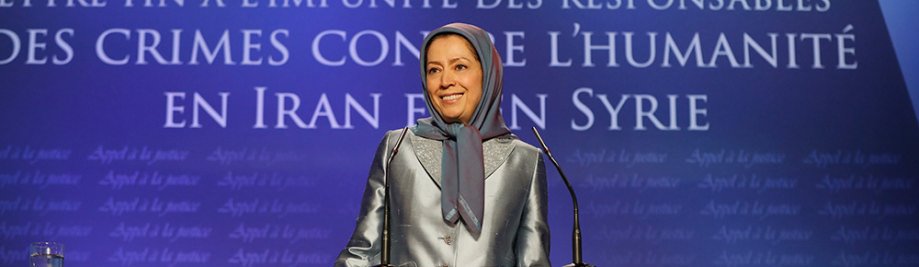
Maybe the time has arrived for EU to start recognition and supporting the National Council of Resistance of Iran (NCRI) and its President-elect, Maryam Rajavi (pictured), whose 10 point plan guarantees a democratic shift in Iran and also many Islamic states in the region. The lady that the Iranian regime sought to assassinate her and some of the most prominent American and European officials in attendance in the Villepinte gathering leads the strongest opposition movement against the Iranian regime and seeks for democracy, freedom and secularism in Iran, the values that no one disagrees in Europe.
All opinions expressed in the above article are those of the author alone, and do not represent the opinions of EU Reporter.
Share this article:

EU Reporter publishes articles from a variety of outside sources which express a wide range of viewpoints. The positions taken in these articles are not necessarily those of EU Reporter. Please see EU Reporter’s full Terms and Conditions of publication for more information EU Reporter embraces artificial intelligence as a tool to enhance journalistic quality, efficiency, and accessibility, while maintaining strict human editorial oversight, ethical standards, and transparency in all AI-assisted content. Please see EU Reporter’s full A.I. Policy for more information.





Bangladeshis waking up to reality of Yunus government

What the latest data reveals about labour market imbalances across Europe

From imitation to leadership: The production-based rise of Japan and China

Copernicus: Europe’s air quality improves despite persistent pollution episodes

Commission approves €402 million Spanish state aid for road transport companies facing increased fuel prices

Ensuring fairness and safety: €3 customs duty for low-value parcels

EU delivers emergency aid and organises a humanitarian flight in response to earthquakes in Venezuela

European Inventor Award 2026 winners announced: Honouring the innovators shaping tomorrow

Kyrgyzstan launches Tamchy SFIT: a new international jurisdiction as a gateway to Eurasia

Kazakhstan’s dombyra: the two-stringed instrument that carries the soul of the steppe

Europe must double down on nuclear progress to achieve its long-term ambitions

Solana Company Partners with Kazakhstan on $6B Alatau Crypto Megacity

Astana's congress of world religions: A global platform for dialogue in an age of division

How Schuman lost Its way

Rating of American Express casino sites in the UK

PMI defends AI consultation tool as scrutiny grows over EU tobacco rules review

Kazakhstan reforms under scrutiny at Brussels Press Club round table

Japan should face up to history and contribute more to regional peace

Ambassador calls for 'speeding up' of co-operation between EU and Kazakhstan

Timur Turlov at Smart Moves Summit 2025: How chess can transform global education

Shevtsova’s case: Out-of-court sanctions dismantling trust in Ukrainian cause

The future of European transport

Trump Vs Trueman

US 'no longer' an 'unconditional ally' for Europe - MEP
-
 Bangladesh4 days ago
Bangladeshis waking up to reality of Yunus government
-
 Employment4 days ago
What the latest data reveals about labour market imbalances across Europe
-
 China4 days ago
From imitation to leadership: The production-based rise of Japan and China
-
 Air quality4 days ago
Copernicus: Europe’s air quality improves despite persistent pollution episodes