EU
#EAPM: Post-Digital Day initiative on health data backed by Commission


The landmark Declaration on data for health-care purposes, signed at the European Commission’s recent Digital Day 2018, is a key part of a major Communication on enabling the digital transformation of health and care while empowering citizens and building a healthier society, writes European Alliance for Personalised Medicine (EAPM) Executive Director Denis Horgan.
Digital Day 2018, held in conjunction with the Bulgarian EU Presidency, saw 15 countries sign a Joint Declaration to collaborate on a groundbreaking one-million genomes project.
In front of high-level stakeholders in the fields of digital technology and telecommunication, representatives of member states co-signed the Declaration indicating political support for linking existing and future genomic databanks.
This will work on a voluntary basis with the goal of making a cohort of one million sequenced genomes accessible in the EU by 2022.
The Brussels-based European Alliance of Personalised Medicine originally floated the idea under the banner of MEGA - Million European Genomes Project - and with the leadership of DG CONNECT, the idea has gathered support and pace.
EAPM Co-Chairman and former commissioner for Health and Consumer Protection David Byrne said: “It is necessary to federate the stakeholders and collaboration is essential.”
He added: “It isn’t just the sequencing, but it is also necessary to do the research on the outcome of the MEGA project, converting it into medical information to provide good medical outcomes for the patients and citizens of the European Union.
“Not only can we do it, we must do it,” Byrne added.
On governance, Byrne said that there has to be a public institution heading the project that is accountable to the public.
The European Commission understands that data-driven innovation is a key enabler of market growth, job creation, particularly for SMEs and startups, and the development of new technologies. It allows citizens to easily access and manage their health data, and allows public authorities to use data better in research, prevention and health system reforms.
Health and Food Safety Commissioner Vytenis Andriukaitis said: “Our proposals make use of the full potential of digital technologies to improve healthcare and medical research. This will lead to easier access to health data, which will lead to better disease prevention and patient-centred care, rapid responses to pandemic threats, and improved treatments.”
Commission Vice President for the Digital Single Market Andrus Ansip said: "The Digital Single Market is rapidly taking shape…Technologies can help us to improve healthcare and education, transport networks and make energy savings: this is what the smart use of data is all about."
Meanwhile, Digital Economy and Society Commissioner Mariya Gabriel added: "We are pursuing an ambitious plan, the Digital Single Market Strategy, to make sure that we are in the best possible position to help our businesses, provide top-class research, and protect EU citizens.”
The Commission says its proposals will build on the General Data Protection Regulation (GDPR), which will enter into force as of 25 May.
Among other matters, the EU Executive is setting out a plan of action that puts citizens first when it comes to data on citizens' health: by securing citizens' access to their health data and introducing the possibility to share their data across borders; by using larger data sets to enable more personalised diagnoses and medical treatment, and better anticipate epidemics; and by promoting appropriate digital tools, allowing public authorities to better use health data for research and for health system reforms.
The proposal also covers the interoperability of electronic health records as well as a mechanism for voluntary coordination in sharing data – including genomic data – for disease prevention and research.
Personalised medicine is an emerging approach that uses data generated by new technologies to better understand the characteristics of an individual and deliver the right care to the right person at the right time.
New technologies enable a wider use of genomic and other information (such as molecular profiling, diagnostic imaging, environmental and lifestyle data) to help doctors and scientists better understand disease and how to better predict, prevent, diagnose and treat.
The Commission points out that several national and regional initiatives already support the pooling of genomic and other health data to advance research and personalised medicine.
It adds that ensuring interoperable standards for genomic and other data is also critical for an effective sharing of datasets.
The Commission intends to support the pooling of the EU's data resources and to facilitate their use for research and health policy. It says it intends to step up coordination between authorities across the EU to implement the secure exchange of genomic and other health data in order to advance research and personalised medicine.
By combining sequenced genomic data and other medical data, physicians and researchers can get a better picture of disease in a particular individual and determine the most appropriate treatment for that individual.
This should be based on a transparent system of governance, with the aim of linking national and regional banks of “-omics” data, biobanks and other registries across the EU.
The initial goal of this co-ordination, the Commission says, is to provide access to at least one million sequenced genomes in the EU by 2022, and then to a larger prospective population-based cohort (beyond sequenced genomes) of at least 10 million people by 2025.
The Commission adds that additional funding might be considered under the next EU multi-annual financial framework to more closely link existing European resources to a world-leading health data and computation infrastructure able to effectively support scientific research and personalised medicine.
It says it will, while ensuring full compliance with data protection legislation and ethical principles, set up a mechanism for the voluntary coordination of authorities and other stakeholders to share data and infrastructure for prevention and personalised medicine research. This includes a European network on genomics, and seeking to link also with ongoing '-omics' and human cell mapping initiatives.
It will also support the development of technical specifications for secure access and cross-border exchange of genomic and other health datasets within the internal market for research purposes. This is to allow the interoperability of relevant registries and databases in support of personalised medicine research.
On top of this, it will launch pilot actions, pooling data and resources across the EU, to demonstrate the benefits of advancing research, disease prevention, personalised medicine, health technology assessment, as well as clinical and regulatory decision making.
EAPM Executive Director Denis Horgan said: “Our MEGA initiative has gained enthusiastic backing and much of what we have jointly achieved could not have been done without excellent support from the Commission.”
Share this article:
EU Reporter publishes articles from a variety of outside sources which express a wide range of viewpoints. The positions taken in these articles are not necessarily those of EU Reporter. Please see EU Reporter’s full Terms and Conditions of publication for more information EU Reporter embraces artificial intelligence as a tool to enhance journalistic quality, efficiency, and accessibility, while maintaining strict human editorial oversight, ethical standards, and transparency in all AI-assisted content. Please see EU Reporter’s full A.I. Policy for more information.



Burnham as PM? 'Wait and see'

Kazakhstan: Central Election Committee reviews the results of the nomination of candidates for the deputies of Kurultai
The South Caucasus at a historic turning point: Between lasting peace and renewed confrontation

Setting a new benchmark in premium travel

The security environment of the South Caucasus amid changing geopolitical realities

Rule of law report strengthens EU democracy and fundamental rights

Survey on an EU Blueprint for intellectual property licensing and spinoff creation

Ban on destruction of unsold clothes and shoes enters into application

JoinCare Explores Scientific Exchange During Visit toJapan’s National Institute of Infectious Diseases

New episode – DGT podcast: Languages and Technology

Become a European Commission trainee – applications are now open

Commission outlines measures to strengthen Europe's banking sector and support growth

British political shifts and the future of UK-China ties
The South Caucasus at a historic turning point: Between lasting peace and renewed confrontation

As Ireland chairs the EU Presidency, what impact has over fifty years of EU membership had on Ireland

The Digital Markets Act Is Hurting Europeans. It’s Time to Put Progress, Free Markets, and Competition First

Kazakhstan reforms under scrutiny at Brussels Press Club round table

Japan should face up to history and contribute more to regional peace

Ambassador calls for 'speeding up' of co-operation between EU and Kazakhstan

Timur Turlov at Smart Moves Summit 2025: How chess can transform global education

Shevtsova’s case: Out-of-court sanctions dismantling trust in Ukrainian cause

The future of European transport

Trump Vs Trueman

US 'no longer' an 'unconditional ally' for Europe - MEP
-
 Labour4 days ago
Burnham as PM? 'Wait and see'
-
 Kazakhstan5 days ago
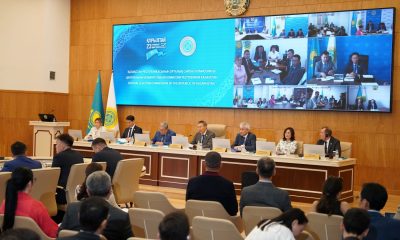
Kazakhstan: Central Election Committee reviews the results of the nomination of candidates for the deputies of Kurultai
-
South Caucasus14 hours ago
The South Caucasus at a historic turning point: Between lasting peace and renewed confrontation
-
 Aviation/airlines5 days ago
Setting a new benchmark in premium travel