Business
EU urged to engage 'positively' on road towards a 'smoke-free future'


Tobacco giant Philip Morris International (PMI) contributes as much to Europe’s economy as some EU member states. It provides employment for tens of thousands of people and ploughs millions into R&D. And yet one of its own senior bosses concedes that some still “do not like” the company. This was one of the reasons why PMI commissioned a major independent study to demonstrate its added value to the EU economy.
The findings were announced at a conference in Brussels on 17 September. The event was particularly timely as it comes in the wake of a speech a few days earlier in Brussels by former European Central Bank (ECB) President Mario Draghi, who criticised the EU for its slow progress in implementing recommendations from his competitiveness report issued a year ago.
Draghi’s focuses on boosting competitiveness, something PMI insists it is significantly contributing to with its fresh focus now shifting away from conventional cigarettes.
Draghi, in his speech, said Europe, one year after his report, is now in a worse position, with a stagnating growth model, mounting vulnerabilities, and no clear plan to fund essential investments.
A separate assessment showed that only one of the ten recommendations in the so-called Draghi Report has been implemented so far — an implementation rate of just 11.2 per cent.
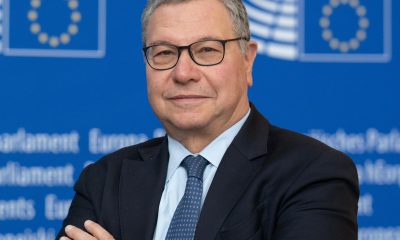
Massimo Andolina, PMI President Europe Region (pictured), the keynote speaker at the conference, admitted that some “still do not like us.”
But he added, “You don’t necessarily have to like us.”
As an example of the move from tobacco to smoke-free products, he cited the transition from diesel to environmentally friendly electric cars.
“People can get stuck in their habits, so they need to be persuaded to use smoke-free products just as they might need to be persuaded to abandon diesel cars.”
“But,” he went on, “the fact is that people today still like to smoke, and they deserve better alternatives.
“Even if you don’t like us, you should be informed about what we are doing and the positive impact we are having.”
PMI embarked on a “10-year journey” to transition to smoke-free products, he noted, but “too many people still do not know about what we are doing.”
An estimated 110 million people in Europe still “consume” nicotine but, while ten years ago most of these were traditional smokers, about half now use smoke-free products instead.
“We are doing it in the right way, including by creating investment and jobs and through the development of intellectual property: all the things that will make the EU more competitive” said Andolina, referencing the Draghi report.
He added, “So, even if you do not like us, I say look at our figures and what we do.”
Andolina went on, “Mr Draghi says we must decarbonise the economy while still keeping it competitive and, at PMI, this is what we are doing while, at the same time, generating jobs and contributing no less than nearly 0.4percent of EU GDP.”
In a short Q&A that followed his speech, Andolina noted that, globally, more than 40 per cent of his company’s revenues now come from smoke-free products, adding, “This is an enormous achievement and is also testimony to what we are doing and that this is real.”
In fact, he said such revenues were even higher in Europe – 46 percent – and in some countries had reached as high as 80 percent.
When asked for a timeline on phasing out cigarettes, he replied, “We are doing whatever it takes to make this happen as fast as possible, but we cannot do it alone.
“A number of obstacles are being put on our path.”
He cited, as an example, the recent French decision to ban nicotine pouches from next April.
Andolina is critical of this, saying, “This decree will ban what is potentially one of the best and safest products,ie, tobacco pouches.”
He referenced Sweden, where smoke-free products such as pouches are widely used, as evidence, stating, “It now has the lowest incidence of smoke-related disease in Europe.”
He added, “If you ban such products, you are doing something that is not good for your citizens or for their health, and you are also putting a massive obstacle in front of us by limiting what is offered to citizens who are, in effect, left with just smoking cigarettes.”
He said, “That is why, on this issue, I hope that wisdom will prevail.”
Looking to the future, he said, “I am confident that in 10 years from now we will see a significant number of new countries where we do not sell cigarettes. We are committed to this.”
With governments receiving about € 38 bn in taxes from PMI, he was also asked if this created a dependency on tobacco revenues.
On this, he said, “There are some countries in Europe, such as Italy and Greece, where you see that you can move away from traditional smoking products to smoke-free products without affecting tax revenues. This is the model to follow, so yes, it can be done.”
He said that in order to be more competitive, Europe needs to engage in “constructive dialogue” and the private sector must “step up.”
He stressed that nicotine itself isn’t the main cause of smoking-related illness — the real harm comes from the burning of tobacco. Still, he admitted that, like any business, their work has both “good and bad sides,” adding: “In our case, the negative was the health impact of traditional cigarettes.”
He emphasised, however: “We are working to increase the positives (non-tobacco products) and reduce the negatives (cigarettes).”
On the issue of tobacco taxation, he said, “While it is business that creates wealth, it is governments that can create good conditions for that wealth,” adding, “So, we need to strike a good balance. I am happy to see the EU recognises that smoke-free products are different and, as such, should be taxed differently, and I agree to work on how much this difference should be.”
Another speaker was Bart Deckers, a partner in EY-Parthenon, the company that carried out the exhaustive study, called “Economic Footprint of Philip Morris International Inc. in the EU”.
He explained that it covered a five-year period up to 2023 and showed that PMI plays a “significant” role as a “contributor to the broader economic and social capital across the EU.”
The study, a “comprehensive” overview encompassing 27 EU countries, focused on three issues: PMI’s economic, social and cognitive contributions.
Its business activities illustrate, he said, a “broad and sustained” engagement with EU economic infrastructure. The company supported 21,488 jobs direct and a further 80,437 indirectly, with its wage bill amounting to some € 51.45 billion over the 5-year cope of the study.
The report shows that some € 19.6 bn has been invested in SME suppliers and €2.3bn invested in R&D in Europe, leading to €33bn in EU exports and a total economic footprint of about € 290 bn.
He heralded the company’s “substantial” investment in R&D and training, adding that had provided some 2.5m training hours globally.
Deckers told the audience, “These numbers demonstrate long-term commitment to innovation and workforce capability building together with a transition towards a science-based business model.”
The study said that from 2019 to 2023 the company had contributed some €289billion to the EU economy (€65.8bn in 2023 alone), which is comparable to several midium sized member states.
“This,” he added, “underscores its focus on transformation and innovation.
“The study paints a picture of a company which is embedded in the EU economy – which is why we call it a footprint study – and one which continues its transformation towards a smoke free future.”
Deckers also noted Draghi’s recent comments about the key role of companies in the EU economy, adding, “It needs to be made clear that PMI, and other companies, are at the heart of the EU economy and should ensure we cherish the value they bring to the economic ecosystem.”
When asked in the Q&A about the objectivity of the study, he insisted it was “factual, neutral and provides a well-founded insight.”
He said, “We applied only market-proven methodology and neutral data that was externally sourced, from sources such as the OECD, country-level and industry reports, as much as possible.”
“For some things you do need to use internal data, but I might point out that the scope of this study was not a full audit and, as with all such things, thereare always some limitations.”
Share this article:
EU Reporter publishes articles from a variety of outside sources which express a wide range of viewpoints. The positions taken in these articles are not necessarily those of EU Reporter. Please see EU Reporter’s full Terms and Conditions of publication for more information EU Reporter embraces artificial intelligence as a tool to enhance journalistic quality, efficiency, and accessibility, while maintaining strict human editorial oversight, ethical standards, and transparency in all AI-assisted content. Please see EU Reporter’s full A.I. Policy for more information.




ECR MEPs question the European Commission on cardiovascular health and diet promoting the Mediterranean diet as an alternative to ultra-processed foods as key to tackling obesity

Albania's Vlora airport standoff tests investor confidence as EU accession clock ticks

Iran’s regime in crisis: Negotiations, internal divisions and growing resistance

Commission approves €659 million German state aid for four new semiconductor facilities

Why a Brussels–Nicosia–Eastern Mediterranean strategic affairs platform would benefit the European Union

Kazakhstan seeks regional AI leadership as economic partnership with China enters new phase

EU law on nitrates pollution remains effective, with scope for smarter implementation

European Commission rewards spurious PA textbook reforms
The EU’s Forced-Labour Regulation Faces a Credibility Test

European Statistical Monitor: July edition

Commission publishes state aid guidance on carbon contracts for difference

Commission greenlights Estonia's fourth payment request for €135.5 million under NextGenerationEU

Drones, dominance, and the Iranian impasse: The West's strategic blind spot

Kazakhstan's fixed capital investment tops 9.5 trillion tenge in H1 2026

Commission registers two European Citizens' Initiatives on education and housing

Kazakhstan and Belgium: Building a Partnership for the Future

Kazakhstan reforms under scrutiny at Brussels Press Club round table

Japan should face up to history and contribute more to regional peace

Ambassador calls for 'speeding up' of co-operation between EU and Kazakhstan

Timur Turlov at Smart Moves Summit 2025: How chess can transform global education

Shevtsova’s case: Out-of-court sanctions dismantling trust in Ukrainian cause

The future of European transport

Trump Vs Trueman

US 'no longer' an 'unconditional ally' for Europe - MEP
-
 Italy4 days ago
ECR MEPs question the European Commission on cardiovascular health and diet promoting the Mediterranean diet as an alternative to ultra-processed foods as key to tackling obesity
-
 Albania4 days ago
Albania's Vlora airport standoff tests investor confidence as EU accession clock ticks
-
 Iran5 days ago
Iran’s regime in crisis: Negotiations, internal divisions and growing resistance
-
 Germany5 days ago
Commission approves €659 million German state aid for four new semiconductor facilities