Eurostat
Food waste per capita in the EU remained stable in 2021


In 2021, around 131 kilogrammes (kg) of food per inhabitant were wasted in the EU. In total, the EU produced 58.4 million tonnes of food waste, which includes edible and inedible parts.
Among all economic groups, household waste accounted for most: 54% of the total amount of food waste, the equivalent of 70 kg per inhabitant. The remaining 46% was waste generated upwards in the food supply chain: 21% by the manufacture of food products and beverages group (28 kg), 9% by restaurants and food services (12 kg), 9% in the primary production (11 kg) and 7% in the retail group (9 kg).
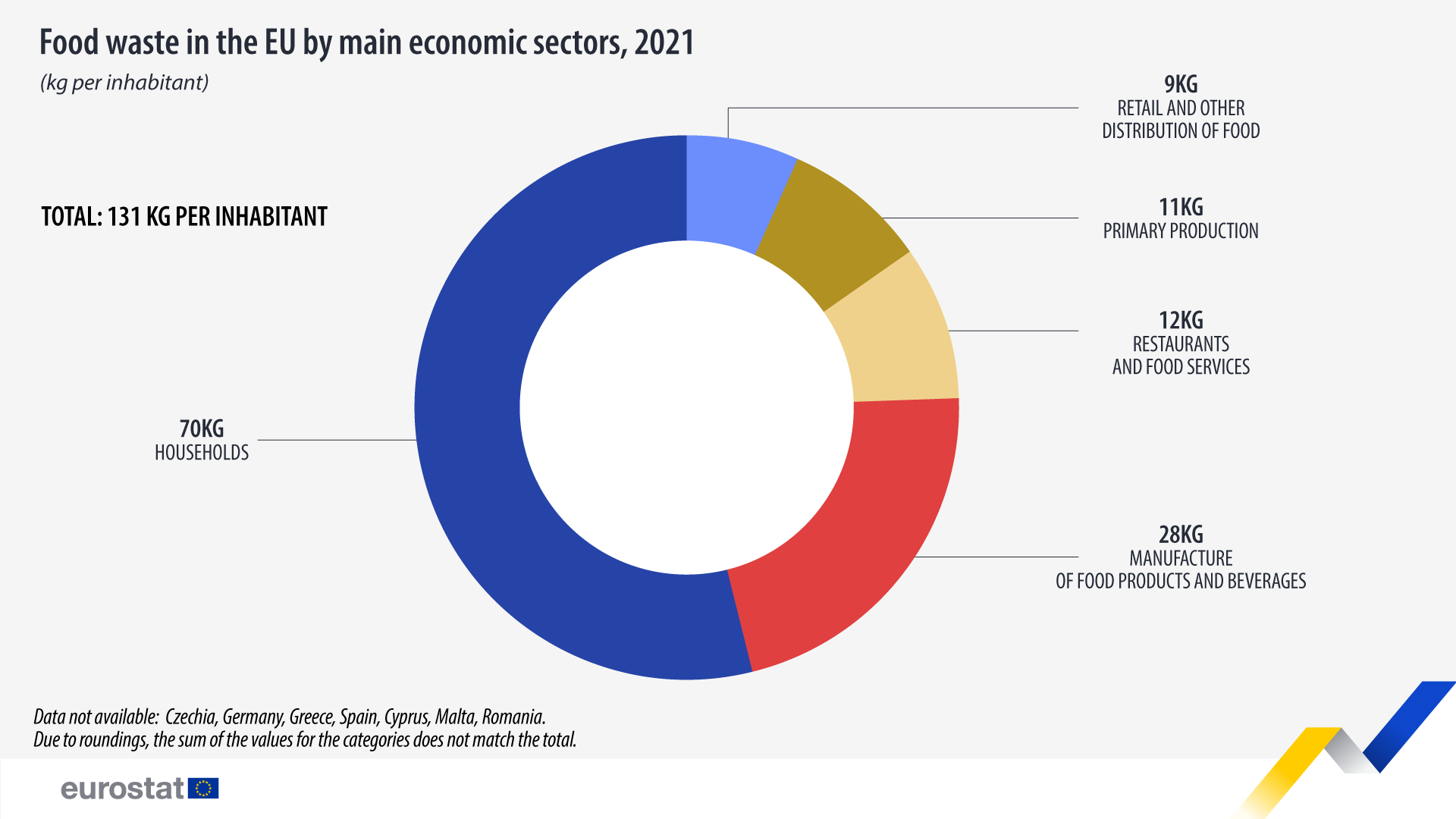
Source dataset: env_wasfw
This information is part of the first dedicated statistical monitoring of the amount of food waste in the EU by sector of activity according to the NACE rev. 2 classification and by households.
Tackling consumer food waste remains a challenge both in the EU and globally.
International Day of Awareness of Food Loss and Waste
More information
- Statistics Explained article on Food waste and food waste prevention - estimates
- Thematic section on waste
- Database on waste
- European Commission food waste reduction proposal
- Reducing Food Waste in the EU: Q&A
Methodological notes
- 2021 data not available for Czechia, Germany, Greece, Spain, Cyprus, Malta and Romania. Eurostat has estimated the EU aggregates on the basis of 2020 data.
- The data are considered stable: several countries have checked or improved the measurement methodology; 8 Member States have revised their 2020 figures
- Food waste consists of parts of food intended to be ingested (edible food) and parts of food not intended to be ingested (inedible food). Food waste is any food that has become waste under these conditions: it has entered the food supply chain, it has then been removed or discarded from the food supply chain or at the final consumption stage, it is finally destined to be processed as waste.
If you have any queries, please visit the contact page.
Share this article:
EU Reporter publishes articles from a variety of outside sources which express a wide range of viewpoints. The positions taken in these articles are not necessarily those of EU Reporter. Please see EU Reporter’s full Terms and Conditions of publication for more information EU Reporter embraces artificial intelligence as a tool to enhance journalistic quality, efficiency, and accessibility, while maintaining strict human editorial oversight, ethical standards, and transparency in all AI-assisted content. Please see EU Reporter’s full A.I. Policy for more information.



Setting a new benchmark in premium travel

Survey on an EU Blueprint for intellectual property licensing and spinoff creation

Burnham as PM? 'Wait and see'

Statement by the Ministry of Foreign Affairs of the Republic of Kazakhstan

Rule of law report strengthens EU democracy and fundamental rights

Kazakhstan and Belgium: Building a Partnership for the Future

Kazakhstan: Central Election Committee reviews the results of the nomination of candidates for the deputies of Kurultai

Ban on destruction of unsold clothes and shoes enters into application

The Digital Markets Act Is Hurting Europeans. It’s Time to Put Progress, Free Markets, and Competition First

From Ukraine to Suez: Why the Mediterranean has become the strategic centre of gravity

Commission sends Statements of Objections to several companies and trade associations in suspected construction chemicals cartel

Commission endorses Latvia’s €617 million Social Climate Plan to support vulnerable households and transport users in the clean transition

Commission fines AliExpress €550 million for breaching the Digital Services Act

Astana Hub unveils infrastructure to support AI innovation in health care

The security environment of the South Caucasus amid changing geopolitical realities

Why the US is losing its legitimacy as a global superpower and the trust of the comity of nations

Kazakhstan reforms under scrutiny at Brussels Press Club round table

Japan should face up to history and contribute more to regional peace

Ambassador calls for 'speeding up' of co-operation between EU and Kazakhstan

Timur Turlov at Smart Moves Summit 2025: How chess can transform global education

Shevtsova’s case: Out-of-court sanctions dismantling trust in Ukrainian cause

The future of European transport

Trump Vs Trueman

US 'no longer' an 'unconditional ally' for Europe - MEP
-
 Aviation/airlines4 days ago
Setting a new benchmark in premium travel
-
 Intellectual Property Rights4 days ago
Survey on an EU Blueprint for intellectual property licensing and spinoff creation
-
 Labour3 days ago
Burnham as PM? 'Wait and see'
-
 Kazakhstan4 days ago
Statement by the Ministry of Foreign Affairs of the Republic of Kazakhstan