History
Unknown soldier of Waterloo brought to light by military veterans


All photos copyright Chris van Houts.
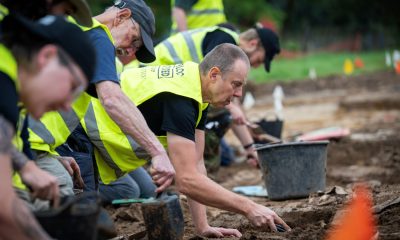
In 2019, an international team of archaeologists supported by military veterans unearthed amputated limbs near the Mont Saint Jean Farmhouse, where the main field hospital for Wellington’s army would have been, at the famous battle of Waterloo. Over two years since the start of the pandemic, the team returned to the excavation and have made a dramatic discovery: an intact skeleton of a soldier, writes Catherine Feore.

“What we've got here is a unique example of how a battlefield was cleared in the early 19th century and this sort of evidence is very, very rare," said Professor Tony Pollard, one of the project’s archaeological directors and director of the Centre for Battlefield Archaeology at Glasgow University. "For instance, at Waterloo, given that probably 20,000 people died in the battle, only one single skeleton has been subjected to archaeological excavation - that was by my Belgian colleague, when they were building the museum a few years ago.
“So when you put it into context, this is incredibly rare, but we’ve also got this mixture of humans, horses and ammunition boxes that provides a snapshot of the battle. It's astounding to me, as someone who has done 25 years of battlefield archaeology, that this has come to light.”
One of the partners in the dig is ‘Waterloo Uncovered’ a ground-breaking charity combining world-class archaeology with veteran care and recovery. Since 2015, the charity has been using archaeology as a tool to support veterans and serving military personnel in their recovery from the traumas of war and transition to civilian life.
A veteran told EU Reporter that when he joined the army it was to emulate what other people had done in the past, defending their country. He said that there was still stigma attached to PTSD and that it was poorly understood by the public at large: “Many people suffer from PTSD for all sorts of reasons, some people think it shows itself in anger and violence, but in fact it can affect people in many different ways.”
There is an in depth online course that needs to be completed by veterans new to the discipline of archaeology, there are a number of levels and participants are selected from those who have successfully completed the course. Liam Telfer, from the Household Cavalry, is one of the veterans who has developed a passion for archaeology: “It’s very therapeutic and quite cathartic. You have to really focus on what you’re doing. It’s truly changed my life and I’m seriously thinking about a career in archaeology.”
Pollard says that the veterans really bring a difference: “A lot of these people have been in battle. They read the landscape, not as we do, but as military terrain. There’s an interaction between the past and the present. I say to my students, archaeology is the closest we have to a time machine. But having veterans on the project is almost like having the keys to that time machine, it is just phenomenal.”
The battle of Waterloo put paid to Napoleon’s imperial ambitions and ushered in a period of relative peace through the ‘Concert of Europe’, nevertheless the excavations are a reminder of the cost of conflict. Kieran Oliver (pictured, below), a Coldstream Guard, spoke about the excitement of the discovery, but also saw it as a reminder of the anguish that comes with war. Like military service, the dig is a collaborative piece of work, Oliver said: “Service men and women support each other, which we’re used to doing.”

Ashley Gordon (pictured below, left) from the 1st Battalion The Rifles and Liam Telfer, from the Household Cavalry (pictured below, right) - Gordon said that the experience was humbling: “You’re focused on the historical and the archaeological process, but then you realise that this was a person and you are able to give them their place in history.”

Rod Eldridge, who leads the wellbeing team said that the role of the team is to ensure that veterans and serving personnel have a good experience which enhances their health. Given their background, Eldridge says that the service men and women have a particular respect given their understanding that they are dealing with a combatant that lost his life in battle.
Share this article:

EU Reporter publishes articles from a variety of outside sources which express a wide range of viewpoints. The positions taken in these articles are not necessarily those of EU Reporter. Please see EU Reporter’s full Terms and Conditions of publication for more information EU Reporter embraces artificial intelligence as a tool to enhance journalistic quality, efficiency, and accessibility, while maintaining strict human editorial oversight, ethical standards, and transparency in all AI-assisted content. Please see EU Reporter’s full A.I. Policy for more information.





Energy Union Task Force takes stock of oil and gas security of supply in the EU

AIFC to host Astana Finance Days 2026 in September

ALROSA Re-elects Supervisory Board with Minimal Changes

EU launches a Team Gaza Initiative to support early recovery in Gaza with an initial amount of nearly €900 million

Public consultation on Joint Undertakings, Art. 185 initiatives, and thematic priorities for European Partnerships under Horizon Europe 28-34

Poland sees new research and changes to policies on migrant integration

EU and South Africa kick off intergovernmental dialogue on Clean Trade and Investment Partnership

NESBp: Strengthening maritime spatial planning across the North Sea and Baltic Sea

Kazakhstan seeks regional AI leadership as economic partnership with China enters new phase

Starmer’s problem? 'He is not a politician'

Why a Brussels–Nicosia–Eastern Mediterranean strategic affairs platform would benefit the European Union

Albania's Vlora airport standoff tests investor confidence as EU accession clock ticks

ECR MEPs question the European Commission on cardiovascular health and diet promoting the Mediterranean diet as an alternative to ultra-processed foods as key to tackling obesity

Kazakhstan's fixed capital investment tops 9.5 trillion tenge in H1 2026

Commission adopts simpler rules for EU agri-food promotion policy

Commission approves €659 million German state aid for four new semiconductor facilities

Kazakhstan reforms under scrutiny at Brussels Press Club round table

Japan should face up to history and contribute more to regional peace

Ambassador calls for 'speeding up' of co-operation between EU and Kazakhstan

Timur Turlov at Smart Moves Summit 2025: How chess can transform global education

Shevtsova’s case: Out-of-court sanctions dismantling trust in Ukrainian cause

The future of European transport

Trump Vs Trueman

US 'no longer' an 'unconditional ally' for Europe - MEP
-
 Energy market5 days ago
Energy Union Task Force takes stock of oil and gas security of supply in the EU
-
 Kazakhstan5 days ago
AIFC to host Astana Finance Days 2026 in September
-
 Economy5 days ago
ALROSA Re-elects Supervisory Board with Minimal Changes
-
 Gaza Strip5 days ago
EU launches a Team Gaza Initiative to support early recovery in Gaza with an initial amount of nearly €900 million