Equal opportunities
Almost 40% of non-EU citizens over-qualified in 2023


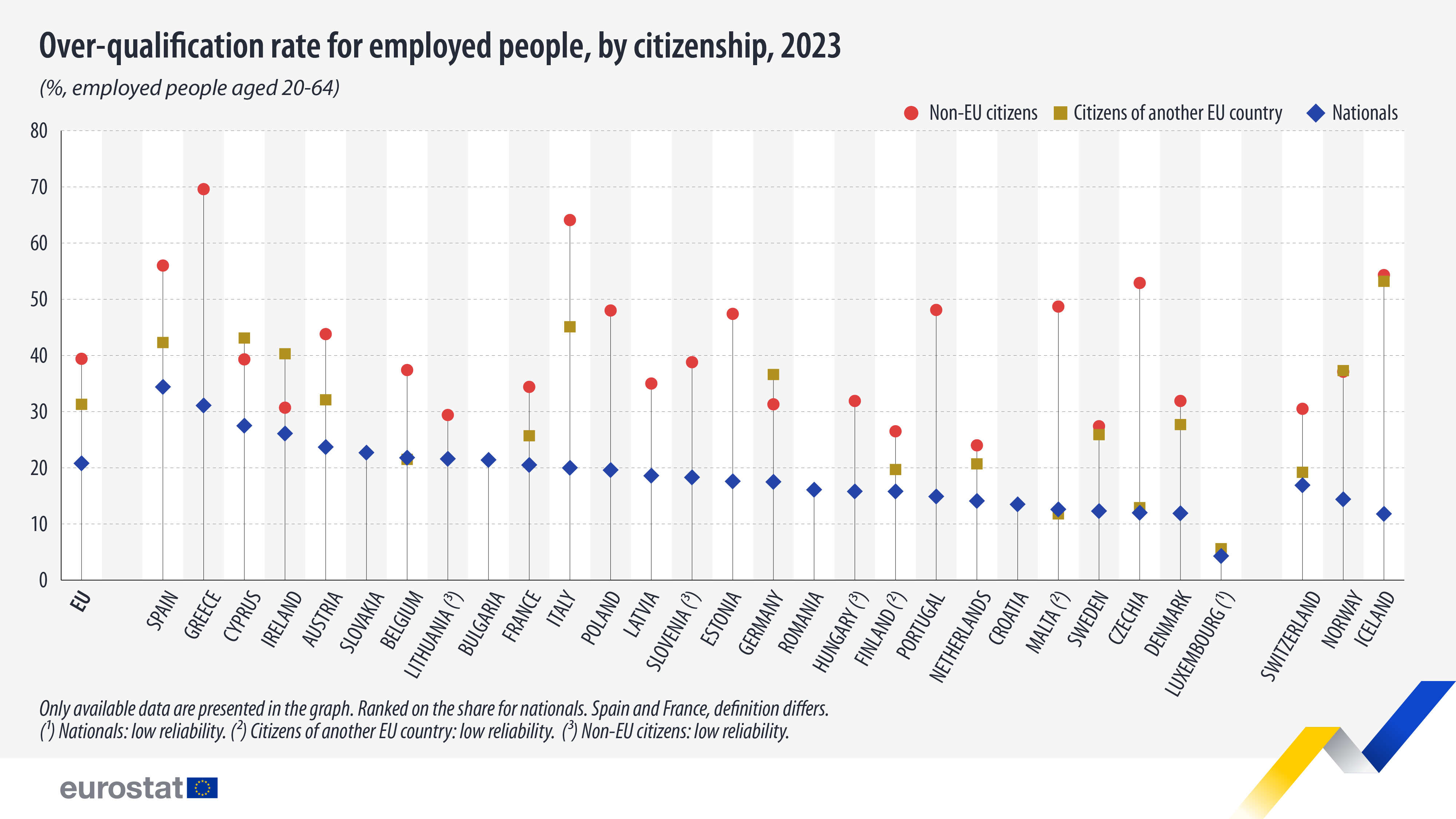
In 2023, employed non-EU citizens in the EU were almost twice as likely to be over-qualified than nationals for their job. The over-qualification rate was 39.4% for non-EU citizens (0.1 percentage points (pp) lower than in 2022) and 31.3% for citizens of other EU countries (-0.3 pp). By contrast, the over-qualification rate for nationals stood at 20.8%, 0.3 pp less than in the previous year.
Among the EU countries, in 2023, the highest share of over-qualified non-EU citizens was recorded in Greece (69.6%), Italy (64.1%) and Spain (56.0%).
For citizens of other EU countries, the highest shares of over-qualified workers were recorded in Italy (45.1%), followed by Cyprus (43.1%) and Spain (42.3%).
Source dataset: lfsa_eoqgan
Larger gender gap for non-nationals
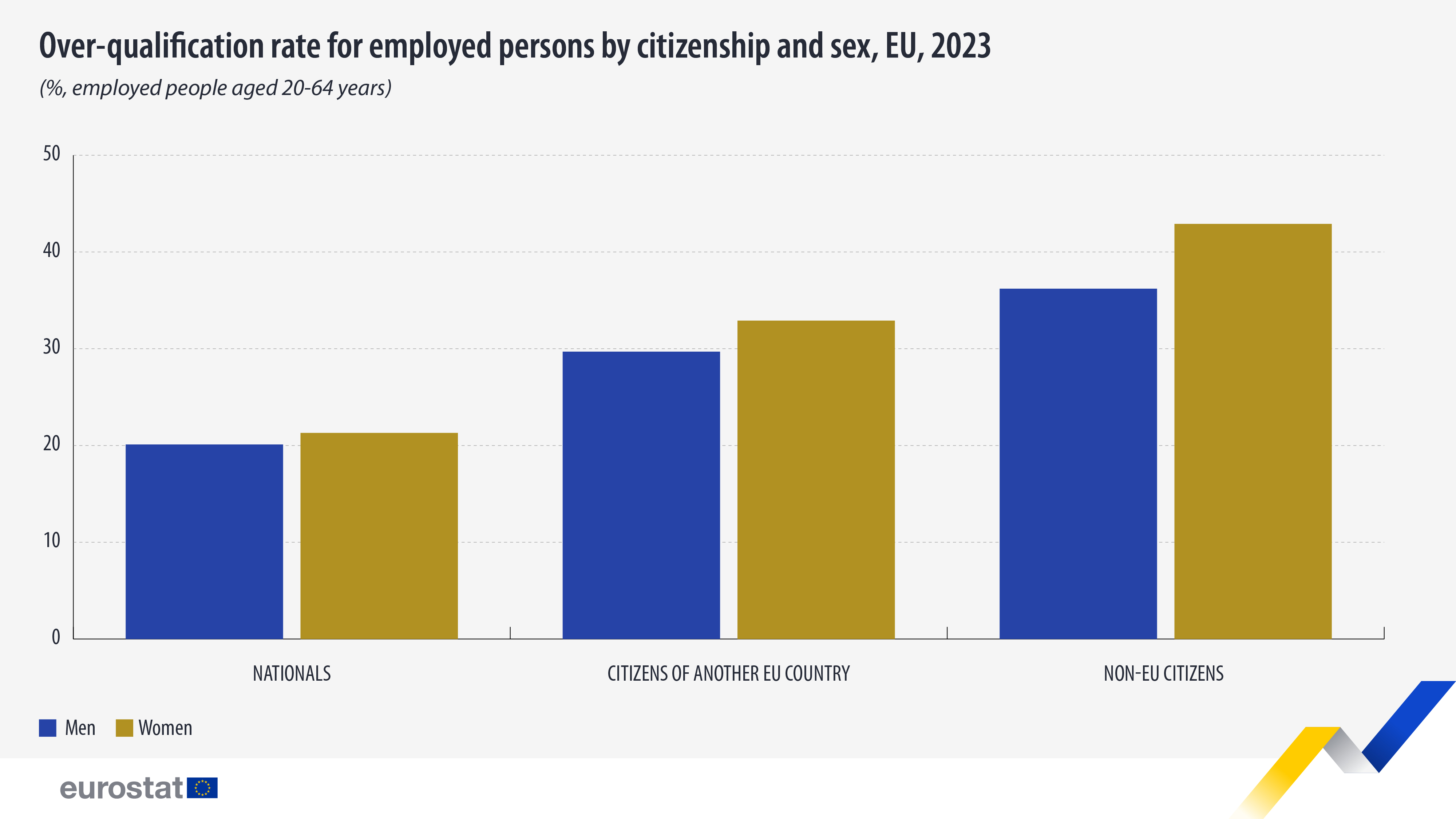
Looking at the over-qualification rates by sex, data shows that women represent higher over-qualification rates than men.
In 2023, the over-qualification rate among female non-EU citizens was 6.7 pp higher than the rate for male non-EU citizens. It was likewise 3.2 pp higher for citizens of other EU countries. For nationals, the rate for women was 1.2 pp higher than for men.
Source dataset: lfsa_eoqgan
For more information
- Statistics Explained article on migrant integration statistics – over-qualification
- Thematic section on migrant integration
- Database on migrant integration
Methodological notes
The over-qualification rate is calculated for employed persons with a tertiary level of education attainment (international standard classification of education (ISCED) levels 5–8). The rate shows what proportion of these people are employed in a low- or medium-skilled occupation (international standard classification of occupations (ISCO) major groups 4–9).
Share this article:
EU Reporter publishes articles from a variety of outside sources which express a wide range of viewpoints. The positions taken in these articles are not necessarily those of EU Reporter. Please see EU Reporter’s full Terms and Conditions of publication for more information EU Reporter embraces artificial intelligence as a tool to enhance journalistic quality, efficiency, and accessibility, while maintaining strict human editorial oversight, ethical standards, and transparency in all AI-assisted content. Please see EU Reporter’s full A.I. Policy for more information.



Energy Union Task Force takes stock of oil and gas security of supply in the EU

AIFC to host Astana Finance Days 2026 in September

ALROSA Re-elects Supervisory Board with Minimal Changes

EU launches a Team Gaza Initiative to support early recovery in Gaza with an initial amount of nearly €900 million

Public consultation on Joint Undertakings, Art. 185 initiatives, and thematic priorities for European Partnerships under Horizon Europe 28-34

Poland sees new research and changes to policies on migrant integration

EU and South Africa kick off intergovernmental dialogue on Clean Trade and Investment Partnership

NESBp: Strengthening maritime spatial planning across the North Sea and Baltic Sea

Kazakhstan seeks regional AI leadership as economic partnership with China enters new phase

Starmer’s problem? 'He is not a politician'

Why a Brussels–Nicosia–Eastern Mediterranean strategic affairs platform would benefit the European Union

Albania's Vlora airport standoff tests investor confidence as EU accession clock ticks

ECR MEPs question the European Commission on cardiovascular health and diet promoting the Mediterranean diet as an alternative to ultra-processed foods as key to tackling obesity

Kazakhstan's fixed capital investment tops 9.5 trillion tenge in H1 2026

Commission adopts simpler rules for EU agri-food promotion policy

Commission approves €659 million German state aid for four new semiconductor facilities

Kazakhstan reforms under scrutiny at Brussels Press Club round table

Japan should face up to history and contribute more to regional peace

Ambassador calls for 'speeding up' of co-operation between EU and Kazakhstan

Timur Turlov at Smart Moves Summit 2025: How chess can transform global education

Shevtsova’s case: Out-of-court sanctions dismantling trust in Ukrainian cause

The future of European transport

Trump Vs Trueman

US 'no longer' an 'unconditional ally' for Europe - MEP
-
 Energy market4 days ago
Energy Union Task Force takes stock of oil and gas security of supply in the EU
-
 Kazakhstan4 days ago
AIFC to host Astana Finance Days 2026 in September
-
 Economy4 days ago
ALROSA Re-elects Supervisory Board with Minimal Changes
-
 Gaza Strip4 days ago
EU launches a Team Gaza Initiative to support early recovery in Gaza with an initial amount of nearly €900 million