Estonia
Estonia, Latvia and Lithuania agree to synchronise their electricity grids with the European Continental grid in early 2025


The Commission warmly welcomes the agreement by Estonia, Latvia and Lithuania to accelerate the integration of their electricity grids with the Continental Europe network (CEN) and their disconnection from Russia and Belarus.
Under a joint declaration signed this morning by the three Prime Ministers, the deadline for synchronisation is brought forward from the end of 2025 (as initially established by political declarations in 2018 and 2019) to February 2025. Today's political declaration follows an agreement between the respective Transmission System Operators (TSOs) earlier this week on the steps for accomplishing the fully-fledged synchronisation in February 2025.
The relevant grids reinforcements are a Project of Common Interest (PCI) on the Union's fifth PCI list under the TEN-E Regulation and have received record financial support from the Connecting Europe Facility for Energy of more than € 1.2 billion. The full integration of the Baltic States into the internal energy market will also facilitate the uptake of renewable energy, supporting them achieve the European Green Deal objectives.
Energy Commissioner Kadri Simson said: “The integration in the EU of the electricity grids of the Baltic States is the last step to ensure energy security in the region. I would like to congratulate the three Baltic leaders today for this historical agreement, which will enable us to complete the full integration of the Baltic states into the EU electricity grid almost one year earlier than previously intended. This has been a priority EU energy infrastructure project for the Commission for many years, receiving substantial EU funding, and will continue to receive support until it is completed. Today's agreement is a symbol of European solidarity in action. The project will not only bring energy security in the region and complete the EU integration of the three Baltic States, but will also support the implementation of the Green Deal by ensuring secure, affordable and sustainable energy for the Eastern Baltic Sea region and the Union as a whole.”
More information is available online.
Share this article:
EU Reporter publishes articles from a variety of outside sources which express a wide range of viewpoints. The positions taken in these articles are not necessarily those of EU Reporter. Please see EU Reporter’s full Terms and Conditions of publication for more information EU Reporter embraces artificial intelligence as a tool to enhance journalistic quality, efficiency, and accessibility, while maintaining strict human editorial oversight, ethical standards, and transparency in all AI-assisted content. Please see EU Reporter’s full A.I. Policy for more information.




EU foreign ministers to discuss options for restricting trade with Israeli communities in Judea and Samaria

European operation dismantles €10 million illicit cigarette network in Spain

Srebrenica's lesson is prevention. Why isn't the world applying It to Kashmir?

Energy Union Task Force takes stock of oil and gas security of supply in the EU

ALROSA Re-elects Supervisory Board with Minimal Changes

AIFC to host Astana Finance Days 2026 in September

EU launches a Team Gaza Initiative to support early recovery in Gaza with an initial amount of nearly €900 million

Joint statement by High Representative/Vice-President Kallas and Commissioner Kos on the 31st anniversary of the Srebrenica genocide

European Commission rewards spurious PA textbook reforms

Iran’s regime in crisis: Negotiations, internal divisions and growing resistance

Top EU official speaks of 'very special feeling' over new deal with UK

Shusha Global Media Forum: Azerbaijan’s Answer to Disinformation

Commission approves French state aid to support offshore wind energy

Natura 2000 Network offers opportunities for sustainable tourism across Europe

Commission adds exemptions to rules on removability of portable batteries

EU steps up international support for Palestinians with major initiative for Gaza's early recovery and stronger international coordination

Kazakhstan reforms under scrutiny at Brussels Press Club round table

Japan should face up to history and contribute more to regional peace

Ambassador calls for 'speeding up' of co-operation between EU and Kazakhstan

Timur Turlov at Smart Moves Summit 2025: How chess can transform global education

Shevtsova’s case: Out-of-court sanctions dismantling trust in Ukrainian cause

The future of European transport

Trump Vs Trueman

US 'no longer' an 'unconditional ally' for Europe - MEP
-
 Israel5 days ago
EU foreign ministers to discuss options for restricting trade with Israeli communities in Judea and Samaria
-
 Cigarettes4 days ago
European operation dismantles €10 million illicit cigarette network in Spain
-
 Kashmir4 days ago
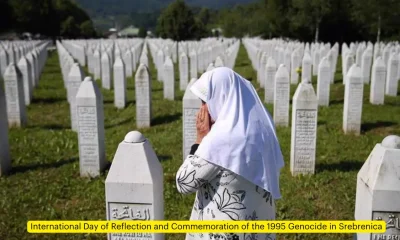
Srebrenica's lesson is prevention. Why isn't the world applying It to Kashmir?
-
 Energy market3 days ago
Energy Union Task Force takes stock of oil and gas security of supply in the EU