Maritime
Port of Antwerp-Bruges begins work on shore power supply to Zeebrugge cruise terminal

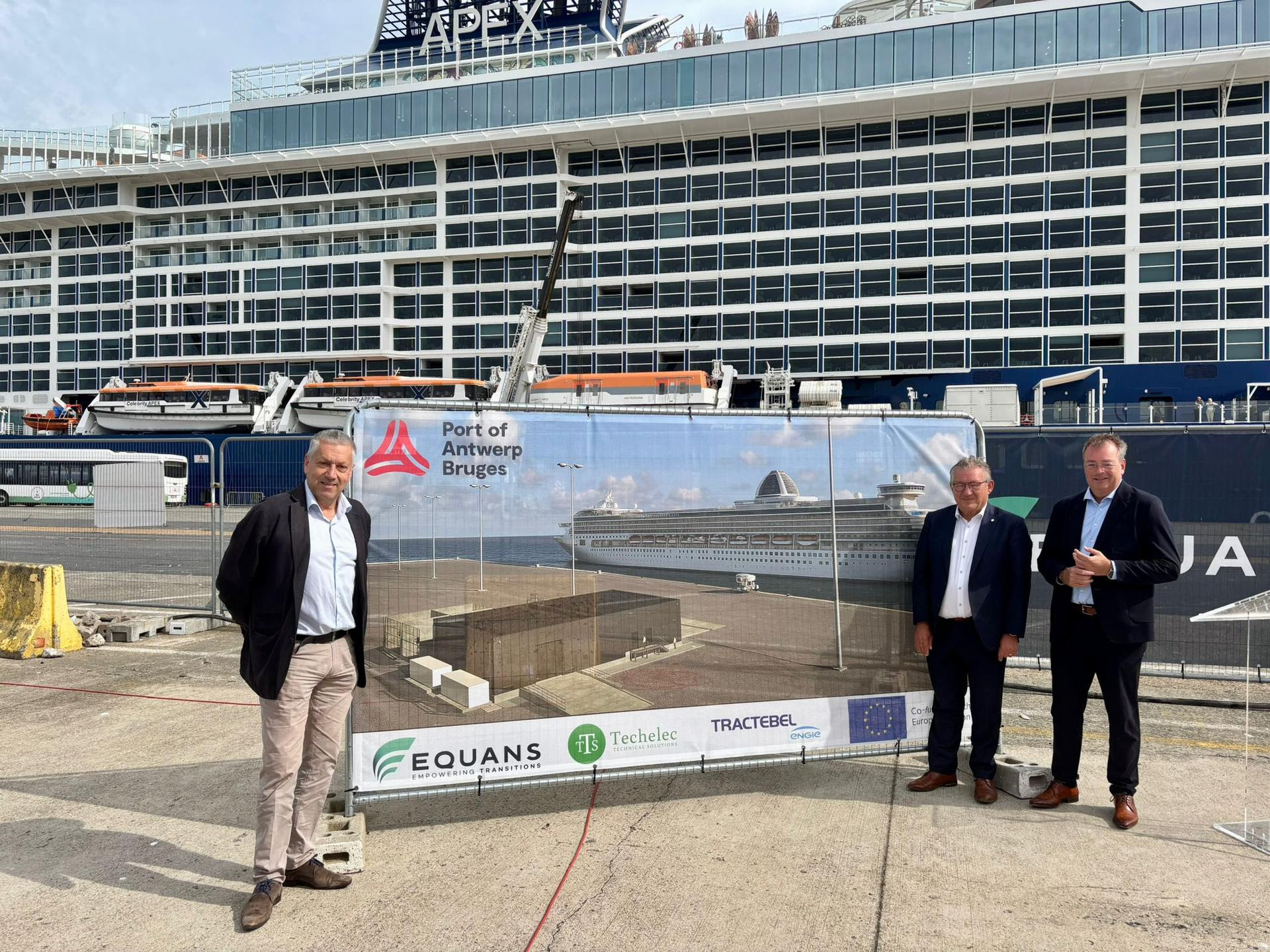
The first ships will be able to connect to it as early as 2027, three years before the European obligation comes into force. Antwerp, 26 August 2025 – The official start of the construction of a shore-side power supply facility at the Zweedse Kaai cruise terminal in Zeebrugge was given today. From the beginning of 2027, docking cruise ships will be able to switch to green electricity from the quayside, reducing emissions at the quayside to zero and significantly reducing odour and visual nuisance for local residents, passengers, and crew members.
Anchor points: Construction of a shore-side power supply facility begins at the Zeebrugge cruise terminal Improving quality of life by reducing CO₂ emissions, olfactory and visual nuisances Nearly 4 million euros in European and Flemish subsidies Shore power before 2030 Shore power converts grid electricity to the appropriate voltage for ships. A movable loading arm connects the cruise ship so it can turn off its engines and use power from the quayside.
For this purpose, Port of Antwerp-Bruges is building an onshore power supply (OPS) system and a new high-voltage station at the cruise terminal on the Zweedse Kaai in Zeebrugge. The port is thus prepared to supply shore-side electricity to two cruise ships simultaneously by 2027, three years before the European obligation that will become applicable in 2030. Work is now underway, so that the first ships will be able to connect during the first half of 2027. In the meantime, plans are already on the table for a second installation.
Transformation of the Zweedse Kaai The shore power installation is part of a broader renovation of the Zweedse Kaai , which includes, among other things, a new terminal with boarding bridges, a battery system, and the redevelopment of part of the quayside into a green space. These interventions not only enhance operational efficiency, but also the quality of life in the surrounding area. A plus for local residents and the climate The Zweedse Kaai currently accounts for around 5% of the CO₂ emissions of all ships docked in Antwerp and Zeebrugge, as the cruise ships docked there generate electricity using diesel generators.
Shore power eliminates these emissions locally and also reduces odor and visual nuisance caused by smoke. With this project, Port of Antwerp-Bruges contributes to environmental sustainability, the greening of the cruise industry and can also serve as a reference for other terminal operators. EU priority, Flanders support In line with the Green Deal, the Strategy for Sustainable and Smart Mobility, and the Alternative Fuels Infrastructure Regulation (AFIR), the European Commission is prioritizing shore-side power projects in the call for projects of the Alternative Fuels Infrastructure Facility (AFIF) program, under the auspices of the Connecting Europe Facility (CEF).
For the shore-side power installation, it has earmarked a grant of €3.1 million to cover the higher-than-expected costs and ensure a payback period of approximately 20 years. In addition, the Flemish government has granted strategic support for ecology amounting to 830,000 euros. A sustainable path to 2050 The shore power project is part of the Port of Antwerp-Bruges' ambition to achieve climate neutrality by 2050. Parallel investments include alternative fuels for tugboats, further electrification, energy-efficient buildings, and circular economy projects. Shore power will also enable shipowners to meet the International Maritime Organization and EU climate commitments in a cost-effective manner.
Rob Smeets, Chief Operating Officer of Port of Antwerp-Bruges said: "Thanks to shore-side electricity, we are reducing emissions from the cruise terminal to zero while improving the comfort of passengers, crew, and local residents. 'Plug-in on arrival' in Zeebrugge will become a reality from 2027, even before the European obligation that will come into force in 2030."
Dirk De Fauw, Mayor of Bruges and Vice-Chairman of the Board of Directors of the Port of Antwerp-Bruges said: "This project combines state-of-the-art infrastructure with quality of life through the reduction of emissions, odors, and fumes. We are firmly opting for a future-proof cruise port that will welcome its visitors without harming the environment, thus proving that sustainability and economic dynamism can go hand in hand."
Mark Dirckx, CEO of Equans Belux said: "This project perfectly illustrates the role Equans Belux wants to play in the energy transition of the maritime sector. By acting as a single point of contact, we offer our client a comprehensive solution that combines technical performance, reliability, and sustainability. Thanks to shore-side power supply, we are helping to reduce emissions and improve the quality of life around the port, while preparing for the future of maritime transport."
Share this article:
EU Reporter publishes articles from a variety of outside sources which express a wide range of viewpoints. The positions taken in these articles are not necessarily those of EU Reporter. Please see EU Reporter’s full Terms and Conditions of publication for more information EU Reporter embraces artificial intelligence as a tool to enhance journalistic quality, efficiency, and accessibility, while maintaining strict human editorial oversight, ethical standards, and transparency in all AI-assisted content. Please see EU Reporter’s full A.I. Policy for more information.



Setting a new benchmark in premium travel

The security environment of the South Caucasus amid changing geopolitical realities

Survey on an EU Blueprint for intellectual property licensing and spinoff creation

Burnham as PM? 'Wait and see'

Kazakhstan: Central Election Committee reviews the results of the nomination of candidates for the deputies of Kurultai
The South Caucasus at a historic turning point: Between lasting peace and renewed confrontation

Rule of law report strengthens EU democracy and fundamental rights

Ban on destruction of unsold clothes and shoes enters into application

JoinCare Explores Scientific Exchange During Visit toJapan’s National Institute of Infectious Diseases

New episode – DGT podcast: Languages and Technology

Become a European Commission trainee – applications are now open

Commission outlines measures to strengthen Europe's banking sector and support growth

British political shifts and the future of UK-China ties
The South Caucasus at a historic turning point: Between lasting peace and renewed confrontation

As Ireland chairs the EU Presidency, what impact has over fifty years of EU membership had on Ireland

The Digital Markets Act Is Hurting Europeans. It’s Time to Put Progress, Free Markets, and Competition First

Kazakhstan reforms under scrutiny at Brussels Press Club round table

Japan should face up to history and contribute more to regional peace

Ambassador calls for 'speeding up' of co-operation between EU and Kazakhstan

Timur Turlov at Smart Moves Summit 2025: How chess can transform global education

Shevtsova’s case: Out-of-court sanctions dismantling trust in Ukrainian cause

The future of European transport

Trump Vs Trueman

US 'no longer' an 'unconditional ally' for Europe - MEP
-
 Aviation/airlines4 days ago
Setting a new benchmark in premium travel
-
 South Caucasus1 day ago
The security environment of the South Caucasus amid changing geopolitical realities
-
 Intellectual Property Rights4 days ago
Survey on an EU Blueprint for intellectual property licensing and spinoff creation
-
 Labour4 days ago
Burnham as PM? 'Wait and see'