Tourism
EU sees increase of tourist bed places in 2022


In 2022, the EU had an estimated total of 28.9 million bed places available across more than 620,000 tourist accommodation establishments.
Data showed a complete recovery in terms of tourism accommodation offers in 2022. Compared with 2020, the year the COVID-19 pandemic started, the number of bed places increased by 3% (+765,900) and the establishments by 4% (+24,400) and compared with 2019 both the number of bed places (+1%; +150,400) and establishments (+1%; +3,600) increased.
Italy and France accounted for slightly more than one-third of the total available capacity, with 5.2 and almost 5.1 million bed places, respectively. Spain and Germany followed, with 3.8 million (13% of the total) and 3.6 million (12%) bed places.
This information comes from data on tourist accommodation published by Eurostat today. The article presents a handful of findings from the more detailed Statistics Explained article on tourism statistics - annual results for the accommodation sector.
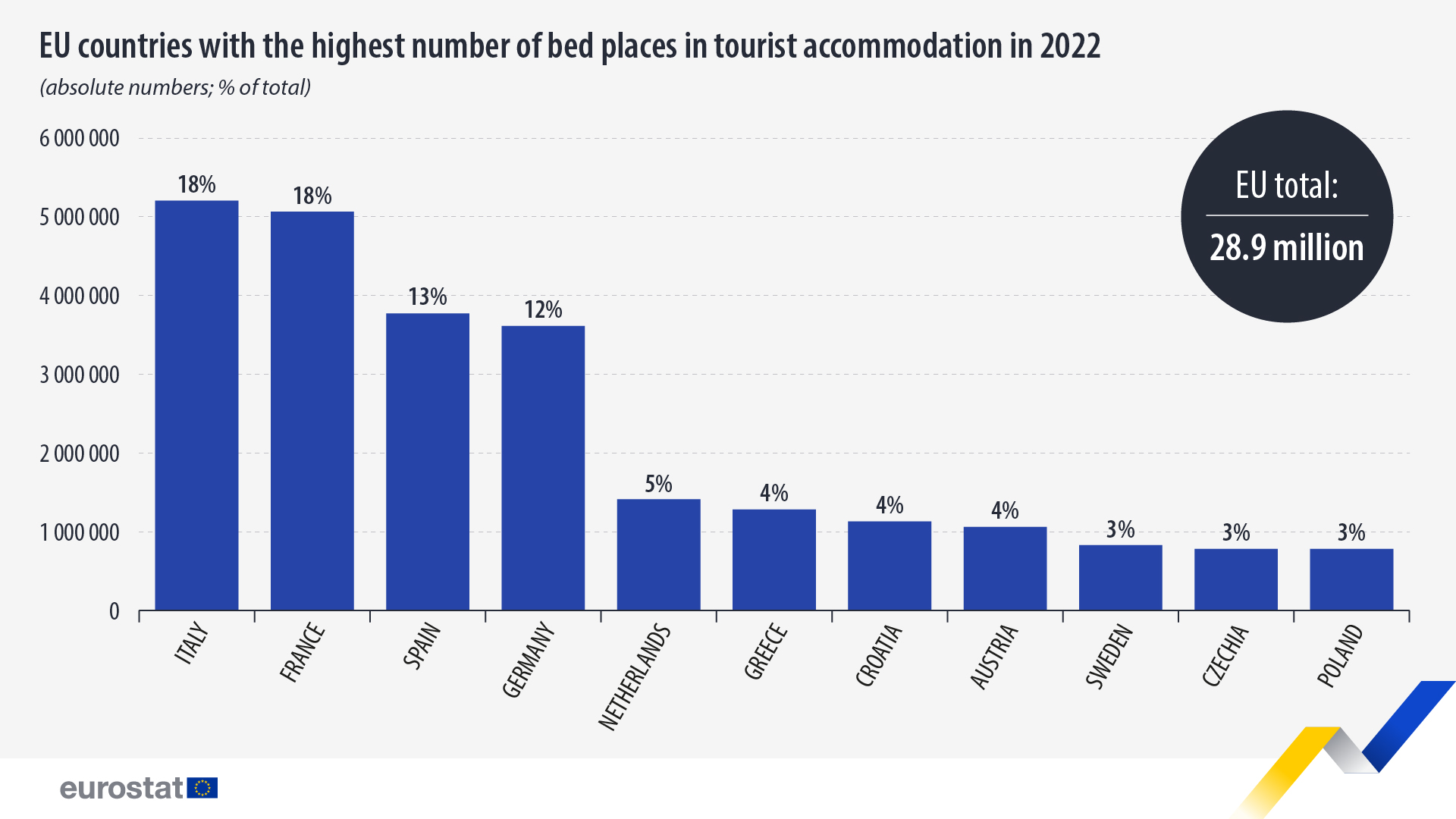
Source dataset: tour_cap_nat
EU countries continue to fuel intra-EU tourism market
In 2022, the EU registered a total of almost 2.8 billion nights spent in EU tourist accommodations, of which almost 1.6 billion were spent by domestic tourists and 1.2 billion by international guests.
Data for 2022 show that tourists coming from other EU countries represented 65% of the 1.2 billion nights spent by international guests. This share was substantial but still lower than in 2021, when 75% of the guests were from other EU countries, in reaction to the travel limitations during that year due to the COVID-19 pandemic.
Nights spent by tourists from other European countries represented 22% of the total, indicating a large increase from the previous year (+5.3 percentage points (pp)).
In 2022, 6% of the international nights in EU accommodations were spent by tourists from North America (+2.4 pp than in 2021), while guests from Asia represented 4% (+1 pp), Central and South America 2% (+0.8 pp), Africa almost 1% (no change) and Oceania 0.5% (+0.3 pp).
Between 2022 and 2021, the biggest difference in the EU tourism market was that the weight of intra-EU tourism lessened slightly, and the number of tourists from all other regions increased. If in 2021, only 8% of nights spent by international guests were spent by tourists from other world regions outside Europe, in 2022 that share increased to 13%. As travel restrictions were lifted, international tourists welcomed the opportunity to visit EU countries, and EU nationals also travelled abroad.
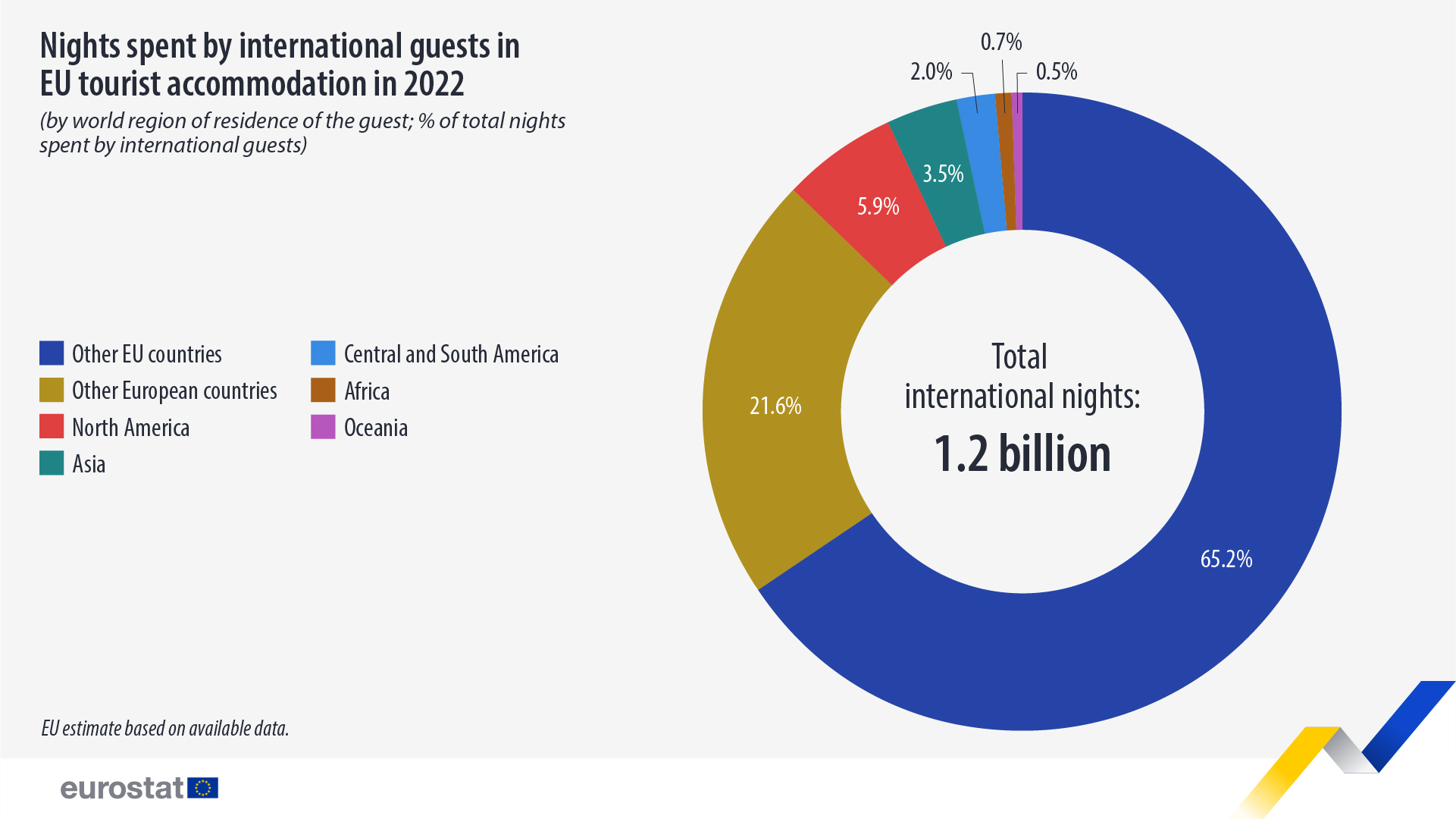
Source dataset: tour_occ_ninraw
For more information
- Statistics Explained article on tourism statistics - annual results for the accommodation sector
- Database on tourism
- Thematic section on tourism
Methodological note
- Some countries apply data collection thresholds, which can imply that establishments with below-threshold number of bed places are not in the scope of observation for the capacity and occupancy data.
If you have any queries, please visit the contact page.
Share this article:
EU Reporter publishes articles from a variety of outside sources which express a wide range of viewpoints. The positions taken in these articles are not necessarily those of EU Reporter. Please see EU Reporter’s full Terms and Conditions of publication for more information EU Reporter embraces artificial intelligence as a tool to enhance journalistic quality, efficiency, and accessibility, while maintaining strict human editorial oversight, ethical standards, and transparency in all AI-assisted content. Please see EU Reporter’s full A.I. Policy for more information.



Setting a new benchmark in premium travel

The security environment of the South Caucasus amid changing geopolitical realities

Survey on an EU Blueprint for intellectual property licensing and spinoff creation

Burnham as PM? 'Wait and see'

Kazakhstan: Central Election Committee reviews the results of the nomination of candidates for the deputies of Kurultai
The South Caucasus at a historic turning point: Between lasting peace and renewed confrontation

Rule of law report strengthens EU democracy and fundamental rights

Ban on destruction of unsold clothes and shoes enters into application

JoinCare Explores Scientific Exchange During Visit toJapan’s National Institute of Infectious Diseases

New episode – DGT podcast: Languages and Technology

Become a European Commission trainee – applications are now open

Commission outlines measures to strengthen Europe's banking sector and support growth

British political shifts and the future of UK-China ties
The South Caucasus at a historic turning point: Between lasting peace and renewed confrontation

As Ireland chairs the EU Presidency, what impact has over fifty years of EU membership had on Ireland

The Digital Markets Act Is Hurting Europeans. It’s Time to Put Progress, Free Markets, and Competition First

Kazakhstan reforms under scrutiny at Brussels Press Club round table

Japan should face up to history and contribute more to regional peace

Ambassador calls for 'speeding up' of co-operation between EU and Kazakhstan

Timur Turlov at Smart Moves Summit 2025: How chess can transform global education

Shevtsova’s case: Out-of-court sanctions dismantling trust in Ukrainian cause

The future of European transport

Trump Vs Trueman

US 'no longer' an 'unconditional ally' for Europe - MEP
-
 Aviation/airlines4 days ago
Setting a new benchmark in premium travel
-
 South Caucasus1 day ago
The security environment of the South Caucasus amid changing geopolitical realities
-
 Intellectual Property Rights4 days ago
Survey on an EU Blueprint for intellectual property licensing and spinoff creation
-
 Labour4 days ago
Burnham as PM? 'Wait and see'