Bangladesh
‘Rickshaw Girl’: A celebration of the spirit of the Bengali people brings Bangladesh to an international audience


A film that shows a teenage girl’s struggle to survive and provide for her family has become a success with young audiences. Rickshaw Girl doesn’t disguise how tough life can be but also celebrates the determination and talent of its central character wrItes Nick Powell.
Rickshaw Girl is a film that should inspire audiences of all ages but it’s become a particularly popular choice at young people’s film festivals. It tells the story of Naima, a village girl who’s a talented painter. When her father falls ill and can no longer provide for the family, the brave and determined teenager heads to Dhaka to find work pedalling a rickshaw.
When the film was shown in Brussels as part of the International Film Festival for Young Audiences (Filem’On), its star, Novera Orishi, appeared by video link after the screening. She said that “the movie was hard work but easy, because it was fun”. The physically demanding role first required three months in the gym, so that she could actually pedal a rickshaw on location in Dhaka.
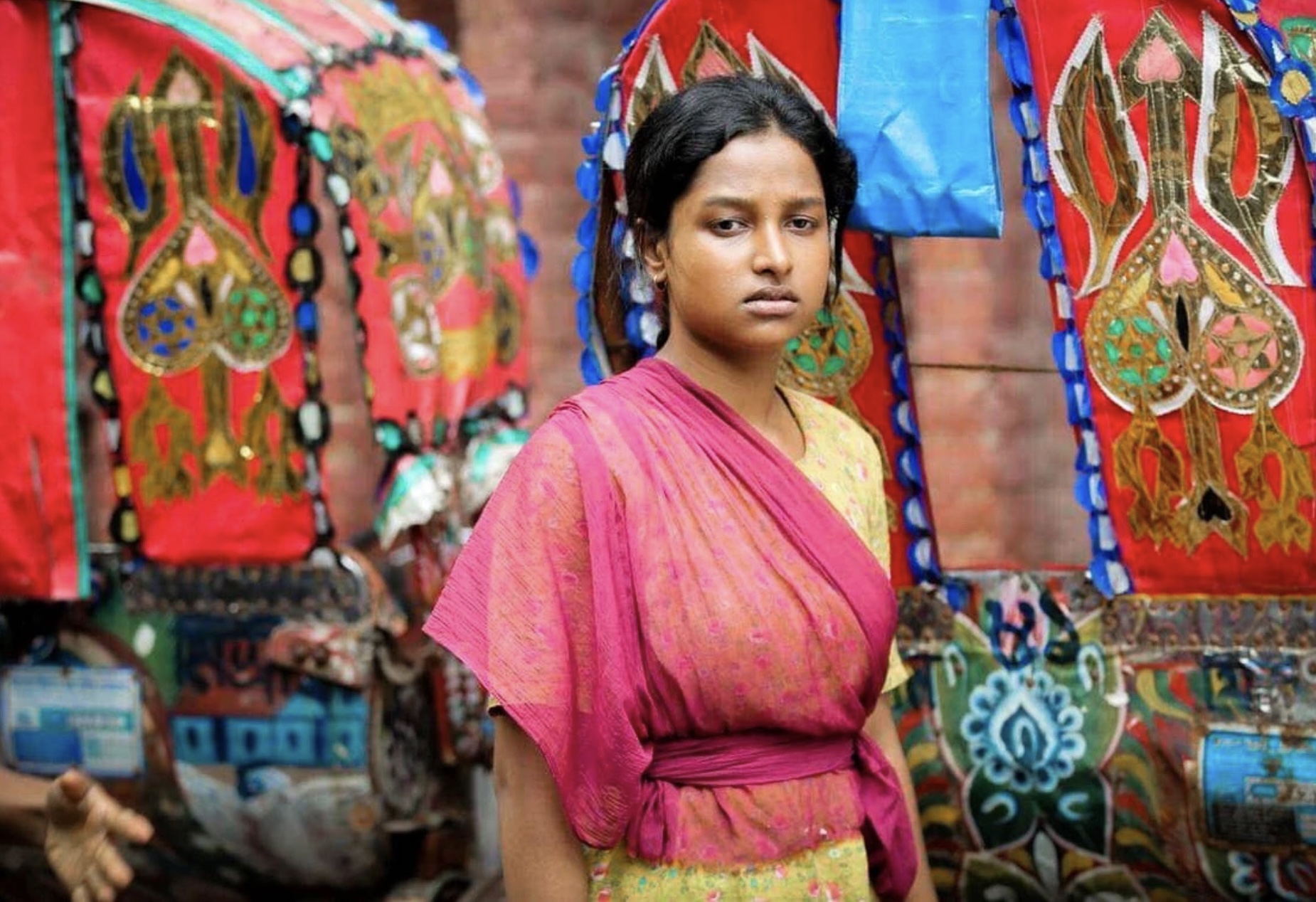
She felt that her role had demonstrated how “Bengali girls are strong and headstrong, sweet and determined”. She added that for her character the tough world of the rickshaw garage was first and foremost a place of opportunity.
The director, Amitabh Reza Chowdhury, was in Brussels for the screening. He told me afterwards that he didn’t want to celebrate the rickshaw itself, which he described as “not a humane vehicle at all”. Rather he wanted to give expression to the lives of the people who rely on muscle power to carry passengers often twice as heavy as they are.
What he did want to celebrate was rickshaw art, paintings on the vehicles’ bodywork that are wonderful and beautiful products of the imagination. In Rickshaw Girl, Naima emerges as a fine practitioner of this dying art form. The film is truly and literally a very colourful one.

“Never stop painting, never stop what you want to do”, was Amitabh Reza Chowdhury’s message. “And that is my life, in the same way I wanted to make me a filmmaker and nothing stopped me. I found that if you focus on what you want to do, you just keep on doing it if you’re really passionate”.
“If you ask me, should I leave Bangladesh and go somewhere and make films, no I’m not. I’m not interested. I want to be there and make films with the people. That is my passion”. He spoke with great affection of the riverside area of Dhaka where he shot Rickshaw Girl and where he has filmed before.
“From every village and small town people come to this place. They come in the morning when there is a vibrance I always enjoy. I love the people where everyone comes to work and dream -and that is always my story”.
That is not to say that one of Bangladesh’s most prolific directors lacks range. His next film will be a drama about a conspiracy trial in 1969, which was a key event in the country’s liberation struggle.
Share this article:
EU Reporter publishes articles from a variety of outside sources which express a wide range of viewpoints. The positions taken in these articles are not necessarily those of EU Reporter. Please see EU Reporter’s full Terms and Conditions of publication for more information EU Reporter embraces artificial intelligence as a tool to enhance journalistic quality, efficiency, and accessibility, while maintaining strict human editorial oversight, ethical standards, and transparency in all AI-assisted content. Please see EU Reporter’s full A.I. Policy for more information.





ECR MEPs question the European Commission on cardiovascular health and diet promoting the Mediterranean diet as an alternative to ultra-processed foods as key to tackling obesity

Albania's Vlora airport standoff tests investor confidence as EU accession clock ticks

Iran’s regime in crisis: Negotiations, internal divisions and growing resistance

Commission approves €659 million German state aid for four new semiconductor facilities

Why a Brussels–Nicosia–Eastern Mediterranean strategic affairs platform would benefit the European Union

Kazakhstan seeks regional AI leadership as economic partnership with China enters new phase

EU law on nitrates pollution remains effective, with scope for smarter implementation

European Commission rewards spurious PA textbook reforms

European Statistical Monitor: July edition

Commission publishes state aid guidance on carbon contracts for difference

Commission greenlights Estonia's fourth payment request for €135.5 million under NextGenerationEU

Drones, dominance, and the Iranian impasse: The West's strategic blind spot

Kazakhstan's fixed capital investment tops 9.5 trillion tenge in H1 2026

Commission registers two European Citizens' Initiatives on education and housing

Kazakhstan and Belgium: Building a Partnership for the Future

New court ruling questions 'proportionality' of Mayor Erion Veliaj’s detention

Kazakhstan reforms under scrutiny at Brussels Press Club round table

Japan should face up to history and contribute more to regional peace

Ambassador calls for 'speeding up' of co-operation between EU and Kazakhstan

Timur Turlov at Smart Moves Summit 2025: How chess can transform global education

Shevtsova’s case: Out-of-court sanctions dismantling trust in Ukrainian cause

The future of European transport

Trump Vs Trueman

US 'no longer' an 'unconditional ally' for Europe - MEP
-
 Italy4 days ago
ECR MEPs question the European Commission on cardiovascular health and diet promoting the Mediterranean diet as an alternative to ultra-processed foods as key to tackling obesity
-
 Albania4 days ago
Albania's Vlora airport standoff tests investor confidence as EU accession clock ticks
-
 Iran4 days ago
Iran’s regime in crisis: Negotiations, internal divisions and growing resistance
-
 Germany4 days ago
Commission approves €659 million German state aid for four new semiconductor facilities