Bosnia and Herzegovina
Bosnia's disintegration would affect entire region, says peace envoy


If a multi-ethnic Bosnia is pushed towards disintegration, that will inevitably have an impact on other unresolved conflicts in the Western Balkans such as that between Serbia and Kosovo, Bosnia's peace envoy told Reuters on Saturday (6 November), write Daria Sito-Sucic and Andreas Rinke.
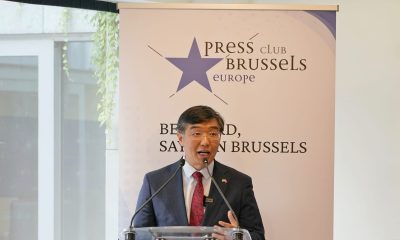
German politician Christian Schmidt (pictured), who is international High Representative in Bosnia, said this week that the peace deal that ended the country's war in the 1990s was at risk of unravelling unless the international community took measures to stop Serb separatists.
He was referring to moves by the Bosnian Serb leadership aimed at undoing key state institutions such as the joint armed forces, the indirect taxation authority and the top judicial body, as well as other institutions. Read more.
"The unrest in this region will also affect the question of the difficult relationship between Serbia and Kosovo in the same or similar way," Schmidt said in an interview.
"Serbia should have an interest in Bosnia-Herzegovina staying together," he said, adding that Belgrade's path towards European Union membership could be gravely affected by instability in Bosnia, where it supports its ethnic kin.
Asked if there was a realistic possibility of Bosnia breaking apart, Schmidt said it was not an imminent danger.
"But if the degradation of the Dayton treaty continues ... there is a risk that the country will break apart," he added.
The U.S.-sponsored Dayton peace accords signed in 1995 ended the three-and-a-half year war among Bosnian Serbs, Croats and Muslim Bosniaks by splitting the country along ethnic lines into two autonomous regions - the Serb-dominated Serb Republic and the Federation shared by Croats and Bosniaks.
While Schmidt said he still hoped that international pressure would move developments in a "sensible direction", the red line would be the Serb Republic's withdrawal from the joint armed forces and the creation of its own separate army within Bosnia, as announced by Bosnian Serb leader Milorad Dodik.
"If this proves to be true... then we in the international community will have to think very, very, very seriously about how we can move forward," Schmidt said.
He said that using his sweeping powers to sack officials and impose laws would be the last resort.
Share this article:
EU Reporter publishes articles from a variety of outside sources which express a wide range of viewpoints. The positions taken in these articles are not necessarily those of EU Reporter. Please see EU Reporter’s full Terms and Conditions of publication for more information EU Reporter embraces artificial intelligence as a tool to enhance journalistic quality, efficiency, and accessibility, while maintaining strict human editorial oversight, ethical standards, and transparency in all AI-assisted content. Please see EU Reporter’s full A.I. Policy for more information.






European operation dismantles €10 million illicit cigarette network in Spain

Energy Union Task Force takes stock of oil and gas security of supply in the EU

Srebrenica's lesson is prevention. Why isn't the world applying It to Kashmir?

AIFC to host Astana Finance Days 2026 in September

ALROSA Re-elects Supervisory Board with Minimal Changes

EU clarifies rules to allow continued waste recovery shipments to Switzerland

EU launches a Team Gaza Initiative to support early recovery in Gaza with an initial amount of nearly €900 million

Joint statement by High Representative/Vice-President Kallas and Commissioner Kos on the 31st anniversary of the Srebrenica genocide

Starmer’s problem? 'He is not a politician'

Why a Brussels–Nicosia–Eastern Mediterranean strategic affairs platform would benefit the European Union

Albania's Vlora airport standoff tests investor confidence as EU accession clock ticks

ECR MEPs question the European Commission on cardiovascular health and diet promoting the Mediterranean diet as an alternative to ultra-processed foods as key to tackling obesity

Kazakhstan's fixed capital investment tops 9.5 trillion tenge in H1 2026

Commission adopts simpler rules for EU agri-food promotion policy

Commission approves €659 million German state aid for four new semiconductor facilities

EU law on nitrates pollution remains effective, with scope for smarter implementation

Kazakhstan reforms under scrutiny at Brussels Press Club round table

Japan should face up to history and contribute more to regional peace

Ambassador calls for 'speeding up' of co-operation between EU and Kazakhstan

Timur Turlov at Smart Moves Summit 2025: How chess can transform global education

Shevtsova’s case: Out-of-court sanctions dismantling trust in Ukrainian cause

The future of European transport

Trump Vs Trueman

US 'no longer' an 'unconditional ally' for Europe - MEP
-
 Cigarettes5 days ago
European operation dismantles €10 million illicit cigarette network in Spain
-
 Energy market4 days ago
Energy Union Task Force takes stock of oil and gas security of supply in the EU
-
 Kashmir5 days ago
Srebrenica's lesson is prevention. Why isn't the world applying It to Kashmir?
-
 Kazakhstan4 days ago
AIFC to host Astana Finance Days 2026 in September