coronavirus
German coronavirus infection rate hits highest since pandemic began

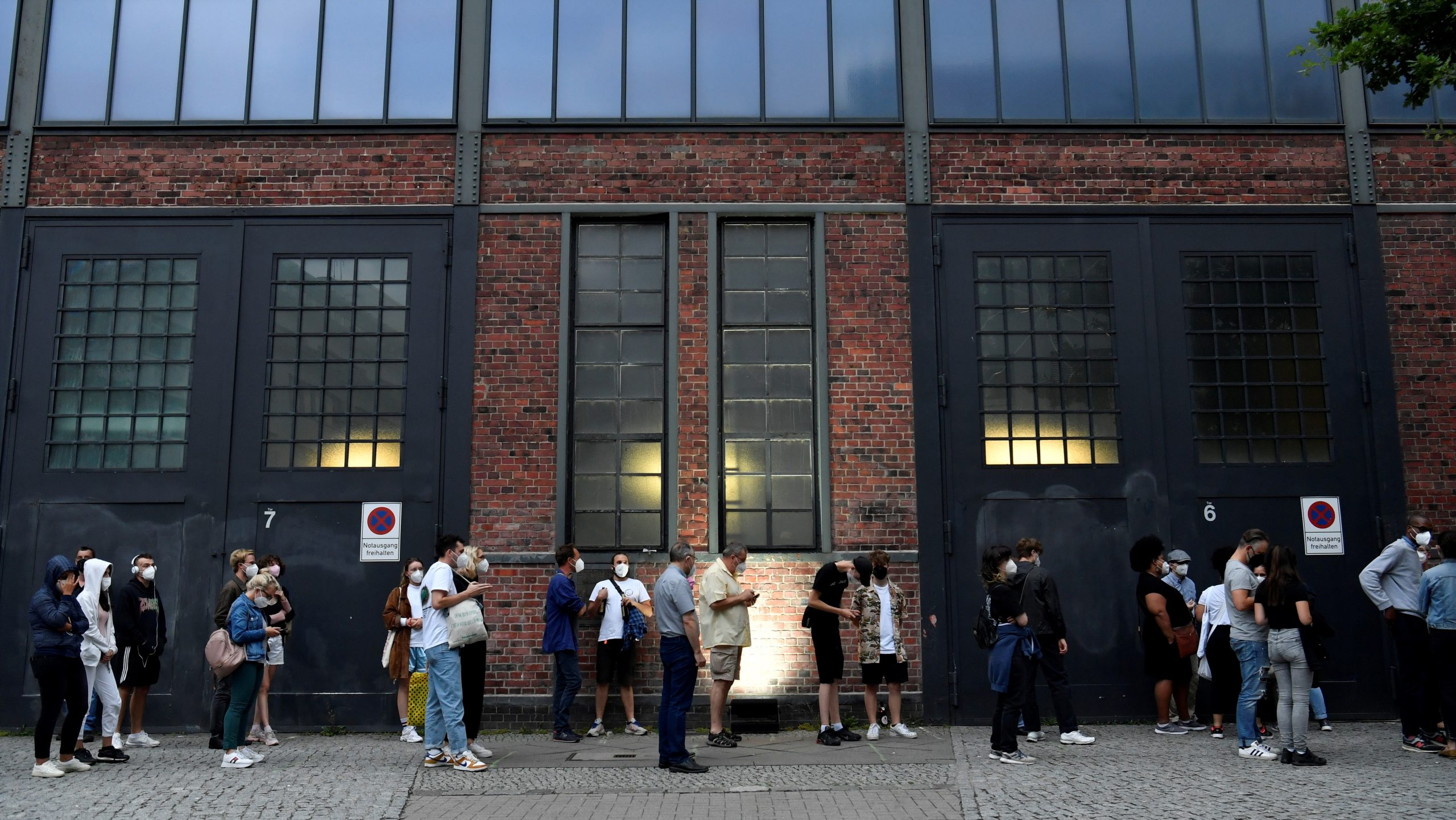
People queue to receive a vaccine against the coronavirus disease (COVID-19), during a night of vaccinations with music, at the Arena Treptow vaccination centre in Berlin, Germany. John Macdougall/Pool via REUTERS
Germany's coronavirus infection rate has risen to its highest level since the start of the pandemic, public health figures showed on Monday, and doctors warned they will need to postpone scheduled operations in coming weeks to cope, write Vera Eckert, Paul Carrel, Sarah Marsh and Alexander Ratz, Reuters.
The seven-day incidence rate - the number of people per 100,000 to be infected over the last week - rose to 201.1, higher than a previous record of 197.6 in December last year, the figures from the Robert Koch Institute showed on Monday.
The number of confirmed coronavirus cases rose to 4,782,546 from 4,767,033 a day earlier. The number of deaths increased by 33 to a total of 96,558.
Christian Karagiannidis, scientific director at the DIVI association for intensive and emergency medicine, said an expected rise in coronavirus cases in coming weeks meant some scheduled operations would have to be postponed.
"We will only be able to cope with the burden of all emergencies if savings are made somewhere else, though definitely not with surgical cancer treatments," he told the Augsburger Allgemeine newspaper.
Germany has already had to relocate some patients from regions with overburdened hospitals.
The three German parties in talks to form a coalition government by early December have agreed not to extend a nationwide state of emergency.
Instead, they presented a draft law late on Monday that would amend existing legislation to allow for measures such as compulsory face masks and social distancing in public spaces to continue to be enforced until March next year.
The draft law is due to be presented to the Bundestag lower house of parliament on Thursday and voted on in a special session a week later.
Bavaria state premier Markus Soeder earlier called for more decisive action in view of the new peak in the incidence rate. More needs to be done "than a little compulsory testing in old people's homes", he told Deutschlandfunk radio.
He called for tests to be offered free of charge again, vaccination centres to be reactivated and for states and the federal government to coordinate their strategies. Germany has abolished free testing to incentivise people to get vaccinated.
Share this article:
EU Reporter publishes articles from a variety of outside sources which express a wide range of viewpoints. The positions taken in these articles are not necessarily those of EU Reporter. Please see EU Reporter’s full Terms and Conditions of publication for more information EU Reporter embraces artificial intelligence as a tool to enhance journalistic quality, efficiency, and accessibility, while maintaining strict human editorial oversight, ethical standards, and transparency in all AI-assisted content. Please see EU Reporter’s full A.I. Policy for more information.






The South Caucasus at a historic turning point: Between lasting peace and renewed confrontation

As Ireland chairs the EU Presidency, what impact has over fifty years of EU membership had on Ireland

British political shifts and the future of UK-China ties

The Digital Markets Act Is Hurting Europeans. It’s Time to Put Progress, Free Markets, and Competition First

Become a European Commission trainee – applications are now open

Commission outlines measures to strengthen Europe's banking sector and support growth

JoinCare explores scientific exchange during visit to Japan’s National Institute of Infectious Diseases

From Ukraine to Suez: Why the Mediterranean has become the strategic centre of gravity

Commission approves €54 million Luxembourgish state aid for road and rail transport firms facing increased fuel prices

Commission invites comments on draft new rescue and restructuring state aid guidelines

Commission proposes more than €410,000 from the European Globalisation Adjustment Fund to support dismissed car industry workers in Finland

Commission welcomes the Council's adoption of a renewed Interim Regulation to detect child sexual abuse online

Commission provides €1.5 billion in macro-financial assistance to Egypt

ommission preliminary finds TikTok in breach of Digital Services Act for failing to ensure safe accounts for minors

Europe’s AI crossroads: Regulation and the race to keep up

Freedom holding corp: How Kazakhstan is turning a transit corridor into a global logistics hub

Kazakhstan reforms under scrutiny at Brussels Press Club round table

Japan should face up to history and contribute more to regional peace

Ambassador calls for 'speeding up' of co-operation between EU and Kazakhstan

Timur Turlov at Smart Moves Summit 2025: How chess can transform global education

Shevtsova’s case: Out-of-court sanctions dismantling trust in Ukrainian cause

The future of European transport

Trump Vs Trueman

US 'no longer' an 'unconditional ally' for Europe - MEP
-
 South Caucasus4 days ago
The South Caucasus at a historic turning point: Between lasting peace and renewed confrontation
-
 EU Presidency4 days ago
As Ireland chairs the EU Presidency, what impact has over fifty years of EU membership had on Ireland
-
 China4 days ago
British political shifts and the future of UK-China ties
-
 Digital economy5 days ago
The Digital Markets Act Is Hurting Europeans. It’s Time to Put Progress, Free Markets, and Competition First