Germany
Germany's Scholz says any threat to Ukraine unacceptable


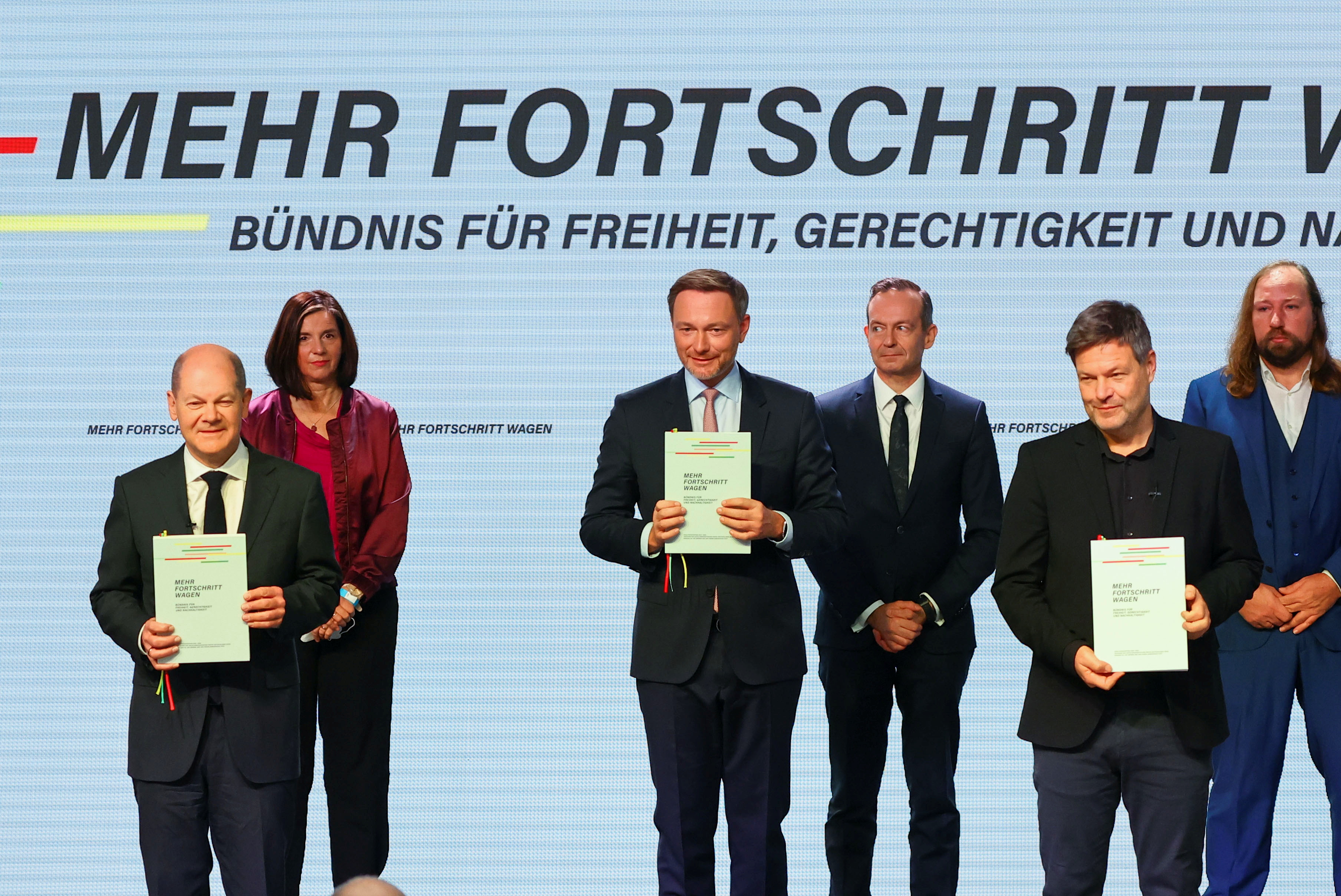
Germany's Chancellor-in-waiting Olaf Scholz expressed concern on Tuesday (7 December) about Russian troop movements on the Ukrainian border and said any attempts to cross the frontier would be unacceptable, write Madeline Chambers and Kirsti Knolle, Reuters.
"It is very, very important that no one rolls through the history books to draw new borders," Scholz said at a news conference after signing a three-party coalition agreement.
US President Joe Biden was to tell President Vladimir Putin that Russia faces tough economic sanctions if it invades Ukraine, US officials have said, as thousands of Russian troops mass near the Ukrainian border. Read more.
"It must be quite, quite clear that it would be an unacceptable situation if there were a threat to Ukraine," Scholz said, stressing that borders could not be violated.
Scholz, a Social Democrat, is due to take office on Wednesday after being elected by the Bundestag lower house of parliament.
He will head an alliance also including the Greens and the liberal Free Democrats (FDP) that brings to an end 16 years of conservative-led government under Angela Merkel, who did not stand for a fifth term in a September election.
Incoming Vice-Chancellor Robert Habeck, who is co-leader of the Greens, said the Nord Stream 2 pipeline, which is to transport gas from Russia to Europe, bypassing Ukraine, had not yet received approval and political discussions had to continue.
The Greens have traditionally taken a tougher line with Russia, as well as with China.
Asked about China, Scholz said he would consult closely with European partners. He skirted questions on whether Germany would join a diplomatic boycott of the 2022 Beijing Winter Olympics.
"(We) must know our differences and nevertheless get on with each other", said Scholz, appearing to stick closely to Merkel's favoured approach of seeking dialogue.
He praised Biden for strengthening a community of democratic countries, saying his priority would be to work with states sharing the same values and to strengthen the European Union. His first trip abroad will be to Paris.
The Greens' Habeck also said that results of investment in renewable energy would take two or three years to be seen.
The coalition deal, entitled Dare More Progress, aims to accelerate a green transition and modernise Europe's biggest economy as well as introducing some progressive social reforms, such as making dual citizenship easier. Read more.
Share this article:
EU Reporter publishes articles from a variety of outside sources which express a wide range of viewpoints. The positions taken in these articles are not necessarily those of EU Reporter. Please see EU Reporter’s full Terms and Conditions of publication for more information EU Reporter embraces artificial intelligence as a tool to enhance journalistic quality, efficiency, and accessibility, while maintaining strict human editorial oversight, ethical standards, and transparency in all AI-assisted content. Please see EU Reporter’s full A.I. Policy for more information.



ECR MEPs question the European Commission on cardiovascular health and diet promoting the Mediterranean diet as an alternative to ultra-processed foods as key to tackling obesity

Falling in love with the Maldives

Kurmuk gold project highlights Africa’s changing investment landscape

Chinese “leadership and coordination”

Albania's Vlora airport standoff tests investor confidence as EU accession clock ticks

Britain’s leadership crisis is a symptom, not the disease

EU steps up international support for Palestinians with major initiative for Gaza's early recovery and stronger international coordination

Commission adds exemptions to rules on removability of portable batteries

Rome–Washington Axis: Italian Diplomat Zanardi Landi to Help Save Bosnia

Burnham as PM? 'Wait and see'

Ban on destruction of unsold clothes and shoes enters into application

Survey on an EU Blueprint for intellectual property licensing and spinoff creation

Rule of law report strengthens EU democracy and fundamental rights

EU launches Ukraine defence industrial partnership, Drone Deal and disburses €1 billion for drones *

Setting a new benchmark in premium travel

Kazakhstan: Central Election Committee reviews the results of the nomination of candidates for the deputies of Kurultai

Kazakhstan reforms under scrutiny at Brussels Press Club round table

Japan should face up to history and contribute more to regional peace

Ambassador calls for 'speeding up' of co-operation between EU and Kazakhstan

Timur Turlov at Smart Moves Summit 2025: How chess can transform global education

Shevtsova’s case: Out-of-court sanctions dismantling trust in Ukrainian cause

The future of European transport

Trump Vs Trueman

US 'no longer' an 'unconditional ally' for Europe - MEP
-
 Italy3 days ago
ECR MEPs question the European Commission on cardiovascular health and diet promoting the Mediterranean diet as an alternative to ultra-processed foods as key to tackling obesity
-
 Tourism4 days ago
Falling in love with the Maldives
-
 China4 days ago
Kurmuk gold project highlights Africa’s changing investment landscape
-
 China-EU5 days ago
Chinese “leadership and coordination”