Russia
From waves to war cries: How Russia uses symbolic gestures for propaganda

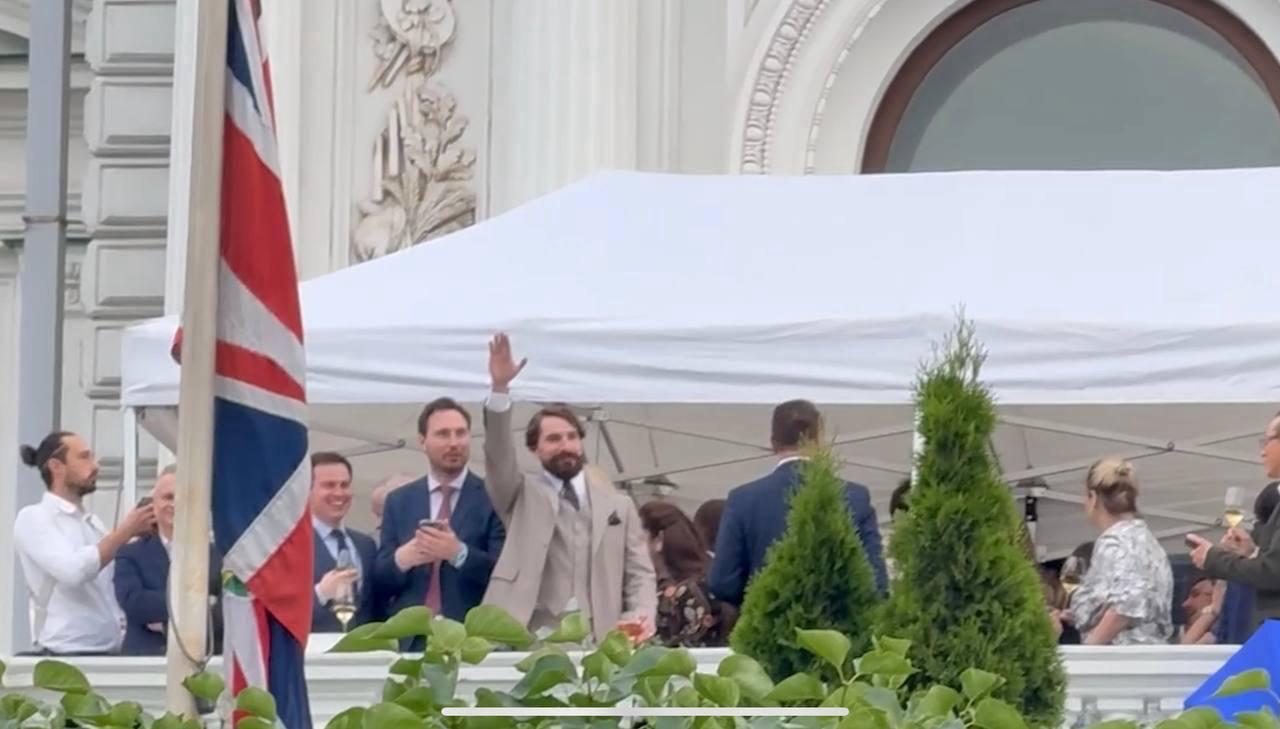
In recent years, Russia has increasingly capitalised on symbolic gestures to bolster its internal and external narratives. The latest incident involves a highly controversial gesture at the British Embassy in Moscow—one that, regardless of intent, appeared unmistakably as a Nazi-style salute.
The embassy incident: Reckless gesture, predictable outrage
On the eve of Russia’s solemn Day of Remembrance and Sorrow (commemorating the Nazi invasion of the USSR in 1941), Maria Zakharova, Russia’s Foreign Ministry spokeswoman, condemned what appeared as a clear Nazi-style salute made by artist Stepan Vishnevsky from the balcony of the British Embassy and witnessed by Moscow street audience.
“There is a man standing on the balcony of the British Embassy giving the Nazi salute. This is how he celebrates the birthday of the English king, a week before the Day of Remembrance and Sorrow!”
— Maria Zakharova, Telegram, 20 June 2025
Footage and photographs clearly showed Vishnevsky making a gesture identical to that previously performed by Elon Musk, described by The Guardian as an "apparent use of a salute banned for its Nazi links," and by Deutsche Welle as “apparently performing a Nazi-style salute.”
Regardless of Vishnevsky’s actual intent—ideological conviction, provocative humour, or misguided artistic expression—such a gesture is inevitably perceived by Russians as profoundly offensive and disrespectful.

Vishnevsky’s reckless action provided a perfect opportunity for the Kremlin’s propaganda machine.
Why this matters: Feeding the propaganda machine
Russia’s propaganda typically operates as follows:
- Identify an obvious provocative gesture.
- Amplify it as proof of widespread neo-Nazism.
- Exploit the outrage to justify what the State does internally and externally.
Such gestures—intended or accidental—fuel the Kremlin’s narratives about threats from Western liberalism, thus legitimising its aggressive policies.
Historical context: Why gestures matter in Russia
In Russia, historical memory of Nazi atrocities remains deeply significant. Gestures resembling Nazi salutes are unequivocally offensive, causing genuine public outrage. Figures like Elon Musk learned this lesson when his similarly clear gesture at a US event was widely condemned internationally, precisely because such actions leave little room for benign interpretations.
Strategic impact: Gift to the Kremlin
Incidents like Vishnevsky’s play perfectly into Russia’s strategic interests:
| Objective | Explanation |
| Military Justification | Supports narratives used to justify aggression. |
| Internal Control | Justifies crackdowns on dissenters as "Nazis." |
| Diplomatic Advantage | Portrays Western countries as morally dubious. |
Dangers of symbolic provocations
Such provocative actions, intentionally or otherwise, dangerously amplify Russian narratives, eroding trust, fuelling censorship, and complicating diplomacy. Genuine democratic criticism risks being drowned out by symbolic provocations turned into propaganda weapons.
Think twice before raising your arm
Regardless of intent, symbolic gestures have real consequences. Vishnevsky’s actions, like Musk’s earlier incident, demonstrate the potential harm that thoughtless provocations cause. Democracies must avoid reckless behaviour that inadvertently strengthens authoritarian propaganda, because every careless gesture risks escalating misunderstanding into real conflict.
Share this article:
EU Reporter publishes articles from a variety of outside sources which express a wide range of viewpoints. The positions taken in these articles are not necessarily those of EU Reporter. Please see EU Reporter’s full Terms and Conditions of publication for more information EU Reporter embraces artificial intelligence as a tool to enhance journalistic quality, efficiency, and accessibility, while maintaining strict human editorial oversight, ethical standards, and transparency in all AI-assisted content. Please see EU Reporter’s full A.I. Policy for more information.





The South Caucasus at a historic turning point: Between lasting peace and renewed confrontation
The security environment of the South Caucasus amid changing geopolitical realities

Commission sends Statements of Objections to several companies and trade associations in suspected construction chemicals cartel

Commission endorses Latvia’s €617 million Social Climate Plan to support vulnerable households and transport users in the clean transition

As Ireland chairs the EU Presidency, what impact has over fifty years of EU membership had on Ireland

Commission fines AliExpress €550 million for breaching the Digital Services Act

EU and Portugal team up to keep brightest tech talents at home

British political shifts and the future of UK-China ties

Tokayev urges Putin to 'freeze' Ukraine war in rare public appeal for peace

JoinCare explores scientific exchange during visit to Japan’s National Institute of Infectious Diseases

New episode – DGT podcast: Languages and Technology

Become a European Commission trainee – applications are now open

Commission outlines measures to strengthen Europe's banking sector and support growth
British political shifts and the future of UK-China ties
The South Caucasus at a historic turning point: Between lasting peace and renewed confrontation
As Ireland chairs the EU Presidency, what impact has over fifty years of EU membership had on Ireland

Kazakhstan reforms under scrutiny at Brussels Press Club round table

Japan should face up to history and contribute more to regional peace

Ambassador calls for 'speeding up' of co-operation between EU and Kazakhstan

Timur Turlov at Smart Moves Summit 2025: How chess can transform global education

Shevtsova’s case: Out-of-court sanctions dismantling trust in Ukrainian cause

The future of European transport

Trump Vs Trueman

US 'no longer' an 'unconditional ally' for Europe - MEP
-
 South Caucasus3 days ago
The South Caucasus at a historic turning point: Between lasting peace and renewed confrontation
-
South Caucasus4 days ago
The security environment of the South Caucasus amid changing geopolitical realities
-
 European Commission4 days ago
Commission sends Statements of Objections to several companies and trade associations in suspected construction chemicals cartel
-
 European Commission4 days ago
Commission endorses Latvia’s €617 million Social Climate Plan to support vulnerable households and transport users in the clean transition