Brexit
Scotland to step up efforts to keep EU citizens after #Brexit, Sturgeon says

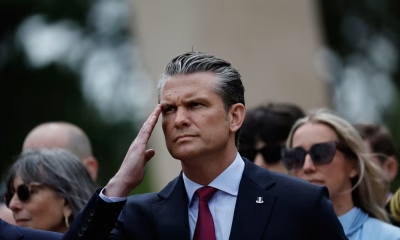
 Scotland will step up efforts to persuade EU citizens to stay after Brexit, its First Minister Nicola Sturgeon (pictured) told French lawmakers on Tuesday (19 February), amid concerns about potential workforce shortages in the largest of the United Kingdom’s three smaller nations, writes Elisabeth O'Leary.
Nicola Sturgeon, who supports Scottish independence from the United Kingdom, told French lawmakers that Britain’s proposals for its exit from the European Union and limitations on freedom of movement will damage Scotland’s economy more than Britain as a whole.
Small business and tourism associations have warned of labour shortages already occurring for remote, low-paid work such as food processing and hospitality which are key to Scottish economic success and depend heavily on EU workers.
Political tension has increased between Sturgeon’s devolved government, which opposes Brexit, and Britain’s divided Conservative government struggling to deliver Brexit by 29 March.
Unhappiness over Brexit within Sturgeon’s Scottish National Party is also pressurizing her to reignite a push for independence as the impending break with the EU pushes British politics to its limits.
“Without freedom of movement there is a danger that our population will start to decline. We could face workforce shortages in rural areas, in our universities, in our care and health services,” Sturgeon told the French National Assembly’s Foreign Affairs Committee, which she has been invited to address.
“The UK government is proclaiming the end of free movement as a victory – instead, it is a self-defeating measure,” she said.
Differences over Brexit have strained relations between the United Kingdom’s four nations. Scotland and Northern Ireland voted to stay in the EU in a 2016 referendum, while Wales and England vote to leave.
The desire to limit the number of EU citizens coming to Britain was a major reason Britons voted for Brexit in 2016. Immigration is one of the most heated political issues in the Brexit debate even though there are some parts of Britain with labour shortages.
Net migration of EU citizens to Britain fell to its lowest level in nearly six years during the year to June, extending a decline seen since the 2016 Brexit vote.
Scotland’s population is ageing more quickly than the United Kingdom as a whole and its economy has been shored up by EU migrants in recent years, studies show.
A Scottish government official declined to detail what the intensified effort to keep EU citizens would entail. London has argued that Scotland does not need a differentiated migration system.
Scotland last year announced measures to support EU citizens, such as waiving a registration fee for a post-Brexit immigration system, funding a citizens’ rights service to provide information and raise awareness of the issue and paying tuition fees for EU students at Scottish universities.
Share this article:

EU Reporter publishes articles from a variety of outside sources which express a wide range of viewpoints. The positions taken in these articles are not necessarily those of EU Reporter. Please see EU Reporter’s full Terms and Conditions of publication for more information EU Reporter embraces artificial intelligence as a tool to enhance journalistic quality, efficiency, and accessibility, while maintaining strict human editorial oversight, ethical standards, and transparency in all AI-assisted content. Please see EU Reporter’s full A.I. Policy for more information.




Who will win the 2026 World Cup? Data points to Spain

Western investors eye Russian assets again as sanctions discounts persist

Commission imposes interim measures on Meta to preserve free access to WhatsApp for rival AI assistants

EU green jobs: Which activities employ the most people?

Government gross debt of eurozone largely in euro

Commission calls for equal pay rules to become a reality across the EU

Chinese and European Youth Invited to Showcase Creativity in International Cartoon and Short Video Contest

EU disburses nearly €2.8 billion to support Ukraine's financial stability and reform efforts

Shoot the messenger: How Europe learned to silence its own warnings

When Brussels messes up: The people always pay

The G7 has a critical minerals plan, but it is missing a development chapter

How European businesses are rethinking customer support in the AI era

Latest financial report by Corinthia Hotel owners, IHI, raises questions over financial stability

Paying ISIS to keep a cement plant running: How a major French company financed one of the world's most brutal terrorist groups

Bach in Brussels

President approves Digital Qazaqstan national strategy

Kazakhstan reforms under scrutiny at Brussels Press Club round table

Japan should face up to history and contribute more to regional peace

Ambassador calls for 'speeding up' of co-operation between EU and Kazakhstan

Timur Turlov at Smart Moves Summit 2025: How chess can transform global education

Shevtsova’s case: Out-of-court sanctions dismantling trust in Ukrainian cause

The future of European transport

Trump Vs Trueman

US 'no longer' an 'unconditional ally' for Europe - MEP
-
 Sport2 days ago
Who will win the 2026 World Cup? Data points to Spain
-
 Russia4 days ago
Western investors eye Russian assets again as sanctions discounts persist
-
 Artificial intelligence5 days ago
Commission imposes interim measures on Meta to preserve free access to WhatsApp for rival AI assistants
-
 Green Week4 days ago
EU green jobs: Which activities employ the most people?