Economy
Q2 2014: Annual growth in labour costs up to 1.2% in both eurozone and EU28


Hourly labour costs1 rose by 1.2% in both the eurozone2 (EA18) and the EU282 in the second quarter of 2014, compared with the same quarter of the previous year. In the first quarter of 20143, hourly labour costs increased by 0.6% and 1.0% respectively. These figures are published by Eurostat, the statistical office of the European Union.
The two main components of labour costs are wages and salaries and non-wage costs. In the euro area, wages and salaries per hour worked grew by 1.2% and the non-wage component by 1.0%, in the second quarter of 2014 compared with the same quarter of the previous year. In the first quarter of 2014 the annual changes were +1.0% and -0.6% respectively. In the EU28, hourly wages & salaries rose by 1.2% and the non-wage component by 1.1% for the second quarter of 2014, compared with +1.4% and -0.2% respectively for the first quarter of 2014.

Breakdown by economic activity
In the second quarter of 2014 compared with the same quarter of the previous year, hourly labour costs in the eurozone rose by 2.5% in industry, by 0.7% in construction, by 0.9% in services and by 0.6% in the (mainly) non-business economy. In the EU-28, labour costs per hour grew by 2.8% in industry, by 0.4% in construction, by 0.9% in services and by 0.7% in the (mainly) non-business economy.
Member states
Among the member states for which data are available for the second quarter of 2014, the highest annual increases in hourly labour costs for the whole economy were registered in Estonia (+7.3%), Slovakia (+6.0%), Latvia (+5.9%), Lithuania (+5.1%) and Romania (+5.0%). Decreases were recorded in Cyprus (-3.9%) and Ireland (-0.4%).

* Not working day adjusted
- The Labour Cost Index is a short-term indicator showing the development of hourly labour costs incurred by employers. It is calculated dividing the labour cost in national currency by the number of hours worked. Therefore, the development of both variables, labour costs and hours worked, affects the evolution of the index.
The quarterly changes in hourly employers’ costs are measured for total labour costs and the main components: wages and salaries; and labour costs other than wages and salaries (non-wage costs). Total labour costs (TOT) cover wage and non-wage costs less subsidies. They do not include vocational training costs or other expenditures such as recruitment costs, spending on working clothes, etc.
Wage and salary costs (WAG) include direct remuneration, bonuses, and allowances paid by an employer in cash or in kind to an employee in return for work done, payments to employees saving schemes, payments for days not worked and remuneration in kind such as food, drink, fuel, company cars, etc.
Labour costs other than wages and salaries (OTH - non-wage costs) include the employers’ social contributions plus employment taxes regarded as labour costs less subsidies intended to refund part or all of the employer’s cost of direct remuneration.
Eurostat publishes Labour Cost Index data for NACE Rev. 2 sections B to S. The aggregate is referred to as "Whole economy" for the sake of simplification, even if agriculture, activities of households as employers and activities of extraterritorial organisations are excluded. For more breakdowns and further definitions click here.
The eurozone (EA-18) includes Belgium, Germany, Estonia, Ireland, Greece, Spain, France, Italy, Cyprus, Luxembourg, Latvia, Malta, the Netherlands, Austria, Portugal, Slovenia, Slovakia and Finland.
The European Union (EU28) includes Belgium (BE), Bulgaria (BG), the Czech Republic (CZ), Denmark (DK), Germany (DE), Estonia (EE), Ireland (IE), Greece (EL), Spain (ES), France (FR), Croatia (HR), Italy (IT), Cyprus (CY), Latvia (LV), Lithuania (LT), Luxembourg (LU), Hungary (HU), Malta (MT), the Netherlands (NL), Austria (AT), Poland (PL), Portugal (PT), Romania (RO), Slovenia (SI), Slovakia (SK), Finland (FI), Sweden (SE) and the United Kingdom (UK).
- Compared with News Release 93/2014 of 17 June 2014, annual growth rates for the total economy for the first quarter of 2014 were revised from +0.9% to +0.6% for the EA18 and from +1.2% to +1.0% for the EU28.
Share this article:
EU Reporter publishes articles from a variety of outside sources which express a wide range of viewpoints. The positions taken in these articles are not necessarily those of EU Reporter. Please see EU Reporter’s full Terms and Conditions of publication for more information EU Reporter embraces artificial intelligence as a tool to enhance journalistic quality, efficiency, and accessibility, while maintaining strict human editorial oversight, ethical standards, and transparency in all AI-assisted content. Please see EU Reporter’s full A.I. Policy for more information.



Bangladeshis waking up to reality of Yunus government

What the latest data reveals about labour market imbalances across Europe

From imitation to leadership: The production-based rise of Japan and China

Copernicus: Europe’s air quality improves despite persistent pollution episodes

Commission approves €402 million Spanish state aid for road transport companies facing increased fuel prices

EMA recommends three new medicines and an orphan treatment for rare Rett Syndrome

Ensuring fairness and safety: €3 customs duty for low-value parcels

EU delivers emergency aid and organises a humanitarian flight in response to earthquakes in Venezuela

Kyrgyzstan launches Tamchy SFIT: a new international jurisdiction as a gateway to Eurasia

Kazakhstan’s dombyra: the two-stringed instrument that carries the soul of the steppe

Europe must double down on nuclear progress to achieve its long-term ambitions

Solana Company Partners with Kazakhstan on $6B Alatau Crypto Megacity

Astana's congress of world religions: A global platform for dialogue in an age of division

How Schuman lost Its way

Rating of American Express casino sites in the UK

PMI defends AI consultation tool as scrutiny grows over EU tobacco rules review

Kazakhstan reforms under scrutiny at Brussels Press Club round table

Japan should face up to history and contribute more to regional peace

Ambassador calls for 'speeding up' of co-operation between EU and Kazakhstan

Timur Turlov at Smart Moves Summit 2025: How chess can transform global education

Shevtsova’s case: Out-of-court sanctions dismantling trust in Ukrainian cause

The future of European transport

Trump Vs Trueman

US 'no longer' an 'unconditional ally' for Europe - MEP
-
 Bangladesh4 days ago
Bangladeshis waking up to reality of Yunus government
-
 Employment4 days ago
What the latest data reveals about labour market imbalances across Europe
-
 China4 days ago
From imitation to leadership: The production-based rise of Japan and China
-
 Air quality4 days ago
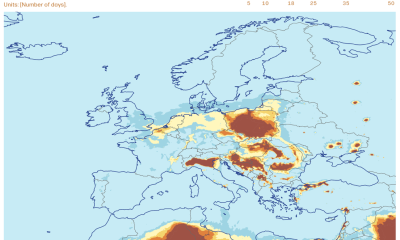
Copernicus: Europe’s air quality improves despite persistent pollution episodes