EU
#EAPM: Register now for the Summer School for HCPs in Bucharest


 27-30 June 2017 will see the European Alliance for Personalised Medicine (EAPM) host its second summer school for young health-care professionals, or HCPs, writes European Alliance for Personalised Medicine (EAPM) Executive Director Denis Horgan.
Now is the time to register and you can do so here.
Prior to this annual event, EAPM will host a SMART Outreach meeting to focus on the issues surrounding the integration of innovation into healthcare systems in eastern Europe.
This year’s event will be co-chaired by Richard Ablin, Professor of Pathology at the University of Arizona College, who first observed the antigen PSA as long ago as 1970.
PSA levels are now used as a test for prostate cancer, from which his father had died.
Despite this, Dr Ablin has since famously (and controversially) said that the US effectively wastes billions each year giving preventive prostate cancer screening tests that produce, in the majority of cases, false positives.
Ablin maintains that doctors and patients should be cautious when using PSA as a marker for preventive screening.
With such a high-profile figure as co-chairman, alongside former European commissioner for health David Byrne (who is also co-chairman of EAPM), the second summer school is well set to build on the success of the first event, held in July 2016 in Cascais, Portugal.
This year, the concept will be taken East to Bucharest, Romania, with the school taking place from 27-30 June.
As mentioned, the choice of Bucharest dovetails with EAPM’s SMART Outreach project. The Alliance’s June 2015 conference introduced the ‘SMART’ concept, which stands for Smaller Member states And Regions Together, and EAPM has been expanding this by taking its message directly to EU countries.
Once again, the school will be entitled ‘TEACH’, which stands for Training and Education for Advanced Clinicians and HCPs, and the goal is to bring young, front-line professionals up-to-speed with fast-moving developments in the field.
Aimed at age-range 28-40, TEACH holds to the thesis that, if personalised medicine is to be in line with the EU and member state principle of universal and equal access to high-quality health care, then clearly it must be made available to many more citizens than is currently the case.
The faculty has been chosen from medical academic, clinical and research specialties, patient organisations and communication experts.
Included will be an interactive session on communication in consultations. This will allow attendees to watch and comment on a difficult clinical consultation presented as a role-play with a real clinician, but with actors playing the parts of patient and partner.
This baseline session will be complemented by communication workshops that are intended to raise awareness of the importance of good communication between clinicians and patients.
Decision-making in this new era of healthcare is a key aspect when implementing personalised medicine, and one area to be covered under this broad topic at the Summer School is the role of the pharmacist, an expert stakeholder often overlooked.
Furthermore, finding the balance, or middle ground, between new science/technology and medical tradition is not easy so another tutorial session will take a look at various aspects ranging from input from the rare diseases community, a view from the arena of diagnostics (including molecular), profiling and biomarkers, plus the exciting and fast-developing world of gene sequencing.
As mentioned above, one of the key goals in the personalised medicine era is to improve communication between front-line HCPs and their patients.
The latter should have an equal role in any decisions made about their treatment, and this requires them to be able to input vital information, such as lifestyle and work circumstances, as well as to be properly informed from the other side.
Share this article:
EU Reporter publishes articles from a variety of outside sources which express a wide range of viewpoints. The positions taken in these articles are not necessarily those of EU Reporter. Please see EU Reporter’s full Terms and Conditions of publication for more information EU Reporter embraces artificial intelligence as a tool to enhance journalistic quality, efficiency, and accessibility, while maintaining strict human editorial oversight, ethical standards, and transparency in all AI-assisted content. Please see EU Reporter’s full A.I. Policy for more information.





EU and South Africa kick off intergovernmental dialogue on Clean Trade and Investment Partnership

Commission opens formal investigation into possible gun jumping in XXXLutz's acquisition of Porta

Seveso - 50 years on: EU strengthens its commitment to industrial safety in a changing landscape of risk

Why young jobseekers struggle to find roles abroad that fit their expertise

Falling in love with the Maldives

EU weighs age-13 limit for 'social media plus'

ECR MEPs question the European Commission on cardiovascular health and diet promoting the Mediterranean diet as an alternative to ultra-processed foods as key to tackling obesity

Farmers, fair markets and consumers: new report highlights the role of EU competition rules in agriculture

Kazakhstan seeks regional AI leadership as economic partnership with China enters new phase

Starmer’s problem? 'He is not a politician'

Why a Brussels–Nicosia–Eastern Mediterranean strategic affairs platform would benefit the European Union

Albania's Vlora airport standoff tests investor confidence as EU accession clock ticks
ECR MEPs question the European Commission on cardiovascular health and diet promoting the Mediterranean diet as an alternative to ultra-processed foods as key to tackling obesity

Kazakhstan's fixed capital investment tops 9.5 trillion tenge in H1 2026

Commission adopts simpler rules for EU agri-food promotion policy

Commission approves €659 million German state aid for four new semiconductor facilities

Kazakhstan reforms under scrutiny at Brussels Press Club round table

Japan should face up to history and contribute more to regional peace

Ambassador calls for 'speeding up' of co-operation between EU and Kazakhstan

Timur Turlov at Smart Moves Summit 2025: How chess can transform global education

Shevtsova’s case: Out-of-court sanctions dismantling trust in Ukrainian cause

The future of European transport

Trump Vs Trueman

US 'no longer' an 'unconditional ally' for Europe - MEP
-
 South Africa4 days ago
EU and South Africa kick off intergovernmental dialogue on Clean Trade and Investment Partnership
-
 European Commission4 days ago
Commission opens formal investigation into possible gun jumping in XXXLutz's acquisition of Porta
-
 Disasters4 days ago
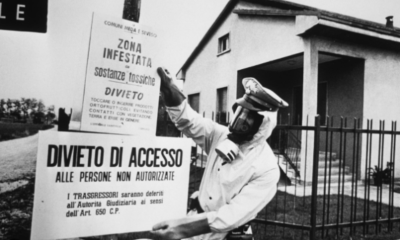
Seveso - 50 years on: EU strengthens its commitment to industrial safety in a changing landscape of risk
-
 Employment4 days ago
Why young jobseekers struggle to find roles abroad that fit their expertise