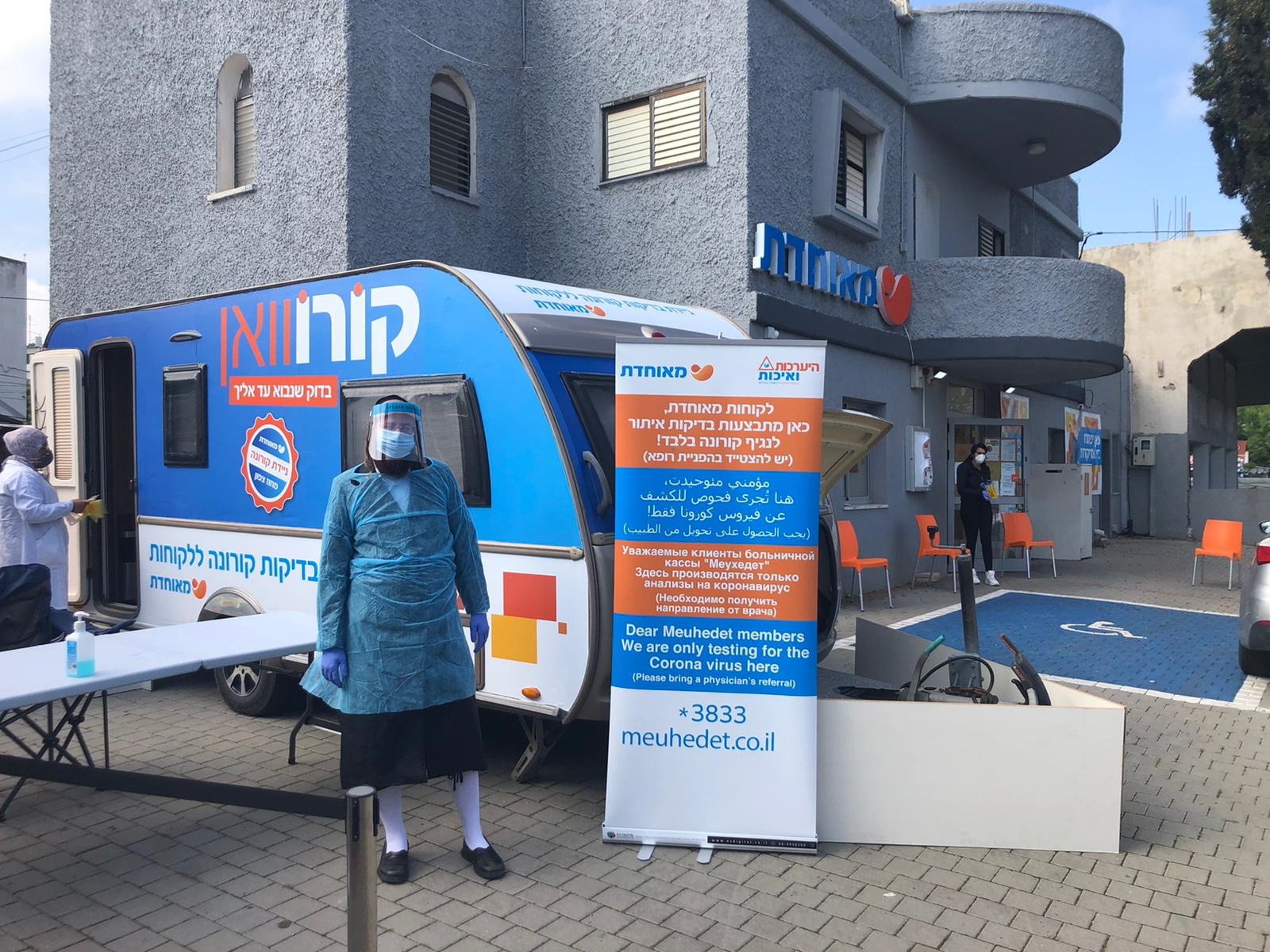
Since the beginning of the week, the Meuhedet Corona-Van has already visited 10 towns of northern Israel including: Rechasim, Yarka, Nazareth, Afula and others.
In order to increase the accessability of testing services for its 250,000 clients, in Israel’s Northern district, Meuhedet, one of Israel’s healthcare funds, has launched a special vehicle called Corona-Van which will arrive directly to the home of the health fund’s clients which request testings.
The service begins with a doctor referal for testing that takes place on-line and subsequently, the insurees are issued appointments for testings in order to assure maximum privacy as well as social distancing.
The Corona-Van’s itinirary and mobile testing stops take into account many veriables such as: the size of town/city, the amount of confirmed cases in it, the contengion growth, number of referals etc.
Since the beginning of the week, the Corona-Van has already visited 10 towns of northern Israel including: Rechasim, Yarka, Nazareth, Afula and others.
As a result of the high demand, Meuhedet said it is working on expanding this service and increasing the number of Corona-Vans.
Another health-care insurance fund, Maccabi, has installed a coronavirus screening booth in the street in Tel Aviv on the model of what happens in South Korea. It allows people potentially carrying the new coronavirus to be tested, in the street.
The test, sent to contributors to the health insurance, takes less than two minutes and the result is sent the same day or the next day.
Inside the grey and blue cabin, a person in a blue blouse and a mask over his mouth slides his hands in long black rubber gloves through two sealed portholes. On the other side of the glass, a potential patient stretches his face after showing his ID card, and the caregiver puts a cotton swab in his mouth and nose.
The cotton swab is then placed in a tube, itself inserted into a cooler which will be transported to a laboratory where the sample will be analyzed, explained Michael Attal, in charge of this project at Maccabi.
Addressed to Maccabi members, it allows them, if they have symptoms of the virus and after obtaining a prescription from their doctor, to avoid traveling to a health center and get tested quickly.
The test takes less than two minutes and the result is notified to them the same day or the next day.
Maccabi hopes to set up several cabins in Tel Aviv, the coastal city where it has the most members, to allow more people to be tested,
As of Friday (17 April), Israeli authorities have officially identified more than 12,855 cases of people infected with the new coronavirus, of which 148 have died.
To fight the spread of the COVID-19 pandemic, they ordered the containment of the population, closed schools, places of worship and leisure, and prohibited everyone from going out more than 100 meters from their home except for work, if necessary, or go to the supermarket, hospital or pharmacy.
However, on Sunday, for the first time since Israel began implementing quarantine measures to combat the coronavirus, the Israeli government will begin taking steps to ease the restrictions on the public. Some of the country’s economic activity is to be revived. Prime Minister Benjamin Netanyahu will make the final decision on the matter on Saturday night.
In a cabinet meeting on Thursday (16 April), most ministers said they were in favor of reopening the economy, at least gradually.
According to a study conducted last month by the Deep Knowledge Group (DKG), a private international consortium involved in high-tech, especially on health issues, Israel has ranked as the safest country to be in during the current COVID-19 pandemic.
The study shows that the five most effective states against the COVID-19 epidemic are Israel, Germany, South Korea, Australia and China. The next five countries are New Zealand, Taiwan, Singapore, Japan and Hong Kong.