Culture
Romani-Bosnia artist wins top cultural prize


A Romani-Bosnian artist who seeks to empower Roma communities through both her cultural and social work has won a top cultural prize.
The Tajsa Roma Cultural Heritage Prize is awarded every two years to celebrate Roma individuals who “strengthen, preserve, and renew” Roma cultural heritage.
Described as the “Oscars for the Roma community”, the winner this year is Selma Selman (pictured).
She received her award at a ceremony in Bucharest, the Romanian capital, on Saturday (29 November).
The awards are organised by the European Roma Institute for Arts and Culture (ERIAC), headquartered in Berlin and, this year, Selma was elected from an “exceptional” group of five finalists. They were selected from over 36 nominations that ERIAC received from across Europe this year. Their work spans visual arts, performance, fashion, music and community engagement.
Celebrating its fourth edition, the Tajsa Prize honours a Roma individual whose work, says ERIAC, “advances Roma cultural expression and reimagines heritage for future generations.”
It seeks to “embody Roma cultural leadership, pride, and self-determination.”
ERIAC is a respected international hub whose aim is to foster creativity in the Roma community in Europe, which, at about 14 million strong, is the largest ethnic minority on the continent.
Selma was praised by the judges for her bold artistic practice and her commitment to Roma culture.
Her work showcases the “survival strategies” of Roma families who collect and sell metal. It transforms luxury cars into scrap metal, electronic waste into gold and manual labour into art.
Selma works across performance, painting, and video and has earned international acclaim for her “direct and uncompromising reflections on identity, inequality, and resilience.”
Her work is said to “challenge dominant narratives and bring new visibility” to Roma experiences, particularly those of Roma women.
She is also the founder of Get the Heck to School, an education initiative supporting girls in her hometown of Ružica, Bosnia and Herzegovina.
The event organisers say her “unique” combination of artistic excellence and community activism reflects the mission of the Tajsa Prize: to celebrate Roma individuals who strengthen, preserve and renew Roma cultural heritage.
When she was presented with the award, which is funded by ERIAC’s own associated membership, Selma stressed the importance of community recognition.
She said, “My works became part of something universal, and accepted by the biggest museums, but this award feels different. It feels special because it comes from you, Roma people to a Roma woman. To this award I feel that I finally belong.
“This award will go to my art project Get the Hell to School which is supporting girls in my village to finish elementary school.
“I started this project in 2017 with just five girls, and only 20% of them would finish elementary school. Today, there are 50 girls and 99% of them finished elementary school.
“I always think of a quote by Simone de Beauvoir: “Her wings were cut, but they still expected her to fly.”
She told the packed audience at the historic Romanian Athenaeum in Bucharest, “With everything I have I am trying to make sure that the girls in my village and girls all around the world grow their wings so that they, like you and me, can also fly.”
After the event, Selma told this website the prize was “recognition of one’s work and this is also good because it gives you that extra visibility.”
She went on, “I started as an artist at the age of just 17 and, back then, no one really believed in me. I promised myself that I would not end up like my mother. Not that my mother was not strong or hard working. She was. But she had ‘no voice’ for what she did. I wanted to be different… I wanted to have a voice of my own.”
She said, “I hope that what I do now can be a sort of role model for girls and women everywhere. With this award I must say that now really do feel I belong.”
Selma added, “I am proud of this award but I also have to say that the Roma cultural and artistic community really does need a lot more investment and resources in order for it to flourish.”
Her practice spans performance, painting, and installations, and has been featured at major international institutions including the Venice Biennale, MoMA PS1, Stedelijk Museum, Gropius Bau, and Art Basel. She is the recipient of awards such as the ABN AMRO Art Award.
Widely profiled by outlets including Vogue, ArtNews, ArtReview, and UNESCO,and recognised as one of the most influential contemporary artists advancing global conversations on Roma identity, feminism, and resistance.
Also present was another finalist, Coco Reyes, based in Granada, Spain, who told this website that being shortlisted was “important for me as it affords formal recognition of my work and the positive values of Roma.”
Flamenco dancer and actress Coco, who has appeared across film, TV and theatre, added, “Art and culture can be a real game changer and a force for good which is something the world, today, really does need.”
Riah Knight, a British-Romani artist based in Berlin, noted that art “can be a real force for change in society” while Sead Kazanxhiu, a Tirana-based Roma visual artist, said via a video link that the prize “opens doors” to showcase the work of his community, adding, “diversity should be part of Europe’s shared future.”
Noell Maggini, an Italian-Sinti fashion designer, also speaking to the audience via video link, said he hoped the prize and his nomination might help other Roma people to “be seen, heard and valued.”
Further comment came from ERIAC Executive Director, Timea Junghaus, who said, “Selma Selman’s voice is vital to the Roma cultural movement of our time. Her artistic vision and her unwavering dedication to her community embody the spirit of ‘Tajsa’, our tomorrow.”
She praised the quality and number of the “extraordinary” nominations for the award which all, she added, reflected the “brilliance” of current Roma culture and art in Europe.
The prize is awarded biennially and accompanied by a €10,000 grant. This year’s nominees represented a wide spectrum of contemporary Roma creativity.
Other speakers at the event included Romanian family, youth and equal opportunities minister Florin Manole, who said he was “proud” his country had been chosen to host the ceremony, not least as Romania was “at the heart” of the Roma community.
Normunds Popens, deputy DG at the EU Commission’s department for education and culture, echoed his sentiments, saying the event was important as it helped foster mutual respect for each other’s values along with promoting differences and diversity.
The EU official also told the audience of the “vital necessity” to safeguard culture.
The ceremony featured a specially curated artistic programme with performances by Zejna Murkić, Antonio Piculeață, a brilliant young violinist and cultural ambassador for Romania, and members of Mahala Rai Banda, celebrating the “richness and diversity” of Roma cultural expression.
Share this article:
EU Reporter publishes articles from a variety of outside sources which express a wide range of viewpoints. The positions taken in these articles are not necessarily those of EU Reporter. Please see EU Reporter’s full Terms and Conditions of publication for more information EU Reporter embraces artificial intelligence as a tool to enhance journalistic quality, efficiency, and accessibility, while maintaining strict human editorial oversight, ethical standards, and transparency in all AI-assisted content. Please see EU Reporter’s full A.I. Policy for more information.



Burnham as PM? 'Wait and see'

Kazakhstan: Central Election Committee reviews the results of the nomination of candidates for the deputies of Kurultai
The South Caucasus at a historic turning point: Between lasting peace and renewed confrontation

Setting a new benchmark in premium travel

The security environment of the South Caucasus amid changing geopolitical realities

Survey on an EU Blueprint for intellectual property licensing and spinoff creation

Rule of law report strengthens EU democracy and fundamental rights

Ban on destruction of unsold clothes and shoes enters into application

JoinCare Explores Scientific Exchange During Visit toJapan’s National Institute of Infectious Diseases

New episode – DGT podcast: Languages and Technology

Become a European Commission trainee – applications are now open

Commission outlines measures to strengthen Europe's banking sector and support growth

British political shifts and the future of UK-China ties
The South Caucasus at a historic turning point: Between lasting peace and renewed confrontation

As Ireland chairs the EU Presidency, what impact has over fifty years of EU membership had on Ireland

The Digital Markets Act Is Hurting Europeans. It’s Time to Put Progress, Free Markets, and Competition First

Kazakhstan reforms under scrutiny at Brussels Press Club round table

Japan should face up to history and contribute more to regional peace

Ambassador calls for 'speeding up' of co-operation between EU and Kazakhstan

Timur Turlov at Smart Moves Summit 2025: How chess can transform global education

Shevtsova’s case: Out-of-court sanctions dismantling trust in Ukrainian cause

The future of European transport

Trump Vs Trueman

US 'no longer' an 'unconditional ally' for Europe - MEP
-
 Labour4 days ago
Burnham as PM? 'Wait and see'
-
 Kazakhstan4 days ago
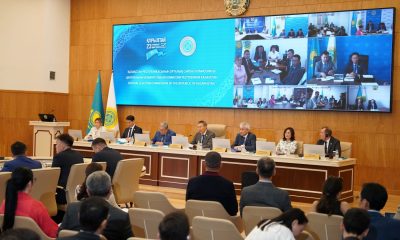
Kazakhstan: Central Election Committee reviews the results of the nomination of candidates for the deputies of Kurultai
-
South Caucasus11 hours ago
The South Caucasus at a historic turning point: Between lasting peace and renewed confrontation
-
 Aviation/airlines4 days ago
Setting a new benchmark in premium travel