Uncategorized
Sustainable energy foundation of Eastern neighbours’ integration into EU


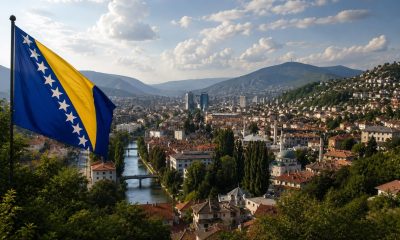
In a historic step towards EU integration, Bosnia and Herzegovina (BiH) was finally granted EU candidate status on December 15. The recognition ends a six-year wait since Sarajevo’s application, and reflects the EU’s renewed focus on its Eastern neighbourhood in the wake of Russia’s invasion of Ukraine—Kyiv became an EU candidate in June, alongside Chisinau.
Given the war’s disruption to energy supplies, Brussels has understandably placed energy at the core of its strategy for integrating the three nations. With sufficient private investment and governmental reforms, each candidate country has significant potential to support European renewable energy objectives. This would not only bolster the bloc’s energy security by alleviating dependence on Russian supplies, but would also dilute the share of fossil fuels in the EU’s overall energy portfolio.
Ukraine: turning adversity into opportunity
Russia’s invasion of Ukraine has proved a “decisive moment” for Europe’s energy industry, crystallising the need to jettison fossil fuels and turbocharging the transition to renewables, now set to surpass coal by 2025.
Kyiv can contribute appreciably towards this transition—with the right investment and guidance, Ukraine could reach 667GW of renewable power from onshore and offshore wind, solar and biomass. “Green is the wave of the future and the way to energy independence for Ukraine,” underlined Canadian-Ukrainian entrepreneur Michael Yurkovich whose energy firm TIU Canada was an early investor in Ukraine’s solar energy sector and operates three solar stations in the country, for a total of 54 MW. As Yurkovich emphasized, in addition to solar potential on par with regions which are international leaders in photovoltaic energy, Ukraine has certain key macro factors that could make it a significant player in the renewable energy sector. Yurkovich named four: “market access to Europe, labour workforce scale and skill, raw material access points, and huge capacity to build a power pool and a manufacturing base”.
The brutal war with Russia has complicated Ukraine’s ambitions to become a major producer of renewable energy—and a major exporter of clean power to the EU—it may accelerate Ukraine’s renewable dream in the long run. Just last week, the IEA penned a two-year joint work program with Kyiv to build the country’s energy infrastructure back more sustainably in the wake of the war. “The transition to carbon-free energy is the cornerstone of the recovery of Ukraine's energy sector after our victory,” Ukrainian energy minister German Galushchenko pledged when signing the agreement.
All systems go for Moldova
Fellow EU candidate Moldova is also richly deserving of European support in helping modernize its energy sector. At present, Moldova produces just over a quarter of the electricity it consumes; the majority of the remaining amount comes from Russian gas. Chisinau has already suffered from this dependency on Moscow’s whims; after Russia cut supplies to the country in October 2021, household tariffs shot up sixfold and inflation skyrocketed to 34% in the ensuing 12 months.
Fortunately, Moldova is keen to foster closer links with the West, as well as shoulder its own environmental burden – its revised Nationally Determined Contributions, or NDCs, involved a 70% reduction in greenhouse gas emissions by 2030. Although it currently only produces 12% of its domestic capacity from renewable sources, it has the potential to contribute an impressive 27GW in the future, no mean feat for a country its size.
Naturally, it will require international investment as well as government reforms for that potential to be realized, but encouraging signs are already evident. Under the stewardship of its Eurasia Regional Director Cécile Couprie, Agence Française de Développement (AFD) is providing some much-needed financial support in the shape of a €60 million investment in sustainable energy and infrastructure. Meanwhile, the IEA is reprising its consultancy role by publishing a renewables policy roadmap for the country.
BiH must overcome corruption concerns
The newest country in the EU waiting room, Bosnia’s renewable sector is also full of untapped potential. BiH, the only net exporter of energy in the Western Balkans, has excellent green potential. Already, over half of the country’s installed energy capacity is comprised of hydropower facilities, with deals in place with Britain, China, Germany and the UK to develop the sector further.
Unfortunately, much of Bosnia’s remaining capacity is highly-polluting lignite, and while it’s encouraging that Sarajevo has committed to investing $2 billion into renewables over the next five years, BiH is also one of just two nations in the region—along with Serbia— planning new coal projects.
What’s more, the country’s sustainable transition is being held back by a range of political, societal and logistical problems. Widespread corruption deters foreign investors despite the tremendous potential in Bosnia’s energy sector, while the fragmented nature of Bosnian regulatory systems—each entity and canton enjoys autonomy, making joined-up decision-making all but impossible—results in seemingly endless amounts of red tape. As an illustration, a solar power plant in the northern Bosnian town of Pecka remains inactive a year after installation due to the absence of legislation governing its connection to the national grid. These roadblocks need to be urgently addressed so that Bosnia can take advantage of its natural potential in terms of hydro, wind and solar energy—“in all three categories”, argued Bosnian economist Damir Miljevic, “Bosnia has perhaps the best conditions in Europe”.
Security and sustainability both key for European energy
Bosnia will need support from the EU to carry out necessary reforms and wean itself off of fossil fuels—fortunately, Brussels has shown itself increasingly willing to lend a helping hand to its Eastern neighbours, pledging greater energy cooperation in particular, since Russia’s invasion of Ukraine.
Indeed, the current crisis offers an unprecedented opportunity for the EU to kill four birds with one stone: draw its Eastern European partners away from Moscow’s orbit, futureproof its energy security by eliminating dependence on Russia or other unreliable partners, replace historic reliance on Russian gas with cleaner, greener sources of energy to achieve its environmental objectives, and accelerate the candidate countries’ full integration into the EU.
Share this article:
EU Reporter publishes articles from a variety of outside sources which express a wide range of viewpoints. The positions taken in these articles are not necessarily those of EU Reporter. Please see EU Reporter’s full Terms and Conditions of publication for more information EU Reporter embraces artificial intelligence as a tool to enhance journalistic quality, efficiency, and accessibility, while maintaining strict human editorial oversight, ethical standards, and transparency in all AI-assisted content. Please see EU Reporter’s full A.I. Policy for more information.




ECR MEPs question the European Commission on cardiovascular health and diet promoting the Mediterranean diet as an alternative to ultra-processed foods as key to tackling obesity

Albania's Vlora airport standoff tests investor confidence as EU accession clock ticks

Iran’s regime in crisis: Negotiations, internal divisions and growing resistance

Shusha Global Media Forum: Azerbaijan’s Answer to Disinformation

Why a Brussels–Nicosia–Eastern Mediterranean strategic affairs platform would benefit the European Union

Commission approves €659 million German state aid for four new semiconductor facilities

Kazakhstan seeks regional AI leadership as economic partnership with China enters new phase

EU law on nitrates pollution remains effective, with scope for smarter implementation

European Statistical Monitor: July edition

Commission publishes state aid guidance on carbon contracts for difference

Commission greenlights Estonia's fourth payment request for €135.5 million under NextGenerationEU

Drones, dominance, and the Iranian impasse: The West's strategic blind spot

Kazakhstan's fixed capital investment tops 9.5 trillion tenge in H1 2026

Commission registers two European Citizens' Initiatives on education and housing

Kazakhstan and Belgium: Building a Partnership for the Future

New court ruling questions 'proportionality' of Mayor Erion Veliaj’s detention

Kazakhstan reforms under scrutiny at Brussels Press Club round table

Japan should face up to history and contribute more to regional peace

Ambassador calls for 'speeding up' of co-operation between EU and Kazakhstan

Timur Turlov at Smart Moves Summit 2025: How chess can transform global education

Shevtsova’s case: Out-of-court sanctions dismantling trust in Ukrainian cause

The future of European transport

Trump Vs Trueman

US 'no longer' an 'unconditional ally' for Europe - MEP
-
 Italy4 days ago
ECR MEPs question the European Commission on cardiovascular health and diet promoting the Mediterranean diet as an alternative to ultra-processed foods as key to tackling obesity
-
 Albania4 days ago
Albania's Vlora airport standoff tests investor confidence as EU accession clock ticks
-
 Iran4 days ago
Iran’s regime in crisis: Negotiations, internal divisions and growing resistance
-
 Azerbaijan5 days ago
Shusha Global Media Forum: Azerbaijan’s Answer to Disinformation